
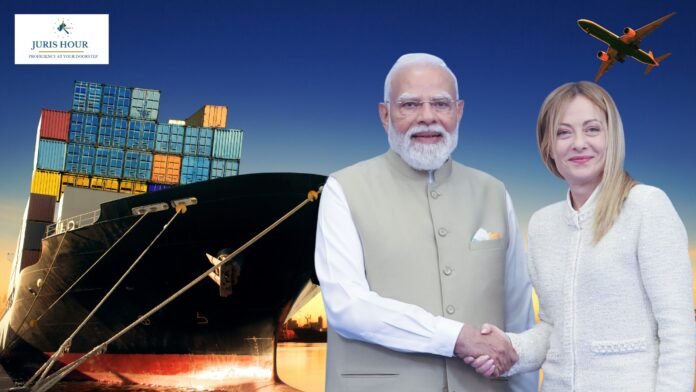
The evolving relationship between India and Italy has increasingly attracted global attention not only because of growing economic cooperation but also because of the visible personal rapport between Prime Minister Narendra Modi and Italian Prime Minister Giorgia Meloni.
Popularly referred to on social media as the “Modi–Meloni chemistry,” the relationship has moved beyond diplomatic symbolism and has contributed to stronger political and economic engagement between the two countries.
Over the last few years, India and Italy have transformed their engagement from a traditionally stable bilateral relationship into a broader strategic partnership encompassing trade, investment, technology, defence, energy cooperation and connectivity initiatives. The personal diplomacy between the two leaders has provided additional momentum to this transition.
Modi–Meloni Chemistry: Diplomatic Optics Becoming Strategic Substance
The public interaction between Prime Minister Narendra Modi and Prime Minister Giorgia Meloni gained significant attention during international events, particularly at the G20 Summit in India and subsequent multilateral engagements. Informal interactions, photographs and social media exchanges generated widespread attention and created an image of cordiality between the leaders.
While such moments attracted online discussion and popular attention, they also coincided with concrete policy developments. In November 2024, India and Italy adopted a Joint Strategic Action Plan for 2025–2029, followed by efforts to elevate bilateral relations into a Special Strategic Partnership.
The significance of leadership chemistry in international relations should not be underestimated. Personal trust between leaders often facilitates quicker decision-making, creates political confidence and accelerates negotiations on sensitive issues such as investments, trade agreements and strategic cooperation.
Historical Foundations of India–Italy Trade Relations
India and Italy have maintained economic relations for decades. Italy is among India’s significant trading partners within Europe and possesses strengths in manufacturing, industrial design, engineering and technology-intensive sectors.
Trade relations between the two countries have traditionally remained complementary rather than competitive. India offers a large consumer market, manufacturing capabilities and skilled human resources, while Italy contributes advanced manufacturing expertise, precision engineering and high-value industrial products.
Bilateral trade reached approximately €14.24 billion in 2024, reflecting continued growth in economic engagement. India exported goods worth approximately €9.02 billion, while imports from Italy stood at about €5.22 billion, resulting in a trade surplus in India’s favour.
India has maintained a favourable trade balance with Italy for several decades.
Major Indian Exports to Italy
India exports a wide range of products to Italy, including:
- Textiles and garments
- Pharmaceuticals
- Leather products and footwear
- Engineering goods
- Refined petroleum products
- Organic chemicals
- Marine products
- Iron and steel products
- Electrical machinery
- Plastics and industrial materials
Indian pharmaceutical and engineering sectors have witnessed increasing opportunities in European markets, including Italy.
Major Italian Exports to India
Italy’s exports to India largely consist of technology-intensive and industrial products, including:
- Industrial machinery
- Precision equipment
- Automobile components
- Luxury and design products
- Electrical equipment
- Engineering products
- Industrial chemicals
- Food processing technology
- Renewable energy equipment
Italian industries are globally known for combining technological efficiency with design expertise, particularly in machinery and manufacturing systems.
Investment Relations: Expanding Beyond Trade
Trade is increasingly accompanied by growing investment flows.
Italian companies have expanded their presence in India in sectors including:
- Automotive manufacturing
- Infrastructure
- Renewable energy
- Industrial machinery
- Food processing
- Fashion and luxury products
- Engineering and technology services
Cumulative Italian foreign direct investment into India has crossed several billion dollars over the last two decades.
Indian companies have also expanded investments in Italy in sectors such as pharmaceuticals, automotive components, information technology and manufacturing.
Emerging Areas of Cooperation
Green Energy and Sustainability
Both countries are increasing cooperation in renewable energy, clean technologies and sustainable industrial practices. Energy transition has become an important component of economic discussions.
Advanced Manufacturing
Italy’s expertise in high-end manufacturing aligns with India’s ambition of strengthening domestic manufacturing under initiatives such as Make in India.
Semiconductor and Technology Cooperation
The countries are exploring cooperation in semiconductors, digital technologies and advanced industrial ecosystems.
Infrastructure and Connectivity
Italy is expected to play an important role in the proposed India–Middle East–Europe Economic Corridor (IMEC), which aims to improve connectivity between India and European markets.
Improved logistics infrastructure could reduce transportation costs and improve supply chain efficiency.
EU–India Free Trade Agreement and Its Impact
Future India–Italy trade relations are also closely linked to broader India–European Union economic engagement.
Progress in India–EU trade negotiations is expected to improve market access and reduce tariff barriers for businesses from both sides.
For India, improved access to European markets could strengthen exports of pharmaceuticals, textiles and engineering goods. Italian companies may similarly benefit from easier access to India’s expanding consumer and industrial market.
Challenges in Bilateral Trade
Despite positive momentum, several challenges continue to exist:
- Regulatory and certification requirements
- Market access concerns
- Logistics costs
- Compliance burdens
- Trade barriers affecting small and medium enterprises
- Need for faster dispute resolution mechanisms
Addressing these concerns will be important for achieving ambitious trade targets.
Conclusion
The much-discussed “Modi–Meloni chemistry” may have begun as a topic of public fascination, but it increasingly reflects a broader strategic reality. Political comfort between leaders has coincided with stronger economic cooperation, higher trade ambitions and expanded investment opportunities.
India and Italy are now moving beyond a conventional trade relationship toward a multidimensional partnership involving manufacturing, technology, sustainability, connectivity and strategic cooperation.
As the two countries work toward ambitious trade targets and greater economic integration, the combination of diplom

