
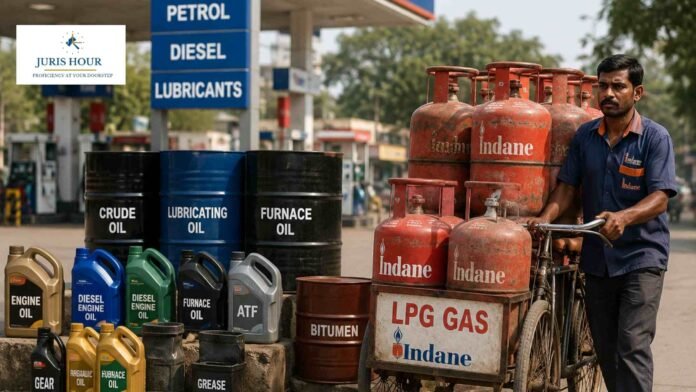
The Goods and Services Tax (GST) framework in India prescribes different tax rates for petroleum-based products depending on their classification under the Harmonised System of Nomenclature (HSN). While major fuels such as petrol, diesel, crude oil, natural gas and aviation turbine fuel are presently outside the GST regime and continue to be taxed under the existing VAT and excise structure, several petroleum derivatives, industrial oils, lubricants, gases, petrochemicals and LPG variants are covered under GST.
Products such as lubricating oils, furnace oil, transformer oil, bitumen, waxes, petrochemical derivatives and industrial gases are generally taxable at 18%, whereas certain domestic LPG and PDS kerosene supplies attract concessional GST rates of 5%. Some specialized petroleum products including AV Gas, brake fluid, coolant and cutting oils are taxed at 28%.
The GST rate structure is important for manufacturers, oil marketing companies, industrial consumers, transport operators, petrochemical businesses and LPG distributors for classification, invoicing, input tax credit and compliance purposes.
GST Rate Chart for Major Petroleum Products
| HSN (4 Digit) | DESCRIPTION OF GOODS | GST Rate (*) |
| 2503 | Sulphur | 18.00% |
| 2710 | AV Gas | 28.00% |
| 2710 | Furnace Oil | 18.00% |
| 2710 | Kerosene | 18.00% |
| 2710 | Kerosene (PDS) | 5.00% |
| 2710 | L.D.O. | 18.00% |
| 2710 | Lube Oil / Greases | 18.00% |
| 2710 | Naphtha | 18.00% |
| 2710 | Transformer Oil | 18.00% |
| 2711 | Butane (Dom) | 5.00% |
| 2711 | Butane (Non-Dom) | 18.00% |
| 2711 | LPG(Dom) | 5.00% |
| 2711 | LPG(Non-Dom) | 18.00% |
| 2711 | Propane (Dom) | 5.00% |
| 2711 | Propane (Non-Dom) | 18.00% |
| 2711 | C-4 Raffinate | 18.00% |
| 2712 | Waxes all types | 18.00% |
| 2713 | LSHS/ HPS & other Res. | 18.00% |
| 2713 | Petroleum Bitumen | 18.00% |
| 2713 | Petroleum Coke | 18.00% |
| 2714 | Bitumen & Asphalt | 18.00% |
| 2715 | CRMB | 18.00% |
| 2901 | Butadiene | 18.00% |
| 2902 | Benzene, Toluene, Xylenen | 18.00% |
| 2905 | MEG | 18.00% |
| 2905 | TEG | 18.00% |
| 2909 | DEG | 18.00% |
| 2917 | PTA | 18.00% |
| 3403 | Cutting oils & others | 28.00% |
| 3817 | LAB | 18.00% |
| 3817 | HAB | 18.00% |
| 3819 | Brake Fluid | 28.00% |
| 3820 | Coolant | 28.00% |
| 3901 | HDPE | 18.00% |
| 3901 | LLDPE | 18.00% |
| 3902 | PP – Homo | 18.00% |
| 3902 | PP – Copolymer | 18.00% |
(*) GST Rate is Centre Tax + State Tax / IGST applicable for specified HSN Code
GST on LPG Gas
Liquefied Petroleum Gas (LPG) is one of the most important petroleum products covered under GST. However, the GST rate depends on whether the LPG is supplied for domestic household consumption or for commercial and industrial use.
Domestic LPG cylinders supplied for household cooking purposes attract GST at the concessional rate of 5%. This concessional treatment is intended to reduce the tax burden on households and support essential cooking fuel affordability.
On the other hand, commercial LPG cylinders supplied to hotels, restaurants, factories, commercial kitchens and industrial establishments attract GST at 18%. Businesses using commercial LPG are generally eligible to claim input tax credit (ITC), subject to GST provisions.
The GST classification for LPG and related gases under HSN 2711 also extends to propane and butane supplies. Domestic supplies of propane and butane attract 5% GST, whereas non-domestic or industrial supplies are taxed at 18%.
Petroleum Products Currently Outside GST
Certain major petroleum fuels remain outside the GST framework under Article 279A(5) of the Constitution until notified by the GST Council. These include:
- Petrol (Motor Spirit)
- Diesel (High Speed Diesel)
- Crude Oil
- Natural Gas
- Aviation Turbine Fuel (ATF)
These products continue to be subject to Central Excise Duty and State VAT, leading to varying fuel prices across states.
Importance of Correct HSN Classification
Correct HSN classification plays a crucial role in GST compliance for petroleum and petrochemical businesses. Wrong classification may lead to:
- Short payment or excess payment of GST
- Interest and penalty exposure
- Denial of input tax credit
- Disputes during departmental audits
- Litigation relating to product categorisation
Industrial users and traders dealing in petroleum derivatives must therefore carefully verify HSN codes and applicable notifications before invoicing products.
Input Tax Credit on Petroleum Products
Input tax credit availability also differs depending on whether the petroleum product falls under GST. GST-paid products such as lubricants, transformer oil, petrochemicals and industrial gases generally allow ITC benefits to registered businesses.
However, products kept outside GST such as petrol and diesel do not allow seamless GST credit flow, resulting in cascading tax costs for several industries including logistics, transportation and manufacturing.
Industry Demand for Inclusion of Petroleum Products Under GST
Industry bodies and transport associations have repeatedly demanded inclusion of petrol and diesel under GST to simplify taxation and reduce cascading taxes. Supporters argue that bringing petroleum products under GST could:
- Create uniform fuel taxation across India
- Reduce logistics costs
- Lower compliance burden
- Improve input tax credit availability
- Reduce price volatility caused by state-wise VAT differences
However, states continue to rely heavily on VAT revenue from petroleum products, making consensus on GST inclusion difficult.
Conclusion
The GST rate structure for petroleum products in India presently covers a wide range of industrial oils, gases, lubricants, petrochemicals and LPG products, with rates primarily ranging between 5%, 18% and 28%. Domestic LPG and PDS kerosene enjoy concessional rates, while commercial and industrial petroleum products are generally taxed at standard or higher GST slabs.
Businesses dealing in petroleum and petrochemical products must ensure proper HSN classification, accurate invoicing and compliance with applicable GST notifications to avoid disputes and maintain smooth input tax credit flow.

