
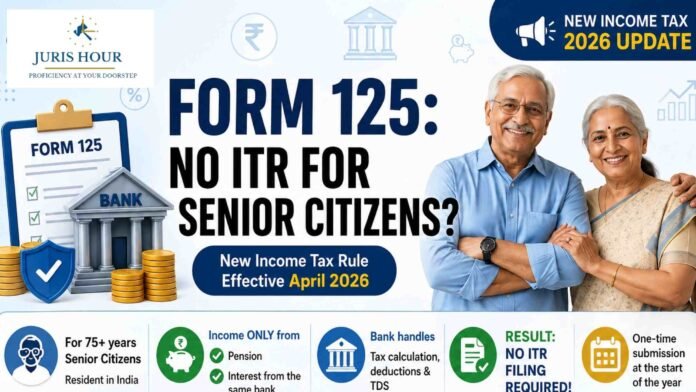
The Income Tax framework for senior citizens is set to undergo a significant shift from April 2026, with the introduction and expansion of Form 125. Designed to simplify compliance for elderly taxpayers, this mechanism allows eligible individuals to avoid filing Income Tax Returns (ITR) altogether—provided strict conditions are met. The move aims to reduce procedural burden and make tax compliance largely bank-driven.
Who Can Use Form 125?
The benefit of Form 125 is not universal and is restricted to a narrowly defined category of taxpayers. Only individuals aged 75 years or above, who are residents in India, can avail this facility. Further, their income must be limited strictly to:
- Pension income; and
- Interest income from the same specified bank where the declaration is filed
This strict eligibility framework ensures that only those with simple income structures qualify. Any additional source of income—such as rental income, capital gains, or business income—automatically disqualifies the taxpayer from using this mechanism.
How the System Works
The functioning of Form 125 represents a shift from taxpayer-led compliance to bank-led tax administration.
The process begins when the eligible senior citizen submits Form 125 to their designated bank. Once submitted:
- The bank computes the total income of the individual
- Applicable deductions under provisions like Section 80C and 80TTB are applied
- The bank calculates the final tax liability
- Tax Deducted at Source (TDS) is adjusted accordingly
The most notable outcome of this process is that no ITR filing is required, as the bank undertakes the responsibility of tax computation and compliance on behalf of the taxpayer.
Form 125 vs Traditional ITR Filing
The introduction of Form 125 creates a parallel compliance route distinct from conventional ITR filing.
Under the Form 125 mechanism, the bank assumes responsibility for tax calculations, and the filing process is effectively replaced by a one-time submission at the beginning of the financial year. In contrast, traditional ITR filing requires individuals to compute their own income, file returns annually, and ensure compliance independently.
However, this simplified route comes with limitations. While ITR filing accommodates multiple income sources and allows flexibility, Form 125 is restricted to pension and interest income, making it suitable only for a specific segment of taxpayers.
Key Information Required
To avail of the benefits under Form 125, eligible senior citizens must provide essential financial and identification details. These include:
- PAN and date of birth
- Pension details, including PPO number
- Bank account details
- Tax regime selection
- Investment proofs for claiming deductions
Accurate disclosure is critical, as the bank relies entirely on the submitted information to compute tax liability.
Important Changes Linked to 2026
The rollout of Form 125 is accompanied by broader changes in the income tax ecosystem:
- Replacement of Form 15H: A new declaration mechanism (Form 121, as indicated) is expected to streamline earlier processes
- Increase in TDS threshold: The threshold for TDS on interest income has been raised to ₹1 lakh, providing additional relief to senior citizens
- Applicability of the New Income Tax Act, 2025: The updated legislative framework supports simplified compliance measures like Form 125
These changes collectively indicate a policy direction focused on reducing compliance burden for elderly taxpayers.
Final Takeaway
Form 125 introduces a hassle-free compliance model for senior citizens with straightforward income sources. By shifting the responsibility of tax computation to banks, it significantly reduces paperwork, minimizes errors, and eliminates the need for annual return filing.
However, the relief is conditional. The moment a taxpayer earns income beyond pension and bank interest, the traditional ITR filing requirement becomes mandatory. Therefore, while Form 125 offers convenience, it is best suited for those with simple and stable financial profiles.
In essence, the new mechanism marks a move towards assisted compliance, balancing ease of taxation with strict eligibility safeguards.
Read More: ED Officers’ Salary & Hierarchy Explained: From Assistant Enforcement Officer to Director

