
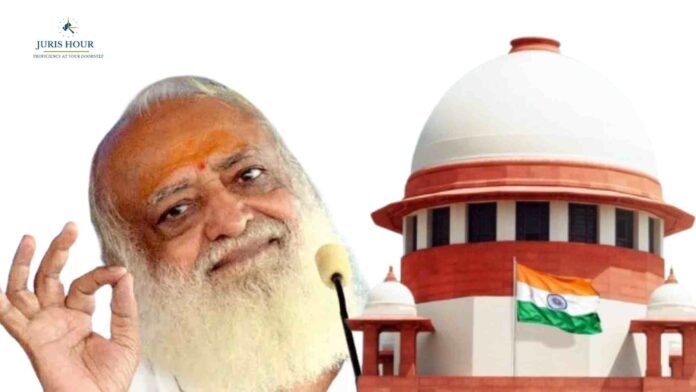
The Supreme Court on Monday directed the Gujarat government not to take any coercive action against the land and properties associated with self-styled godman Asaram Bapu’s ashram in Ahmedabad, noting that the municipal authorities’ show-cause notice appeared to lack essential details at first glance.
A bench comprising Justices Vikram Nath and Sandeep Mehta ordered that the status quo be maintained. This effectively stays the April 17 judgment of the Gujarat High Court, which had allowed the state to reclaim nearly 45,000 square metres of land occupied by the Sant Shri Asaram Ashram in Motera, close to the Narendra Modi Stadium.
The disputed land is part of a larger 650-acre area earmarked for the proposed Sardar Patel Sports Enclave, which is expected to include an Olympic Village and other infrastructure linked to Ahmedabad’s bid for the 2036 Olympics and preparations for the 2030 Commonwealth Games.
During the hearing, the Supreme Court raised concerns about the basis of the state’s action, pointing out that the show-cause notice did not clearly spell out the allegations. The bench told Solicitor General Tushar Mehta that the government’s case must stand on the contents of the notice itself, which appeared insufficient.
The judges also questioned the state’s change in stance over time. They noted that parts of the land earlier described as encroachments had been regularised by authorities in the past, asking what had led to the sudden reversal of that position.
The Gujarat government argued that the ashram had exceeded its original land allotment of 6,261 square metres granted in 1980 and had encroached on additional areas, which were later regularised in phases. It also relied on findings of unauthorised construction and violations of land-use conditions recorded by the High Court.
However, the bench emphasised that such claims must be clearly mentioned in the show-cause notice itself. It reiterated that administrative actions must be justified based on the reasons communicated to the affected party.
Buy Now: E-Compilation of Supreme Court Judgements – March 2026
Senior advocate Mukul Rohatgi, representing the ashram, argued that the action was illegal and driven by mala fide intent, alleging that the trust was being targeted because the land falls within a proposed sports development zone. He maintained that the ashram possessed valid approvals dating back to the 1980s and that similar cases had been treated differently.
The court has given the state three days to file its response, with the petitioners allowed the same time to reply. The matter is scheduled for further hearing on May 5, and status quo will continue until then.
The Supreme Court’s interim order effectively halts the implementation of the Gujarat High Court’s April 17 ruling, which had dismissed the ashram’s challenge to eviction notices. The High Court had held that the trust violated allotment conditions and encroached on significant portions of land, including parts of the Sabarmati riverbed, and refused to allow regularisation.
Asaram Bapu, who established the ashram in 1972, is currently serving life sentences in multiple rape cases. He was convicted in 2018 by a Jodhpur court for sexually assaulting a minor and again in 2023 by a Gandhinagar court in a separate case involving a woman disciple. He remains out on medical bail, while his convictions continue to stand.
Read More: ‘Last Seen’ Theory Alone Cannot Sustain Conviction: Supreme Court Acquits Co-Accused in Murder Case

