
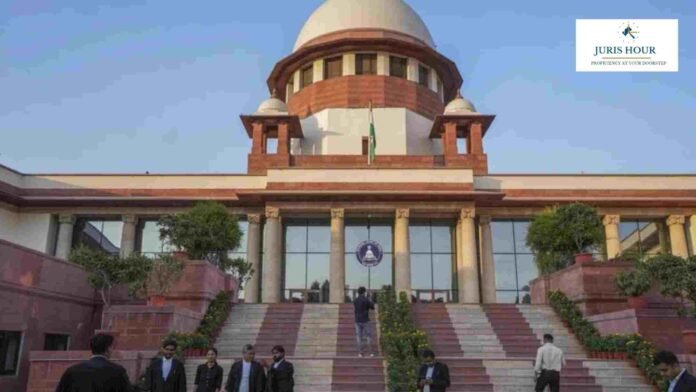
The Supreme Court examined whether a writ petition filed after several decades seeking compensation for land allegedly acquired by the State could be entertained under Article 32 of the Constitution.
The bench of Justice J.B. Pardiwala and Justice R. Mahadevan while the Limitation Act does not strictly govern writ petitions, its principles can be applied to ensure that constitutional remedies are not misused for long-settled matters.
Historically, Mizo chiefs governed territories known as “Ram,” exercising authority over villages and collecting customary tribute called “Fathang.” The petitioners argued that the chiefs held proprietary control over these lands even during the British administration.
Following independence, the region came under the administration of Assam and later under the Sixth Schedule of the Constitution, which created autonomous district councils for tribal areas.
The dispute arose after the Assam Lushai Hills District (Acquisition of Chief’s Rights) Act, 1954, which abolished the traditional chieftainship system and vested the chiefs’ rights in the State government. Under the law, the State issued a notification on 23 March 1955 transferring these rights to the government and provided statutory compensation to the chiefs.
Records indicate that approximately ₹14.78 lakh was paid to the chiefs as compensation under the statute.
The Mizo Chief Council contended that the compensation granted under the 1954 law was grossly inadequate and did not represent the value of the lands that were effectively taken over by the State.
The petitioners argued that the chiefs historically held absolute ownership rights over the territories in Mizoram. The State effectively acquired the land without proper compensation, violating the fundamental right to property that existed at the time. The statutory compensation was merely nominal and amounted to an illusory payment. Former princely rulers were granted privy purses and privileges, while the Mizo chiefs were deprived of equivalent treatment.
Based on these claims, the petitioners sought fresh compensation for the alleged acquisition of land.
The Union of India and the State of Mizoram opposed the petition and argued that the case was hopelessly barred by delay and laches.
According to the government the chiefs were not absolute landowners but held administrative privileges under customary law. The 1954 Act lawfully abolished the chieftainship system and compensated chiefs for the loss of their rights. The petition, filed decades after the acquisition, sought compensation for virtually the entire territory of Mizoram, which would have far-reaching consequences.
The Supreme Court emphasised that although Article 32 guarantees a fundamental right to approach the Court for enforcement of fundamental rights, the remedy cannot be used to revive stale claims after an unreasonable delay.
Relying on earlier constitutional bench precedents, including Tilokchand Motichand v. H.B. Munshi, the Court reiterated that the doctrine of delay and laches applies even to Article 32 petitions. Courts may decline relief where petitioners fail to approach the Court within a reasonable time and where third-party rights or public interests may have intervened.
Case Details
Case Title: Mizo Chief Council Mizoram Versus Union Of India & Ors
Citation: JURISHOUR-362-SC-2026
Case No.: Writ Petition (Civil) No. 22 Of 2014
Date: 13/03/2026

