
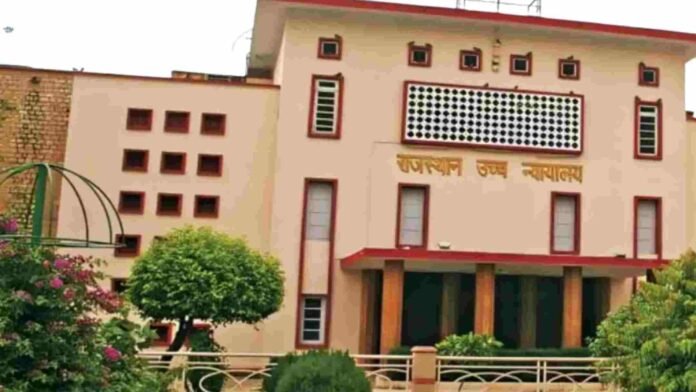
In a significant ruling reinforcing the constitutional obligation of the State to act as a model employer, the Rajasthan High Court has directed the regularisation of a daily-wage Class IV worker who has rendered uninterrupted service for over 30 years.
The bench of Justice Anand Sharma held that prolonged denial of regularisation while extracting work of a perennial and essential nature amounts to exploitation and violates Articles 14, 16 and 21 of the Constitution
Background of the Case
The writ petition was filed by a worker engaged on a muster-roll, daily-wage basis since April 1994 in the Commercial Taxation Department of Rajasthan. Initially appointed at a nominal wage of Rs. 9 per day, the petitioner continued to discharge duties identical to those performed by regular Class IV employees for more than three decades.
Despite possessing the requisite qualifications and working under the direct supervision of departmental authorities, his services were never regularised. Multiple representations seeking regular appointment and parity of pay were ignored, prompting him to invoke the extraordinary jurisdiction of the High Court under Article 226 of the Constitution.
State’s Defence
The State government opposed the petition, arguing that the engagement was purely temporary and did not confer any right to regularisation. It was contended that regular appointments can only be made against sanctioned posts and through prescribed recruitment rules, and that continuity of service alone cannot create a legal entitlement. The State also warned that granting regularisation outside the statutory framework would undermine merit-based recruitment and fiscal discipline
Core Legal Issue
The principal question before the Court was whether a worker who has rendered long and continuous service, while performing duties of a regular and perennial nature, can be denied regularisation indefinitely, and whether such denial withstands constitutional scrutiny.
Court’s Analysis
Justice Anand Sharma undertook an extensive examination of Supreme Court jurisprudence on regularisation and ad-hoc employment. While reiterating that regularisation cannot be claimed as a matter of right—particularly in cases of illegal appointments—the Court stressed that constitutional principles do not permit the State to exploit labour by keeping workers in perpetual temporariness.
Relying on landmark rulings such as Secretary, State of Karnataka v. Uma Devi (3) and its subsequent clarification in State of Karnataka v. M.L. Kesari, the Court noted that employees who have completed long years of service, possess requisite qualifications, and whose appointments are irregular rather than illegal, cannot be denied consideration for regularisation due to administrative inaction.
The Court further drew strength from recent Supreme Court decisions, including Jaggo v. Union of India (2024), Dharam Singh v. State of U.P. (2025), and Shripal v. Nagar Nigam, Ghaziabad (2025), which emphasised that the State cannot use Uma Devi as a shield to perpetuate exploitative employment arrangements. The focus, the Court observed, has shifted from the form of appointment to the substance of employment—namely the nature of duties, length of service, and conduct of the employer.
Findings of the Court
Applying these principles, the High Court found that:
- The petitioner had rendered long, uninterrupted service spanning over three decades.
- He performed duties of a perennial and essential nature identical to those of regular employees.
- There was no allegation of fraud or backdoor entry.
- Continued refusal to consider regularisation reflected administrative arbitrariness and violated the State’s constitutional duty as a model employer.
The Court held that permitting such prolonged ad-hocism would amount to endorsing exploitation and undermine the dignity of labour guaranteed under the Constitution.
Directions Issued
Allowing the writ petition, the Court directed the State authorities to:
- Undertake the exercise of regularising the petitioner against a sanctioned post corresponding to the duties he is currently performing.
- Grant regularisation with effect from the date the petitioner completed ten years of continuous service, subject to verification of eligibility, without rejecting the claim on hyper-technical grounds.
- Extend all consequential service benefits, including continuity of service, pay fixation, seniority, and pensionary benefits.
- Restrict arrears of salary to three years preceding the filing of the writ petition.
- Complete the entire exercise within three months from receipt of the certified copy of the judgment
Case Details
Case Title: Dharam Singh Saini Versus State of Rajasthan
Case No.: S.B. Civil Writ Petition No. 3711/2003
Date: 21/01/2026
Counsel For Petitioner: C. P. Sharma, Adv.
Counsel For Respondent: Manaswita Nakhwaal, AAAG
Read More: Anticipatory Bail Can’t Be Made Conditional on Payment of Disputed Amounts: Supreme Court

