
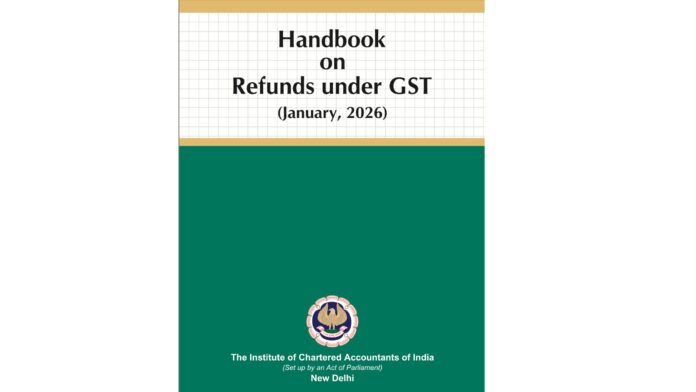
The Institute of Chartered Accountants of India (ICAI) has released a comprehensively revised edition of its Handbook on GST Refunds, updating refund law and procedures in line with legislative amendments, notifications, and circulars issued up to 31 December 2025 gst refund.
The updated Handbook comes at a time when GST refunds—particularly export-related refunds—remain critical for liquidity management, working capital efficiency, and ease of doing business. With exports constituting a major share of refund claims, ICAI noted that an efficient and predictable refund mechanism is central to enhancing the global competitiveness of Indian businesses gst refund.
Focus on Automation and Faster Refunds
In the Foreword, ICAI President CA. Charanjot Singh Nanda highlighted that over eight years since GST implementation, the refund framework has evolved into a more technology-driven and automated system, aided by CBIC’s special refund drives and virtual processing mechanisms. These initiatives have significantly reduced pendency and improved transparency in refund disbursement gst refund.
The Handbook documents this transition, explaining how automated processing, digital verification, and system-based checks—such as mandatory matching of Input Tax Credit with GSTR-2B—now shape the refund ecosystem under GST.
Key Updates Covered in the 2026 Edition
The revised Handbook incorporates several important policy and procedural changes, including:
- Refund admissibility based on GSTR-2B matching, reflecting the government’s tightened compliance framework.
- Special procedures for refund in case of export of electricity, a relatively new and technically complex area under GST.
- Refund mechanisms for unregistered persons, particularly in cases involving cancellation of contracts.
- Revised rules on zero-rated supplies, including restrictions where exports are subject to export duty.
- Virtual and faceless processing of refund claims, aligning with the broader digitisation of tax administration gst refund.
The Handbook also explains refunds relating to inverted duty structure, deemed exports, excess tax payments, and supplies not made, along with updated jurisprudence and statutory timelines under Section 54 of the CGST Act.
Practical Guidance for Professionals and Businesses
In the Preface, CA. Rajendra Kumar P, Chairman of ICAI’s GST & Indirect Taxes Committee, emphasised that timely refunds are essential for uninterrupted business operations and working capital flow. The revised publication seeks to explain complex refund provisions in simple, practical language, making it useful not only for chartered accountants but also for taxpayers, exporters, and consultants gst refund.
The Handbook contains step-by-step procedural guidance, relevant statutory provisions, prescribed forms (GST RFD-01 to RFD-11), and annexures listing mandatory statements, declarations, and supporting documents required for refund applications.
Strengthening GST Knowledge Dissemination
Reaffirming ICAI’s role as a “Partner in GST Knowledge Dissemination”, the Institute stated that the revised Handbook is intended to bridge knowledge gaps, reduce errors in refund filings, and support smoother interaction between taxpayers and tax authorities.
ICAI has invited feedback from readers to further refine future editions, underscoring that while the Handbook reflects the law as it stands, interpretational issues may still arise in practice.

