
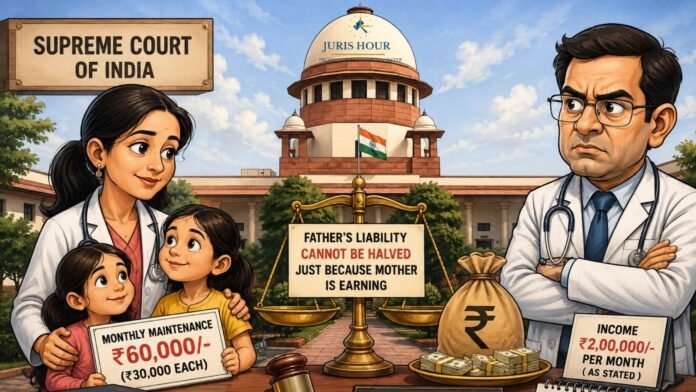
The Supreme Court of India has set aside an Allahabad High Court order that had reduced interim maintenance payable to two minor daughters from ₹30,000 each per month to ₹15,000 each.
The bench of Justice Vikram Nath and Justice Sandeep Mehta has observed that the mere fact that the mother is gainfully employed cannot, by itself, justify halving the father’s financial liability towards the children.
The bench restored the Family Court’s order awarding ₹30,000 per month to each of the two daughters, aggregating to ₹60,000 per month, as interim maintenance. The Court also directed that any arrears be paid by the respondent-husband to the appellant-wife within three months.
Buy Now: JurisHour Ultimate Legal Research Combo – 4 Premium E-Magazines at an Unbeatable Price
The dispute arose from a matrimonial relationship solemnised on June 18, 2006. During the marriage, the couple had two daughters, presently aged approximately nine and eight years. The appellant-wife had also given birth to a son, who unfortunately passed away shortly after birth.
With differences arising between the parties and the appellants leaving the matrimonial home, the wife and her two daughters initiated maintenance proceedings in 2022 under Section 125 of the Code of Criminal Procedure, 1973. They sought monthly maintenance of ₹2.50 lakh from the husband and father.
The wife is an MBBS and DGO-qualified gynaecologist and stated that she earns approximately ₹1.50 lakh per month while working at a hospital in Greater Noida. The husband is also a qualified doctor, holding MBBS and MD degrees, and stated that he earns ₹2 lakh per month as a consultant paediatrician at a children’s nursing home. The wife, however, disputed his disclosure and contended that he owned his own nursing home.
The Family Court, while considering the interim maintenance application, declined to award interim maintenance to the wife. It noted that both parties were earning sufficient income and that interim maintenance was intended to protect a person from unemployment or an immediate inability to meet daily needs.
However, the Family Court took a different view concerning the two minor daughters. It noted that the wife was bearing expenses relating to their education and upbringing and that the responsibility of maintaining the children rested upon both parents.
After considering the expenses and material placed before it, the Family Court awarded ₹30,000 per month to each daughter, amounting to ₹60,000 per month, from the date of filing of the maintenance petition until they attained majority.
The husband challenged the Family Court’s order before the Allahabad High Court. The High Court partly allowed the revision petition and reduced the maintenance payable to each daughter from ₹30,000 to ₹15,000 per month.
The High Court proceeded on the basis that ₹60,000 per month was sufficient for both daughters but held that the entire burden should not fall upon the father because the mother was also earning ₹1.50 lakh per month as a doctor. It therefore effectively divided the maintenance amount equally and reduced the father’s contribution to ₹30,000 per month in total.
The wife and the daughters challenged this reduction before the Supreme Court.
The Supreme Court found the High Court’s reasoning unsustainable. It noted that the High Court had not found the Family Court’s assessment to be perverse or concluded that ₹60,000 per month was excessive.
On the contrary, the High Court itself had proceeded on the footing that ₹60,000 was sufficient for the two daughters considering the status of their parents. According to the Supreme Court, there was no adequate reasoning explaining why that amount should nevertheless be reduced merely because the mother was earning.
The Court made an important observation concerning the manner in which parental responsibility towards children must be assessed. It held that the fact that the mother earns an income is not, by itself, a reason to halve the father’s liability.
The Court emphasised that while the obligation to maintain children is shared by both parents, that responsibility cannot simply be divided through arithmetic. The daughters were living with their mother, who was responsible for their daily needs and upbringing while simultaneously continuing her professional work. The Court recognised that such caregiving constitutes a genuine contribution even though it cannot readily be assigned a monetary value.
The Supreme Court further held that even if the wife’s income were completely excluded from consideration, the reduction ordered by the High Court could not be sustained.
The husband himself had disclosed an income of ₹2 lakh per month. Against this background, the Court observed that ₹60,000 per month for the maintenance of two school-going daughters aged approximately nine and eight years could not be regarded as an excessive amount for a father in his position.
The Court specifically noted that the education and upbringing of children require substantial expenditure and that the amount awarded by the Family Court was justified having regard to the circumstances of the parties.
The Supreme Court found that the Family Court had correctly considered the financial circumstances of both parties, their income affidavits and the expenses placed on record.
After examining these factors, the Family Court had concluded that ₹30,000 per month for each daughter was a just and reasonable amount by way of interim maintenance.
The Supreme Court therefore held that the Family Court’s determination did not call for interference in revision and restored the monthly maintenance of ₹30,000 for each child, aggregating to ₹60,000 per month.
The Supreme Court also clarified the limited nature of its decision. The principal maintenance petition filed under Section 125 CrPC remains pending before the Family Court.
The proceedings before the Supreme Court concerned only the quantum of interim maintenance. Accordingly, the Court found an additional reason not to interfere with the amount determined by the Family Court at the interim stage.
The Court further directed that the main Section 125 CrPC proceedings must be decided independently on their own merits and that the findings recorded in the orders under challenge should not influence the final adjudication of the main maintenance application.
The Supreme Court set aside the Allahabad High Court’s order dated February 9, 2026, passed in Criminal Revision No. 10 of 2025, and restored the Family Court’s order dated October 21, 2024.
The respondent-husband has been directed to pay any arrears to the appellant-wife within three months from the date of the Supreme Court judgment. The appeal was accordingly allowed and all pending applications, if any, were disposed of.
Membership Required to Access Case Details & Order Copy
To view the complete Case Details and Download Order Copy, you must have an active membership. Please subscribe to continue.

