
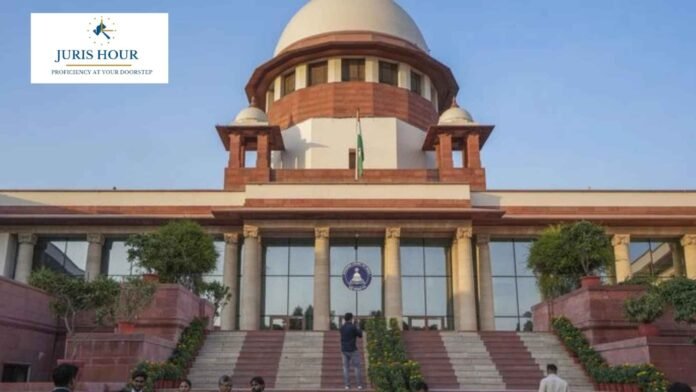
The Supreme Court has set aside concurrent rulings directing specific performance of an alleged oral agreement for a ₹20.5 crore property sale, holding that the buyer’s suit was barred because it had omitted the relief of specific performance in an earlier injunction suit despite that relief being available at the time.
The bench of Justice J.B. Pardiwala and Justice K. Vinod Chandran independently examined the evidence and found that the buyer had failed to establish a concluded oral contract. It emphasised that inconsistencies or evasive answers from the defendants could not substitute for the plaintiff’s obligation to prove the agreement.
Buy Now: Supreme Court Judgments E-Magazine – 5 Month Combo (2026) (1st February – 30th June 2026)
The dispute arose from negotiations concerning the sale of property belonging to Bombay Garage Ahmedabad Limited. The plaintiff claimed that the parties had orally agreed to sell the property for ₹18.51 crore and subsequently increased the consideration to ₹20.5 crore.
According to the plaintiff, ₹5.11 lakh had been paid in cash as token advances, and a cheque for ₹5 crore had also been handed over. It relied on meetings involving persons connected with the defendant company and a communication dated November 25, 2006, forwarding documents relating to the property.
The defendants disputed the existence of a concluded agreement. They also questioned the authority of the person who allegedly negotiated the transaction on behalf of the company.
The plaintiff initially filed a suit seeking a permanent injunction restraining the defendants from alienating the property, changing its nature or undertaking construction. In that suit, it specifically alleged that the defendants had refused to honour the agreement on May 8, 2007.
The injunction suit was subsequently withdrawn, with the plaintiff seeking liberty to institute fresh proceedings on the ground that settlement discussions were underway. A second suit was then filed seeking specific performance—an order compelling completion of the alleged sale.
The trial court decreed the suit, and the High Court upheld the decision. The defendants challenged those concurrent findings before the Supreme Court.
The Supreme Court held that the pleadings in the earlier injunction suit disclosed a clear refusal by the defendants to perform the alleged agreement.
According to those pleadings, the defendants had stated that they would sell the property for a higher price and challenged the plaintiff to take whatever action it wished. Consequently, the cause of action for seeking specific performance had already arisen when the first suit was instituted.
Despite this, the plaintiff confined its prayer to an injunction. It neither claimed specific performance nor obtained leave of the court to reserve that relief for subsequent proceedings.
The Court therefore held that the later suit attracted the bar under Order II Rule 2 of the Code of Civil Procedure, 1908.
The plaintiff argued that its withdrawal application had sought liberty to file a fresh suit. Although the withdrawal order did not expressly record such liberty, the plaintiff contended that permission should be inferred because the suit had been withdrawn on the basis of that application.
The Supreme Court accepted that permission to institute a fresh suit could be inferred from the withdrawal proceedings. However, it held that this did not cure the failure to obtain leave to reserve an available relief when the original suit was instituted.
The Court distinguished permission to withdraw and refile a suit under Order XXIII Rule 1(3) from leave to omit a relief under Order II Rule 2(3).
Where multiple reliefs arise from the same cause of action and are available when the first suit is filed, a plaintiff cannot omit one without the requisite leave and later introduce it through an independent suit merely because permission to withdraw the earlier proceedings was obtained.
The plaintiff also argued that the second suit had been filed within limitation and that it could have amended the first suit to add specific performance. The Court rejected this argument, observing that no such amendment had actually been sought.
The Supreme Court clarified that the application of Order II Rule 2 depends on the facts of each case.
Relying on the Constitution Bench decision in Gurbux Singh v. Bhooralal, it explained that the bar requires identity between the causes of action underlying the earlier and later suits, entitlement to more than one relief on that cause of action, and omission of the subsequently claimed relief without leave.
The Court distinguished cases where an earlier injunction suit concerned protection of possession and the cause of action for specific performance arose only later.
It also discussed Cuddalore Powergen Corporation Ltd. v. M/s. Chemplast Cuddalore Vinyls Limited, where a government prohibition on registration of conveyances had made specific performance unavailable when the earlier suit was filed.
In the present case, however, the defendants’ alleged refusal was expressly pleaded in the first suit, and specific performance was both available and capable of being claimed at that stage.
The earlier plaint was also on record, having been produced by the plaintiff itself. The Court held that it could examine that document regardless of which party had produced it.
Apart from the procedural bar, the Supreme Court examined whether the alleged oral agreement had been proved.
It reaffirmed that an agreement to sell immovable property need not necessarily be in writing. However, a plaintiff seeking specific performance solely on an oral agreement bears a heavy burden to establish that the parties reached a concluded agreement on its essential terms.
Referring to Brij Mohan v. Smt. Sugra Begum and K. Nanjappa v. R.A. Hameed, the Court emphasised the need for strict proof of a concluded contract rather than an inference drawn from incomplete negotiations or surrounding circumstances.
The Court found substantial inconsistencies in the plaintiff’s account of the meetings, the persons involved, the payments allegedly made and the sequence in which the transaction was said to have been finalised.
The first suit referred to three meetings, while the second suit initially described only two. A later amendment introduced further details that did not consistently align with the earlier pleadings.
The Court also noted that the second plaint did not identify a fresh refusal following the alleged settlement discussions that could establish a new cause of action.
The alleged ₹5 crore advance cheque was another significant factor.
The Supreme Court noted that neither plaint established that the cheque had been presented to the bank or encashed. In the circumstances of this case, the non-encashment of a cheque allegedly handed over as a substantial advance weighed against the assertion that a binding sale agreement had been concluded.
The Court also found that the plaint did not identify a specific date for completion of the transaction after payment of the entire consideration.
These deficiencies, read with the inconsistencies in the pleadings and testimony, undermined the plaintiff’s claim.
The plaintiff relied on the testimony of Vajubhai Vala, who had served as a State Minister and subsequently as Governor of Karnataka. It claimed that the agreement had been concluded in his presence and that his stature explained why the parties had not reduced it to writing.
The Supreme Court rejected the suggestion that a witness’s political position gave their testimony any special presumption of truthfulness.
It also noted that the plaintiff’s pleadings did not state that the relevant meeting had occurred at the witness’s residence or explain why such a high functionary was involved in the transaction.
The witness had further testified that one defendant obtained another defendant’s agreement over the telephone. The Court treated this assertion as hearsay because there was no basis to establish how the witness knew the identity of the person at the other end of the call.
The Court rejected the argument that the witness’s presence could compensate for the absence of proper pleadings and proof of a concluded agreement.
The trial court had placed considerable reliance on evasive answers given by defence witnesses.
The Supreme Court held that this approach was erroneous. Even if defence witnesses were inconsistent or reluctant to answer questions, their conduct could not establish a contract that the plaintiff had failed to prove through its own evidence.
The burden remained on the plaintiff to unequivocally establish the agreement. Weaknesses in the defence could not, by themselves, justify a decree for specific performance.
The Court also found that another plaintiff witness lacked direct knowledge of the negotiations and had merely repeated information received from the person representing the plaintiff company.
The Court rejected reliance on the November 25, 2006 letter forwarding property documents. It held that transmission of documents relating to the property did not, by itself, establish a concluded sale agreement.
It also examined the role of the person who allegedly negotiated the deal and was the son-in-law of another defendant. No authority authorising him to deal with the company’s assets had been produced.
His family relationship did not confer power to promise or contract for the sale of company property. At most, the Court considered him an intermediary in the negotiations.
Further, his affidavit stated that the negotiations had not materialised into a deal.
Having found both the suit barred and the contract unproved, the Supreme Court considered it unnecessary to separately determine the authority of the ninth defendant to deal with the company’s assets.
The Supreme Court found that even the alleged cash payment of ₹5.11 lakh had not been established. It therefore declined to order a refund. The alleged ₹5 crore cheque had also not been presented for payment.
Describing the concurrent findings as perverse, the Court allowed the appeal, set aside the trial court’s decree and the High Court’s judgment, and dismissed the suit for specific performance.
Membership Required to Access Case Details & Order Copy
To view the complete Case Details and Download Order Copy, you must have an active membership. Please subscribe to continue.
Read More: Cattle Transport Without Documents Doesn’t Prove Slaughter Intent: Supreme Court

