
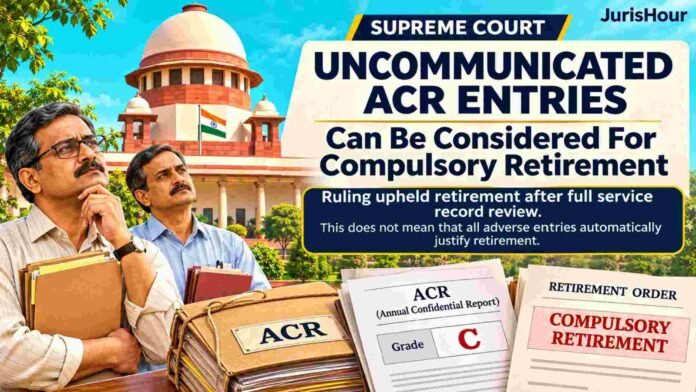
The Supreme Court has held that an order of compulsory retirement cannot be set aside merely because the authorities considered adverse remarks or below-benchmark gradings in an employee’s Annual Confidential Reports (ACRs) that had not been communicated to the employee.
The Bench of Justice Manmohan and Justice Shree Chandrashekhar upheld the compulsory retirement of two employees of Chhattisgarh’s Legal Metrology Department, finding that the State had assessed their complete service records, uniformly applied the prescribed standards and based its decision on relevant material.
Buy Now: 90+ Supreme Court Judgments E-Magazine – October 2026
The two employees, Chatur Singh Dhruv and Manharan Lal Sahu, initially joined the Legal Metrology Department, also known as the Weights and Measures Department, as Class-IV peons. They were subsequently promoted to Assistant Grade-III in 2013 and 2012, respectively. Their services were regularised through separate orders dated June 19, 2015.
On April 25, 2017, the Chhattisgarh Government’s General Administration Department issued a circular directing departments to review the records of government servants who had completed 20 years of qualifying service or attained 50 years of age.
The prescribed criteria included honesty and integrity, physical capacity, reputation, efficiency and an overall assessment of the entire service record. The circular also required scrutiny of whether the employee’s performance had declined during the preceding five years.
Following this exercise, the employees were compulsorily retired through orders dated October 9, 2017. A Single Judge of the Chhattisgarh High Court declined to interfere on August 23, 2019. The Division Bench affirmed those decisions on April 12, 2023, leading to the appeals before the Supreme Court.
The employees argued that the retirement criteria had not been applied uniformly and that similarly situated employees had been retained.
They also contended that the screening reports contained observations questioning their performance, reputation and integrity, making the action punitive and stigmatic in substance. According to them, the State could not use compulsory retirement to bypass the safeguards applicable to disciplinary proceedings.
Another objection was that the authorities had concentrated on recent ACRs instead of examining their entire service careers. They further argued that uncommunicated adverse entries could not lawfully be used against them, relying on Dev Dutt v. Union of India and Sukhdev Singh v. Union of India.
The employees also relied on their promotions and subsequent regularisation to contend that earlier adverse material had lost its significance.
The State submitted that a Screening Committee had examined the records of all 14 eligible clerical employees and recommended compulsory retirement for five, including the appellants.
The review covered service dossiers, confidential reports, integrity records, personal files and leave and medical records. ACR grades were assigned numerical values to ensure uniform assessment: A+ received five points, A four, B three, C two and D one.
Where reports for particular years were unavailable, the assessment used the available reports without drawing an adverse inference merely because records were missing.
The State maintained that the appellants’ overall service assessments fell below the prescribed Grade B benchmark and that their recent records disclosed sustained poor performance or declining efficiency.
Rejecting the challenge based on non-communication of adverse entries, the Supreme Court relied on Baikuntha Nath Das v. Chief District Medical Officer, Baripada.
It reiterated that an order of compulsory retirement is not liable to interference merely because the authority took uncommunicated adverse remarks into account.
The Court distinguished Dev Dutt and Sukhdev Singh, explaining that those decisions concerned promotion, career progression and communication of entries affecting promotional prospects. Those principles could not be mechanically extended to compulsory retirement, which operates under a distinct body of settled law.
The ruling therefore treats non-communication as insufficient, by itself, to invalidate compulsory retirement. The decision must nevertheless satisfy the requirements governing that power, including a foundation in relevant material and compliance with the applicable rules.
The Bench reiterated that compulsory retirement under the relevant service rules is neither punitive nor stigmatic. Such an order does not, by itself, amount to a finding of misconduct.
Accordingly, the requirement of a prior hearing and the protection under Article 311(2) do not apply to a compulsory retirement order made in accordance with those rules.
However, the authority’s satisfaction cannot rest on conjecture or whim. It must be supported by objective and relevant material bearing on the employee’s suitability for continued service.
Judicial review is concerned with whether such material existed, whether the authority considered it and whether a reasonable person could have reached the resulting conclusion. Courts do not reweigh the service record as though hearing an appeal against the administrative assessment.
The Court rejected the allegation that the Screening Committee had confined itself to the immediately preceding five years.
It found that the Committee first assessed the employees’ entire service records against the minimum benchmark. The ACRs for 2013–2017 were then examined as an additional, corroborative exercise to identify repeated low gradings or a declining performance trend.
Those reports formed one component of the broader assessment rather than its sole foundation. Giving particular attention to recent performance was also consistent with the State’s circular.
The Court further found that the same methodology had been applied to all eligible employees. Nine were retained and five recommended for retirement. No discriminatory treatment or selective application of the prescribed criteria was established.
The Supreme Court explained that the principle under which adverse entries may lose their significance following promotion concerns entries predating the promotion that the employer can be regarded as having overlooked while granting it.
That principle does not neutralise adverse assessments recorded after the employee assumes the higher post.
Here, both employees had been promoted before the relevant ACR period. Dhruv received an A grading in 2013 but C gradings for the next four consecutive years. Sahu’s reports for 2013–2017 reflected repeated C gradings and remarks indicating unsatisfactory performance.
These entries directly concerned their work in the promoted posts and remained relevant to deciding whether they should continue in service.
The Court separately rejected reliance on regularisation. Regularisation in a post already held does not constitute promotion based on merit or comparative assessment and cannot itself be treated as an endorsement of efficiency or future suitability.
Examining the retirement orders, the Bench found that they recorded retirement in public interest under Fundamental Rule 56 and Rule 42(1)(b) of the Chhattisgarh Civil Services (Pension) Rules, 1976, with State Government approval.
The orders contained no allegation of misconduct, finding of culpability or expression casting a stigma on the employees.
The Committee’s internal assessments of efficiency, integrity and utility did not, by themselves, turn the resulting orders into punishment. The Court found that the review was administrative and did not involve adjudication of misconduct.
It also noted that no departmental inquiry was pending or contemplated against either employee at the relevant time. The allegation that compulsory retirement had been used to circumvent disciplinary proceedings was therefore unsupported by the record.
The Supreme Court concluded that the retirement decisions complied with the applicable statutory provisions and the April 25, 2017 circular. They were supported by relevant and cogent material, and the employees had not established arbitrariness, mala fides, perversity or violation of a constitutional or statutory guarantee.
The Court affirmed the High Court’s judgments and dismissed both appeals, with no order as to costs.
Membership Required to Access Case Details & Order Copy
To view the complete Case Details and Download Order Copy, you must have an active membership. Please subscribe to continue.
Read More: Debt Acknowledgment In Balance Sheets Can Renew Limitation Without Naming Creditor: Supreme Court

