
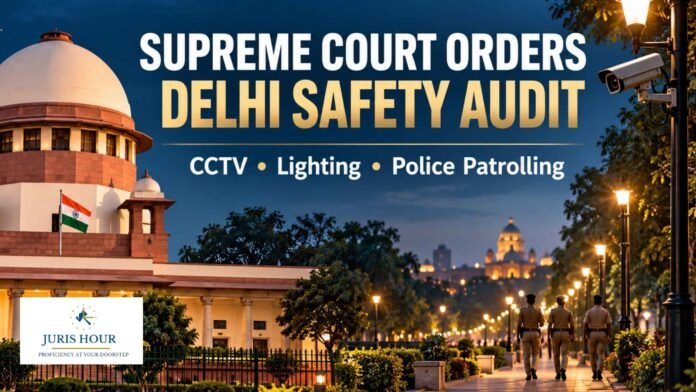
The Supreme Court has initiated suo motu proceedings over recent reports of sexual violence against women and minor girls in Delhi-NCR, directing immediate safety audits, intensified police patrolling, repairs to lighting and CCTV infrastructure, and closer scrutiny of mechanisms intended to protect vulnerable persons.
The bench of Justice J.B. Pardiwala and Justice K. Vinod Chandran has observed that the reported incidents exposed systemic failures by law enforcement and civil administrative authorities in ensuring basic public safety.
Buy Now: Supreme Court Judgments E-Magazine – 5 Month Combo (2026) (1st February – 30th June 2026)
The Court made it clear that statements expressing concern must be followed by measurable action, with responsibility and accountability fixed upon the authorities entrusted with preventing crime and protecting vulnerable persons.
The proceedings arose from news reports concerning alleged sexual offences in Delhi-NCR, including incidents reported at Aastha Kunj Park, in the Swaroop Nagar area, and inside a moving sleeper bus travelling from Greater Noida towards Delhi.
Referring to the incident at Aastha Kunj Park, the Court noted that earlier complaints of recurring sexual harassment faced by students of a nearby women’s college had failed to prompt adequate preventive action by the police and local administration.
The bench also expressed concern that law enforcement agencies reportedly failed to intercept the sleeper bus despite its travelling more than 47 kilometres. Drawing parallels with the 2012 Nirbhaya case, the Court questioned whether systemic law enforcement mechanisms had made meaningful progress since then.
Safe Public Spaces Form Part Of The Right To Life
The Court linked public safety to the constitutional protection of life and personal liberty under Article 21, observing that the right to live with dignity includes freedom from the fear of violence.
It emphasised that parks, roads, buses, metro stations, subways and footbridges cannot be allowed to become high-risk spaces because of inadequate lighting, poor surveillance, lax patrolling or other preventable administrative deficiencies.
The bench further observed that such deficiencies endanger every citizen, irrespective of age, gender or sexual identity. While the State must maintain safe and accessible public spaces for all, it must remain particularly attentive to the heightened risks faced by children, women and sexual minorities.
Proceedings To Examine Institutional Failures
The Supreme Court clarified that the proceedings would examine broader institutional failures and the effectiveness of preventive and monitoring systems, rather than determine the criminal responsibility of individual accused persons.
Specific allegations must be investigated according to law, and guilt or innocence can be determined only through due process and a fair trial, the bench said.
The principal question before the Court is whether effective systems are actually functioning to ensure safety in public spaces across Delhi-NCR.
Authorities Must Show Whether Safety Measures Work On The Ground
The Court sought a comprehensive status report on existing public-safety arrangements, including their effectiveness during peak hours, late evenings and early mornings.
The report must explain how the Delhi Police uses the National Database on Sexual Offenders, including its use for antecedent verification and identification of repeat or habitual offenders. Authorities must disclose the number of investigations in Delhi in which the database was used during the preceding five years and whether its information is translated into lawful preventive measures.
The Court also sought details on the Investigation Tracking System for Sexual Offences, particularly how investigations subject to statutory timelines are monitored, which officers are responsible, how frequently cases are reviewed, and what remedial action follows delays.
Authorities must additionally explain whether senior officers receive alerts or periodic reports when investigation timelines are breached.
Helplines, Safe City Infrastructure And Support Services Under Scrutiny
The bench called for details of the operation of Mission Shakti in Delhi, including its components, implementing agencies, services available to women and children, and mechanisms for evaluating accessibility and effectiveness.
It also sought information on the actual functioning of the Emergency Response Support System through number 112, the Women Helpline through number 181, the Safe City Project, Women Help Desks in police stations, and One Stop Centres.
For emergency services, the Court sought details of integration with police, fire and ambulance services, dispatch arrangements, and escalation of calls requiring immediate police intervention.
For the Safe City Project, authorities must disclose CCTV coverage, command-and-control infrastructure, smart lighting and emergency-response arrangements, along with the number of vulnerable locations covered and measures to keep equipment functional.
The report must also address staffing, training and operating hours at Women Help Desks, and coordination of police, medical, legal, counselling and rehabilitation assistance through support centres.
Reports Cannot Be Limited To Schemes Existing On Paper
The Supreme Court expressly directed that the reports must go beyond descriptions of schemes or infrastructure existing merely on paper.
For each mechanism, authorities must disclose whether it is operational, its geographical and population coverage, the officer or authority responsible, the volume of complaints or interventions handled during the preceding three years, and average response times wherever measurable.
The bench stressed that protective mechanisms serve their purpose only when they are accessible, functional, adequately staffed, capable of responding promptly and subject to continuing institutional oversight.
District Safety Audits And Vulnerability Maps Within Four Weeks
The Court directed immediate interim measures to be undertaken within four weeks of the order.
The Delhi Police Commissioner must constitute dedicated teams for every police district, headed by an officer not below the rank of Deputy Superintendent of Police, to inspect vulnerable public spaces.
The assessment must cover isolated stretches, outskirts, parks, transport hubs, markets, educational-institution zones and other public places. Teams must use NCRB data, local intelligence, complaints, previous incidents and other objective indicators to identify locations prone to crime.
District-wise vulnerability maps must be prepared and shared across adjoining police stations so that information about recurring crime patterns and habitual offenders does not remain confined to individual jurisdictions.
The Court also directed appropriate patrolling and security arrangements at identified parks and vulnerable areas, particularly during evenings, early mornings and other periods identified through the assessment. Each location must have a designated responsible officer and a mechanism for periodic inspection.
Repair CCTV Cameras And Lighting, Address Citizen Complaints
An immediate lighting and CCTV audit must be conducted across public parks and vulnerable zones to identify and eliminate blind spots.
Non-functional equipment must be repaired or restored expeditiously, with additional lights and cameras installed wherever inadequacy is identified or reported by citizens. Similar audits must cover metro stations, bus stops, bus terminals, railway stations and other major public-transport facilities.
The Court directed authorities to use existing grievance mechanisms, including the CM Jan Sunwai Portal, to gather complaints about dark stretches, insufficient surveillance, unsafe access points and other public-safety deficiencies.
Complaints should, wherever appropriate, be geo-tagged or otherwise location-specific, forwarded for verification and acted upon within a prescribed timeframe. Complainants must be able to track their status and the action taken.
Recurring or corroborated complaints must also inform vulnerability mapping.
Enforce Prohibition On Aftermarket Window Films
The Court directed intensified patrolling through mobile check-posts and vehicle inspections at regular intervals.
Referring to its directions in Avishek Goenka v. Union of India & Anr., the bench ordered strict enforcement of the prohibition on aftermarket window films. Police must impound non-compliant vehicles, remove illegal coatings and prosecute offenders.
Special Court Data Sought; Trials Preferably Within One Year
The Registrar General of the Delhi High Court must file an affidavit within four weeks detailing the functioning of Fast Track Special Courts and Exclusive POCSO Courts in Delhi.
The affidavit must specify the number of functional courts, cases pending before each court, annual disposal rates for the preceding three years, and average time taken for final disposal.
The Delhi High Court, on its administrative side, was also directed to assign the cases referred to in the order to a designated Fast Track Special Court and ensure expeditious trials, preferably within one year from commencement.
Media Must Protect Survivors’ Dignity And Identity
The Supreme Court cautioned media organisations against sensationalist headlines, graphic descriptions and insensitive language that can cause further trauma to survivors and their families.
It reminded print, electronic and digital publishers of the statutory restrictions under Section 72 of the Bharatiya Nyaya Sanhita, 2023, and Section 23 of the POCSO Act concerning direct or indirect disclosure of protected identities.
The Court emphasised that reporting must prioritise dignity, factual accuracy and institutional accountability.
It also directed the district administration to meet media houses to facilitate dedicated newspaper space and broadcast time for information about protective services and emergency assistance numbers, expressing confidence that such public-awareness coverage would be provided pro bono.
Membership Required to Access Case Details & Order Copy
To view the complete Case Details and Download Order Copy, you must have an active membership. Please subscribe to continue.

