
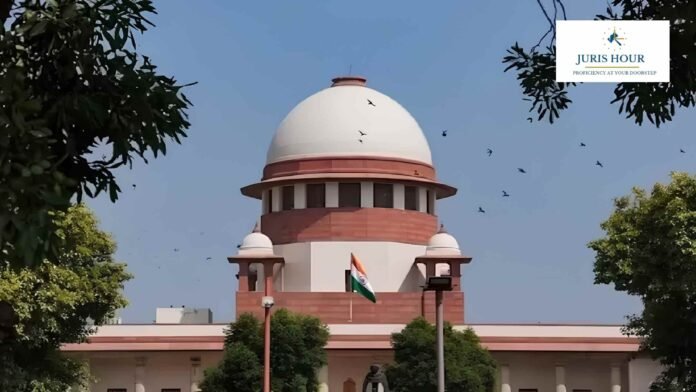
The Supreme Court has ruled that Order XVIII Rule 17 of the Code of Civil Procedure, 1908 (CPC) cannot be routinely invoked to reopen evidence, recall witnesses or allow a party to cure omissions and lacunae in evidence already placed on record.
The bench of Justice S.V.N. Bhatti and Justice N.V. Anjaria held that the provision primarily confers a discretionary power on the court to recall an already examined witness for the purpose of clarification and cannot be converted into a procedural device for improving a party’s case at a later stage of the trial.
The underlying litigation arose from a suit instituted in 2010 concerning ownership and possession of certain properties situated at Ghatkesar village and Mandal in the erstwhile Ranga Reddy District. The plaintiffs sought a declaration that they were the absolute owners of the scheduled properties and also sought a declaration that two sale deeds executed in 1987 in favour of defendant No.1 were null and void. They additionally sought a permanent injunction against interference with their possession.
Buy Now: 50+ Supreme Court Judgments – July 2026
The defendant, on the other hand, maintained that she had purchased two plots through registered sale deeds in 1987 and had remained in uninterrupted possession. The defendant also relied upon an earlier decree of perpetual injunction passed in her favour in 1990, which she claimed continued to operate. Pursuant to permissions obtained from the Gram Panchayat, construction had also allegedly been undertaken on the property.
During the proceedings, an important development concerned the existence of structures on the disputed properties. The plaintiffs had initially claimed that they had been residing on the properties since 1970. However, they subsequently admitted before the Trial Court that the houses had collapsed during heavy rains in 2016 and that no structure existed on the suit property. On that basis, the Trial Court declined to appoint an Advocate Commissioner for inspecting the property.
The suit subsequently progressed substantially. Evidence on both sides was completed, and the matter had reached the stage of final arguments. In fact, arguments on behalf of the defendant had already been concluded when the plaintiffs filed three interlocutory applications.
The first application, under Order XVIII Rule 17 CPC, sought recall of PW-1 for marking documents in evidence. The second, under Section 151 CPC, sought reopening of the plaintiffs’ evidence, while the third, under Order VII Rule 14 CPC, sought permission to receive additional documents by condoning the delay.
The plaintiffs contended that during arguments the defendant had raised certain pleas concerning the existence of houses and house numbers which, according to them, were not contained in the written statement or evidence. They therefore sought to introduce additional documents relating to house numbers and records maintained by the municipal and local authorities.
The Trial Court allowed all three applications on December 8, 2022. Although it noted that the issues had already been settled and both sides had completed their evidence, it reasoned that allowing the applications would not cause prejudice to the opposite party.
The Telangana High Court subsequently modified the Trial Court’s directions. It directed that PW-1 be recalled, the evidence be reopened and the documents be marked within ten days. It further directed the defendant to complete cross-examination of PW-1 within one week thereafter and imposed costs of ₹20,000 on the applicants.
The central question before the Supreme Court was the proper scope of Order XVIII Rule 17 CPC, which permits a court to recall a witness already examined and put questions to that witness as the court considers appropriate.
The Supreme Court emphasised that the provision gives the court—not the litigating party—a discretionary power to recall a witness. Its object is to enable the court to clarify doubts arising during examination of a witness. It is therefore fundamentally a procedural aid to the court in adjudicating the dispute.
The Court referred to its earlier decision in Vadiraj Naggappa Vernekar v. Sharadchandra Prabhakar Gogate, explaining that recall may be ordered either by the court on its own motion or upon an application by a party, but the ultimate power remains a judicial discretion exercised for clarification of evidence.
The Supreme Court relied extensively on earlier decisions including K.K. Velusamy v. N. Palanisamy and Bagai Construction through its Proprietor Lalit Bagai v. Gupta Building Material Store.
The Court noted that after deletion of Order XVIII Rule 17-A CPC, the power to permit reopening of evidence in appropriate cases could be traced to Section 151 CPC. However, such inherent power also cannot be exercised routinely or for enabling a party to repair weaknesses in its case.
In Bagai Construction, the Supreme Court had made it clear that Order XVIII Rule 17 was intended to assist the court in clarifying doubts regarding evidence already led and was not meant to fill omissions in evidence. The power to recall a witness could not be used for further examination-in-chief or for introducing additional material that a party had failed to produce earlier.
The Court reiterated that this principle has been consistently followed: Order XVIII Rule 17 cannot become a mechanism for filling evidentiary lacunae.
The Bench further referred to Shubhkaran Singh v. Abhayraj Singh, holding that the power under Order XVIII Rule 17 should not be exercised lightly. It is an exceptional and discretionary power that must be used sparingly.
The Court also considered Section 165 of the Evidence Act, 1872, under which a Judge may ask questions necessary to discover or obtain proper proof of relevant facts. Read together, these provisions reinforce that the power to recall a witness under Order XVIII Rule 17 principally belongs to the court conducting the trial.
The Supreme Court cautioned that frequent resort to the provision can contribute to unnecessary prolongation of civil litigation. Referring to Gayathri v. M. Girish, the Court stressed that applications seeking reopening of evidence or recalling witnesses should be entertained only where there are compelling circumstances and acceptable reasons.
One of the important aspects of the judgment is the Court’s rejection of the reasoning that evidence may be reopened merely because doing so would cause “no prejudice” to the opposite party.
The Supreme Court held that absence of prejudice cannot, by itself, constitute a valid basis for exercising the power under Order XVIII Rule 17. An independent justification must exist for recalling a witness or reopening evidence.
The Court reiterated that the provision cannot be invoked merely because a party believes that additional evidence would improve its case or that some points were left out during the original evidence.
Summarising the legal position, the Supreme Court held that Order XVIII Rule 17 is a power-cum-discretion vested in the court and is intended to facilitate adjudication while remaining within the discipline of the trial and the rules of evidence.
The Court categorically held that the provision cannot be used to permit a party to fill gaps, omissions or lacunae in evidence. Evidence already led and concluded cannot be reopened merely to improve, embellish, supplement or refine a party’s case at a later stage.
The judgment also stresses that the mere fact that the other side would not suffer prejudice is not a sufficient justification. The court must identify an independent legal basis for exercising the power.
Applying these principles to the case, the Supreme Court found that the plaintiffs had filed the applications only after the issues had been settled, evidence had been completed and final arguments had progressed substantially.
PW-1 to PW-4 had already been examined and Exhibits A1 to A35 had been marked. The record also showed that questions concerning the house numbers had already arisen during cross-examination and that the plaintiffs had failed to produce certain documents concerning those house numbers earlier.
The Court also took note of the earlier proceedings concerning appointment of an Advocate Commissioner. The application had been closed after the plaintiffs admitted that the houses had collapsed during heavy rains in 2016 and that no structure existed on the property. Against this backdrop, the Supreme Court found that recalling PW-1 and reopening evidence concerning house numbers would serve no meaningful purpose.
The Court concluded that the applications appeared to have been filed as a delaying tactic and that permitting them would not be legally sustainable under Order XVIII Rule 17 CPC.
The Supreme Court separately addressed the High Court’s direction requiring completion of the cross-examination of PW-1 after recall.
It held that this direction was completely beyond the scope of Order XVIII Rule 17 CPC. The provision does not empower a court to recall a witness for the purpose of permitting a party to undertake cross-examination as a matter of course.
The Bench endorsed the Bombay High Court’s interpretation in Balkrishna Shivappa Shetty v. Mahesh Nenshi Bhakta, under which Order XVIII Rule 17 permits recall of a witness for examination by the court itself, but does not confer a general power to recall a witness so that the parties may cross-examine the witness afresh.
The Supreme Court further noted that the request to receive additional documents under Order VII Rule 14 CPC read with Section 151 CPC was closely interconnected with the applications seeking reopening of evidence and recall of PW-1.
Since the foundation for reopening the evidence under Order XVIII Rule 17 was legally impermissible, the directions concerning the documents were also unsustainable. The Court found that the applications effectively sought to fill gaps in evidence that had already been completed and closed.
Concluding that the High Court’s directions were contrary to the settled parameters governing Order XVIII Rule 17 CPC, the Supreme Court set aside the High Court’s common order dated September 15, 2023, passed in Civil Revision Petition Nos. 458, 496 and 621 of 2023.
The appeals were accordingly allowed, and the interlocutory applications ceased to survive following disposal of the appeals.
Membership Required to Access Case Details & Order Copy
To view the complete Case Details and Download Order Copy, you must have an active membership. Please subscribe to continue.

