
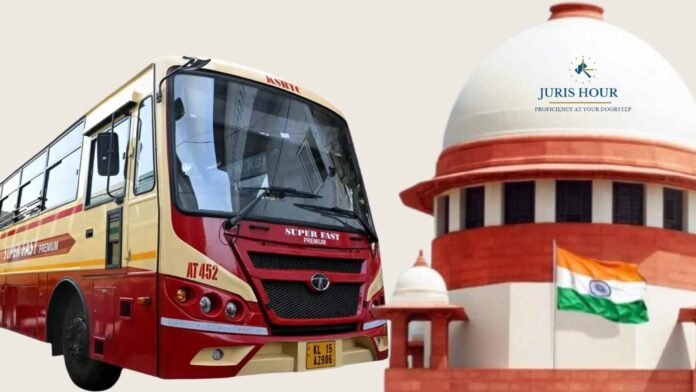
The Supreme Court held that criminal acquittal does not displace civil negligence in motor accident claims and charge sheet and FIR remain relevant prima facie evidence.
The bench of Justice S.V.N. Bhatti and Justice N.V. Anjaria set aside a finding of 50% contributory negligence imposed on the deceased driver in a long-pending motor accident compensation dispute, holding that the Karnataka High Court had erred in relying substantially on the post-accident position of vehicles in the site sketch while failing to properly appreciate the FIR, charge sheet, eyewitness material and the distinction between criminal and civil proceedings.
The Bench noted that a criminal court’s acquittal of the driver of the KSRTC bus, particularly where the acquittal was based on the benefit of doubt, could not be treated as determinative of negligence in proceedings before the Motor Accident Claims Tribunal (MACT). The Court restored the Tribunal’s finding that the accident occurred because of the rash and negligent driving of the KSRTC bus driver.
Buy Now: 50+ Supreme Court Judgments – July 2026
The judgment, delivered on August 19, 2026, also substantially enhanced compensation payable to the claimant. After reassessing the deceased’s income and accepting additional documentary evidence, the Court fixed the total compensation at ₹50,81,876, together with interest at 6% per annum from the date of filing of the claim petition until realisation.
The dispute arose from a road accident that occurred at about 1:20 a.m. on October 14, 2005, on NH-48 near Siddeshwara Petrol Bunk, opposite Sapthagiri Hospital at Kunigal in Karnataka.
A Hyundai Santro car bearing registration No. KA-04-MB-2073, driven by Nandan Shet, collided with a KSRTC heavy passenger vehicle bearing registration No. KA-01-F-7846. The claimant was travelling as a passenger in the Santro. Her husband, her mother-in-law and a family friend were also travelling in the car. The husband, Nandan Shet, the mother-in-law, Geetha Shet, and the family friend Mahesh died in the accident, while the claimant survived with injuries and required hospitalisation.
The accident resulted in an FIR at Kunigal Police Station, followed by a charge sheet against the KSRTC bus driver. However, the driver was subsequently acquitted in the criminal case by the trial court on October 3, 2008, by giving him the benefit of doubt.
The claimant thereafter pursued separate compensation claims concerning the death of her husband, the death of her mother-in-law and the injuries suffered by her.
Before the MACT, the claimant relied upon her own evidence, the FIR, charge sheet and the statement of the bus conductor who was sitting beside the bus driver when the accident occurred.
The Tribunal found that the accident was caused by the rash and negligent driving of the KSRTC heavy passenger vehicle. The bus conductor’s statement supported the claimant’s case that the bus had collided with the Santro and dragged it towards the side of the road.
However, while deciding compensation, the Tribunal did not award loss of dependency for the death of the claimant’s husband, observing that she herself was employed as an Associate Manager with Accenture in Bangalore. It awarded ₹1.50 lakh under the heads of loss of consortium and funeral expenses in the claim relating to her husband’s death.
The Tribunal awarded ₹1.67 lakh for the claimant’s injuries and ₹1.50 lakh concerning the death of her mother-in-law.
The matter was subsequently carried to the Karnataka High Court. The High Court enhanced the compensation relating to the death of the claimant’s husband to ₹14,35,267, but then applied 50% contributory negligence, reducing the payable amount to ₹7,17,634, with interest at 6% per annum.
The High Court relied significantly on the position of the Santro car depicted in the accident sketch and concluded that both drivers had contributed to the collision equally. It also considered the bus driver’s criminal acquittal while assessing the evidence.
The Supreme Court found this approach legally unsustainable.
A central aspect of the judgment concerns the distinction between criminal proceedings and motor accident compensation proceedings.
The Supreme Court reiterated that criminal proceedings and MACT proceedings operate under different standards of proof. A criminal case requires proof of culpable rashness to the criminal standard, whereas a motor accident claim under the Motor Vehicles Act is decided on the preponderance of probabilities.
Consequently, an acquittal in a criminal prosecution does not automatically eliminate civil or tortious liability arising from the same accident. The Court specifically noted that the bus driver in the present case had not received an unequivocal finding of innocence; rather, he had been acquitted by extending the benefit of doubt.
The Court therefore held that the High Court was wrong to treat the criminal acquittal as a significant basis for overturning the MACT’s finding of negligence.
The Supreme Court also addressed the evidentiary significance of police records in motor accident cases.
It noted that FIRs and charge sheets constitute relevant and admissible prima facie material for determining negligence in MACT proceedings. Such documents are not conclusive proof by themselves, but they form part of the evidentiary record and must be considered along with oral and documentary evidence.
The Court found that the High Court had erred by effectively disregarding the FIR and charge sheet while assessing contributory negligence. According to the Supreme Court, those documents pointed towards negligence on the part of the KSRTC bus driver and could not simply be displaced by the criminal acquittal.
Another important issue was the reliance placed on the topographical or accident sketch.
The High Court had concluded that the Santro was positioned on the extreme right side of the road even though sufficient space allegedly existed on the left, and consequently attributed 50% negligence to the Santro driver.
The Supreme Court rejected this reasoning. It observed that the contact point of the vehicles at the time of collision was more significant than the subsequent position of the vehicles or drag marks shown in the sketch. A smaller vehicle involved in a collision with a heavier vehicle may be pushed or dragged from its original position. Therefore, the post-impact location of a vehicle cannot automatically establish the manner in which it was being driven immediately before the collision.
The Court reiterated the principle that a site map or accident sketch cannot be read in isolation or treated as the sole basis for attributing contributory negligence, particularly where there is no corroborating ocular evidence establishing negligence on the part of the deceased driver.
The Court also attached importance to the evidence of the bus conductor, Suresh, who was sitting beside the bus driver at the time of the accident.
According to the material considered by the Court, the conductor’s police statement indicated that the KSRTC bus was being driven rashly and negligently and collided with the car coming from the opposite direction. The impact allegedly dragged the Santro for a considerable distance before it struck the PWD compound wall.
The Supreme Court noted that the KSRTC bus driver himself admitted that the conductor was sitting beside him and knew how the accident occurred. Yet the respondent did not examine the conductor before the Court to rebut the version recorded by the police.
The Court found that the High Court had failed to properly account for this evidentiary circumstance.
After reassessing the evidence, the Supreme Court categorically concluded that the finding of 50:50 contributory negligence was incorrect.
The Court restored the MACT’s finding that the accident occurred because of the rash and negligent driving of the KSRTC bus driver. It held that the High Court’s conclusion attributing negligence to the deceased driver was not supported by the evidence on record.
The Court consequently modified the liability position in the connected compensation claims as well, directing that the compensation confirmed in those matters be paid exclusively by KSRTC.
The Court also dealt with an application seeking permission to place additional documents on record.
The claimant sought to produce documents including employment records, Geetha Technologies’ invoices and quotations, banking records, educational documents and other material relating to the deceased’s professional qualifications and income.
The High Court had rejected the application as belated. The Supreme Court, however, held that in the peculiar circumstances of the case, the additional evidence ought to have been received for the limited purpose of determining just and fair compensation.
The Court took into account the claimant’s explanation that the accident had caused acute physical and mental shock, followed by job loss, while the retrieval of old banking records had also been affected by the merger of Vijaya Bank with Bank of Baroda.
Importantly, the Court noted that the accident had occurred in 2005 and the litigation had continued for approximately 21 years. Given the summary and welfare-oriented nature of MACT proceedings, the Court considered it appropriate to receive the additional evidence rather than prolong the litigation further.
The question of the deceased’s income was also reconsidered.
The claimant had asserted that her husband was earning between ₹1 lakh and ₹1.50 lakh per month. The High Court had, however, notionally fixed his monthly income at ₹20,000.
The Supreme Court found the ₹20,000 figure to be too low in light of the documentary material and the deceased’s qualifications and professional background. The Court noted that he possessed a Bachelor of Engineering degree, had specialised in software certifications and had moved from salaried employment into independent IT entrepreneurship.
The documentary record included quotations and invoices issued by Geetha Technologies. Among the documents considered were a quotation of ₹30,000 from May 2003, an invoice for ₹50,000 from August 2003, a purchase order of ₹52,000 from June 2004 and an invoice for ₹28,200 dated October 4, 2005—just ten days before the accident.
Although the Court did not accept the claimed income of ₹1 lakh to ₹1.50 lakh per month, it concluded that a realistic monthly income in October 2005 would be ₹70,000.
The Supreme Court’s calculation proceeded on the basis of ₹70,000 monthly income.
The Court arrived at a gross annual income of ₹8.40 lakh. After statutory tax and professional tax deductions amounting to ₹2,08,440, the net annual income was calculated at ₹6,31,560.
The Court then added 40% towards future prospects, producing a net effective annual income of ₹8,84,184. One-third was treated as annual savings to the estate, amounting to ₹2,94,728.
Applying a multiplier of 17, corresponding to the deceased’s age of 30 years, the substantive loss to the estate was calculated at ₹50,10,376.
The Court additionally awarded ₹52,000 towards loss of spousal consortium, after applying a 30% inflation adjustment; ₹19,500 towards funeral and transportation expenses, also after a 30% inflation adjustment.
This resulted in total compensation of ₹50,81,876.
Membership Required to Access Case Details & Order Copy
To view the complete Case Details and Download Order Copy, you must have an active membership. Please subscribe to continue.

