
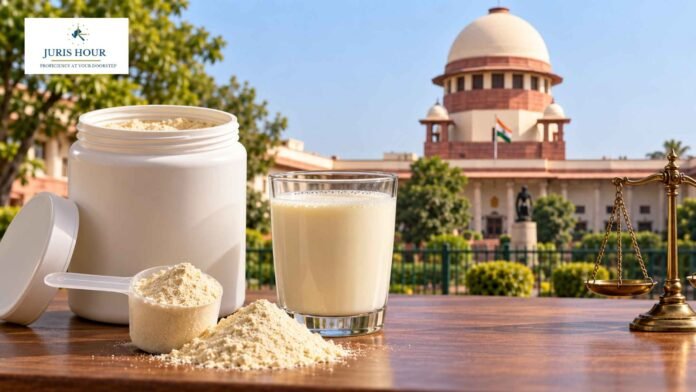
The Supreme Court has held that goods must be classified for taxation according to their form at the time of sale, rather than the product consumers may subsequently prepare from them. It ruled that “GRD Powder” and “GRD Mix”, sold in powder and biscuit form, could not be classified as non-alcoholic drinks or beverages merely because consumers were instructed to mix them with milk or water.
A Bench of Justice Manmohan and Justice Arun Palli dismissed the tax authorities’ appeals against a Madhya Pradesh High Court judgment that had upheld the products’ classification under the residuary entry of the Madhya Pradesh Commercial Tax Act, 1994. This classification attracted commercial tax at 8%, against the 10% sought by the Revenue under the entry covering non-alcoholic drinks and beverages.
Buy Now: Legal & Taxation Combo – 4 Premium E-Magazines
The department challenged the High Court’s August 3, 2011 decision in two writ petitions. Its principal argument was that the products’ packaging, imagery and preparation instructions identified them as health drinks.
According to the tax authorities, consumers were encouraged to enjoy the preparation hot or cold after mixing it with milk or water. The Revenue therefore sought classification under Entry 20(ii), Part IV of Schedule II to the 1994 Act.
That entry covered non-alcoholic drinks and beverages, including syrups, cordials, distilled juices, ark and essences, when sold in sealed, capsuled or corked bottles or jars.
The company maintained that the products were sold across the counter in powder and biscuit form. Since they did not answer the description of goods covered by the beverage entry, it argued that they belonged under the residuary entry.
The appeals also involved classification under the Entry Tax Act, 1976. The Court recorded that the applicable regime changed during the assessment year. For April 1997, the goods fell under the residuary entry attracting 1% entry tax. Between May and September 1997, they were not amenable to entry tax because there was no applicable entry. From October 1997 to March 1998, the competing classifications were the entry for non-alcoholic drinks and beverages attracting 2%, and the residuary entry attracting 1%.
The Supreme Court identified the central question as whether taxation should depend on the goods supplied or on the end product subsequently prepared by the consumer.
It held that the taxable event was the act of supply and that classification must follow the nature of the goods in the form in which they were sold.
“The tax authorities are bound to look at what is supplied and not at what is the ‘end use’ of the good,” the Court observed.
Explaining the distinction, the Bench said that a powder mix, such as protein powder, must attract the tax applicable to that product. A ready-to-drink product, such as bottled cold coffee or a packaged protein shake, would attract the tax applicable to beverages.
The consumer’s subsequent decision to mix a powder with milk or water does not change its identity at the taxable event. The Court also noted that such powder could be used to prepare a solid food item, such as barfi, rather than a drink.
Consequently, the possible uses of a product after purchase could not determine its classification under the entries in dispute.
The Bench examined the words accompanying “beverages” in Entry 20(ii). It found that syrups, cordials, distilled juices, ark and essences shared a common characteristic: they were liquids or liquid preparations.
These associated words informed the meaning of the broader expression “beverages”. Applying the rule of ejusdem generis, under which general words are interpreted in the context of accompanying specific words, the Court held that the entry could not be extended to goods having an altogether different physical form.
The Court further noted that Entry 20(ii) contained no reference to the use or adaptation of goods. Classification therefore depended on their physical characteristics and identity at sale, rather than what consumers might later make from them.
The department relied on the common parlance, functional character and basic nature tests. It argued that consumers understood the products as health drinks and that their function supported classification as beverages.
The Supreme Court held that these tests could not introduce an end-use criterion that overrode clear statutory guidance.
Reaffirming the strict interpretation of taxing statutes, the Bench said courts could not assume an intention beyond the provision’s plain language or add words to expand its scope.
It also held that goods outside the description of a specific entry must fall under the residuary entry. They could not be forced into an unsuitable specific entry merely to attract a higher tax rate.
The Bench distinguished the department’s reliance on Pioma Industries v. State of Kerala, which concerned Rasna. It noted that the relevant entry in that case expressly included powders, tablets and concentrates used to prepare non-alcoholic drinks. The matter had also been remanded without a final determination that Rasna was classifiable as a beverage.
The Madhya Pradesh entry contained no comparable provision expressly bringing powders within the beverage category.
The Court also distinguished S. Samuel M.D., Harrisons Malayalam v. Union of India. That decision concerned whether tea was a foodstuff; it did not decide whether tea leaves in granular or powder form were themselves beverages.
Similarly, the 2026 ruling in Hamdard (Wakf) Laboratories v. Commissioner, Commercial Tax, U.P. concerned sharbat already existing in liquid form. The Bench held that the word “including” in a taxing entry did not make its scope unlimited or bring within it goods of every character and physical form.
Concluding that the disputed products existed in powder and biscuit form at the time of sale, the Supreme Court held that they did not fall within the expression “beverage”.
The dismissal of the Revenue’s appeals leaves intact the High Court’s classification under the residuary entry attracting 8% commercial tax. The ruling turns on the wording of the statutory entries applicable to the dispute and does not determine the products’ classification under present-day GST provisions.
Membership Required to Access Case Details & Order Copy
To view the complete Case Details and Download Order Copy, you must have an active membership. Please subscribe to continue.
Read More: Uncertified WhatsApp Chats, Untested Statements Can’t Sustain Rs. 10 Lakh Customs Penalty: CESTAT

