
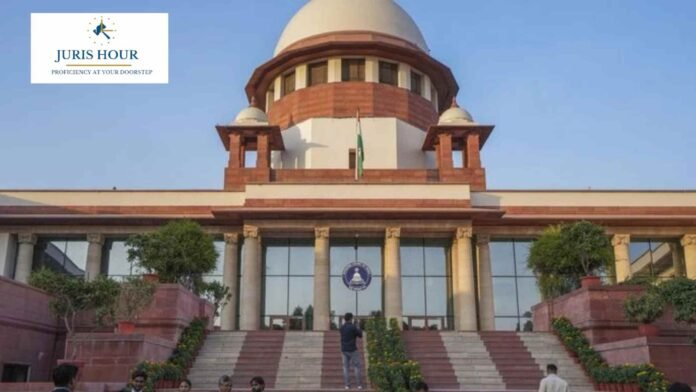
The Supreme Court has held that a High Court, while exercising its certiorari jurisdiction, can interfere with concurrent factual findings when the findings are based on assumptions, unsupported by evidence, or recorded after ignoring crucial documentary material.
The bench of Justice Ujjal Bhuyan and Justice Atul S. Chandurkar upheld a Delhi High Court judgment denying allotment of a housing society plot to the legal heir of a former claimant after finding that the original claimant had resigned from the society and was never readmitted as a member.
The Court found that the Arbitrator and the Delhi Co-operative Tribunal had overlooked documents conclusively showing that Sharma’s membership had ended in 1951. Their conclusion that he continued to remain a member throughout his lifetime was therefore perverse and open to correction through a writ of certiorari.
Buy Now: 50+ Supreme Court Judgments – July 2026
The dispute arose from Sharma’s claim that he was a member of the housing society and consequently entitled to allotment of a plot. Alleging that he had been illegally deprived of an allotment, he raised a dispute before the Joint Registrar of Co-operative Societies, Delhi, which was referred to arbitration under Section 61 of the Delhi Co-operative Societies Act, 1972.
An ex parte award was initially passed in Sharma’s favour. The society had challenged the appointment of the Arbitrator before a civil court and obtained a restraint order, but the arbitration proceedings continued nevertheless.
The matter eventually reached the Supreme Court, which, by a judgment dated August 21, 2002, set aside the ex parte award and directed the arbitration proceedings to continue from the stage at which the society had been proceeded against ex parte. As the original Arbitrator had died in the meantime, the Registrar of Co-operative Societies, Delhi, was appointed in his place.
Following the remand, the Registrar passed an award on October 7, 2003, holding that Sharma was a member of the society and had performed the obligations required to obtain a plot. The Registrar concluded that Sharma had nevertheless been deprived of an allotment.
Since Sharma had died during the proceedings, the Registrar directed the society’s managing committee to allot a plot to his legal heir, subject to payment of the full cost of the land and completion of the necessary membership-transfer formalities.
The society challenged the award before the Delhi Co-operative Tribunal under Section 76 of the 1972 Act. By a brief order dated March 18, 2004, the Tribunal upheld the Registrar’s decision and dismissed the society’s appeal.
The Tribunal observed that although Sharma had resigned from the society in 1951, the managing committee subsequently decided to admit him as a member as a special case for clearing suspense-account entries. It also relied on the fact that Sharma’s name appeared in lists supplied by the society during earlier court proceedings.
The society approached the Delhi High Court under Articles 226 and 227 of the Constitution. It argued that the Arbitrator and the Tribunal had ignored documentary evidence showing that Sharma had voluntarily resigned from the society in 1951 and had never been readmitted.
The High Court accepted the society’s contention. It found that the orders passed by the Arbitrator and the Tribunal were cryptic, substantially unreasoned and failed to consider documents that could have conclusively determined the dispute in the society’s favour.
According to the High Court, Sharma’s subsequent claim for membership arose in 1952, demonstrating that his earlier resignation was not disputed. His name appeared in the society’s records only because an amount of ₹25 remained in a suspense account and not because he continued to hold valid membership.
The High Court further noted that no resolution admitting Sharma as a member after his 1952 application had been produced. Nor was there any membership or share certificate demonstrating his readmission. The society had also declined to accept ₹15,000 offered by Sharma because he was not a member.
On these grounds, the High Court set aside the arbitral award and the Tribunal’s appellate order and dismissed the claim for allotment of a plot.
The principal question before the Supreme Court was whether the Delhi High Court had exceeded its limited supervisory jurisdiction by interfering with concurrent orders passed by the Arbitrator and the Tribunal.
The appellant contended that the Arbitrator had examined all relevant material and correctly concluded that Sharma remained a member of the society. It was argued that the High Court had effectively acted as an appellate court and reappreciated the evidence, which is generally impermissible while exercising jurisdiction under Articles 226 and 227.
The society, however, maintained that the authorities had failed to consider decisive documents. It submitted that Sharma’s resignation had been accepted in 1951, his share had been transferred to another member, and his subsequent application for fresh membership had been expressly rejected.
The Supreme Court reiterated that the power to issue a writ of certiorari is supervisory and not appellate. Ordinarily, a writ court cannot reappreciate evidence or substitute its own factual conclusions for those reached by a competent adjudicatory authority.
However, the Court clarified that a factual finding based on no evidence, conjecture or surmise can amount to an error of law. Similarly, a finding unsupported by documents or contrary to the overwhelming weight of evidence may be treated as perverse and corrected in certiorari jurisdiction.
The Court relied upon its earlier decisions in General Manager, Electrical Rengali Hydro Electric Project, Orissa v. Giridhari Sahu and Central Council for Research in Ayurvedic Sciences v. Bikartan Das. These decisions recognise that although mere factual errors are generally outside the scope of certiorari, findings based on no evidence or wholly unwarranted by the record are open to judicial correction.
The Bench explained that certiorari may be issued to correct errors concerning the absence, excess or failure to exercise jurisdiction. It may also be invoked where an authority, despite possessing jurisdiction, acts illegally or records a manifestly erroneous decision.
Applying these principles, the Supreme Court found that both the Registrar and the Tribunal had glossed over important documentary evidence, including:
- The acceptance of Sharma’s resignation recorded in the minutes of the society’s managing committee meeting held on May 5, 1951.
- The transfer of Sharma’s share to another member on August 18, 1951.
- The rejection of his fresh membership application recorded in the managing committee meeting held on November 5, 1952.
- The rejection, as late as November 4, 1979, of his request for permission to deposit money towards a plot.
The Court observed that consideration of these documents could have led to only one conclusion: Sharma was not a member of the society after his resignation.
Despite this evidence, the Arbitrator presumed that Sharma continued as a member throughout his lifetime merely because his name appeared in certain lists. The Supreme Court described the perversity of this finding as evident from the Arbitrator’s observation that Sharma’s resignation and subsequent re-entry for settlement of accounts were unsupported by reason or law and that his membership must therefore be presumed to have continued.
The Tribunal affirmed this finding through a cryptic order consisting of only six paragraphs without independently addressing the decisive documentary material.
The Supreme Court ruled that the High Court was fully justified in correcting the orders. Its intervention was not an impermissible reappreciation of evidence but a valid exercise of certiorari jurisdiction to correct findings rendered perverse by the omission of crucial documents.
The Bench held that no fault could be found with the High Court’s conclusion that proper consideration of the relevant documents would have resulted in a decision in favour of the housing society.
The Court also rejected the appellant’s reliance on Shalini Shyam Shetty v. Rajendra Shankar Patil, which explains the distinction between the High Court’s jurisdiction under Articles 226 and 227. It noted that the society’s petition before the Delhi High Court had been instituted under both constitutional provisions, making the cited ruling inapplicable to the case.
The Supreme Court also approved the High Court’s consideration of equitable factors. It noted that four other members had prior claims to allotment of a plot.
In those circumstances, directing the society to allot a plot to Sharma’s legal heir, merely on the basis of an earlier contribution of ₹25 and an unaccepted offer of ₹15,000, would not have been equitable.
The existence of members with superior claims supplied an additional reason for declining to interfere with the High Court’s judgment.
The parties had also addressed arguments on whether any plot was actually available for allotment. The Supreme Court, however, declined to adjudicate that question.
Once it was established that Sharma had never been readmitted as a member of the society, he had no legal entitlement to seek allotment. Consequently, the availability or otherwise of a vacant plot was irrelevant to the final determination.
Dismissing the appeals, the Supreme Court upheld the Delhi High Court’s judgment and ruled that Sharma’s legal heir was not entitled to allotment of a plot. No order as to costs was passed, and all pending interlocutory applications were disposed of.
Membership Required to Access Case Details & Order Copy
To view the complete Case Details and Download Order Copy, you must have an active membership. Please subscribe to continue.

