
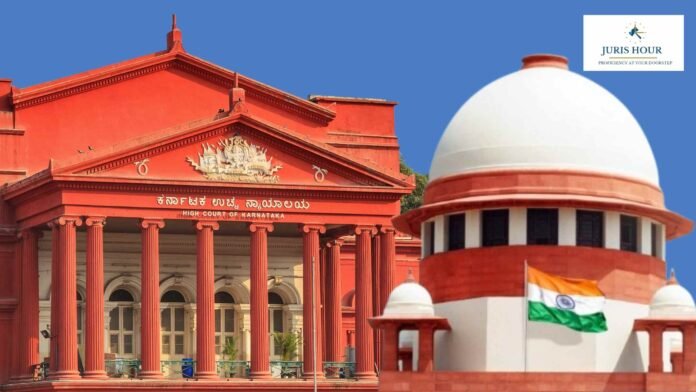
The Supreme Court has held that an appellate court commits a jurisdictional error and causes miscarriage of justice if it disposes of an appeal without adjudicating a pending application for production of additional evidence under Order XLI Rule 27 of the Code of Civil Procedure, 1908 (CPC).
The bench of Justice S.V.N. Bhatti and Justice N.V. Anjaria set aside the judgment passed by the Karnataka High Court, after finding that the High Court had failed to consider an application seeking permission to produce additional documents before deciding the appeal and cross-objections. The Supreme Court pronounced the judgment on August 6, 2026.
The proceedings originated from a partition and separate possession suit filed before the Court of the Senior Civil Judge, Devanahalli.
Buy Now: 50+ Supreme Court Judgments – July 2026
The Trial Court decreed the suit on September 12, 2006. Aggrieved by the decree, Respondent Nos. 1 to 4 approached the Karnataka High Court by filing RFA No. 2076 of 2006. A cross-objection, RFA Cross Objection No. 17 of 2012, was also filed by the appellant, who had been arrayed as Defendant No. 1 in the original suit.
The Karnataka High Court ultimately dismissed the appeal as well as the cross-objections by judgment dated December 16, 2025. The matter thereafter reached the Supreme Court.
The principal grievance before the Supreme Court was procedural rather than an immediate determination of the underlying property dispute.
The appellant contended that the High Court had failed to hear and decide I.A. No. 1/25, an application seeking permission to produce additional evidence under Order XLI Rule 27 CPC.
It was argued that the proposed additional evidence was material to the case and could demonstrate infirmities in the plaintiffs’ case. According to the appellant, the High Court proceeded to pronounce its final judgment without providing a determination on whether the additional documents should be taken on record.
The respondents, however, disputed the characterization of the issue as one where the application had simply not been heard. An affidavit placed before the Supreme Court stated that the application for bringing additional documents on record had been filed on October 28, 2025.
The matter was listed before the High Court on November 4, 2025, along with applications concerning production of additional documents and condonation of delay. The High Court recorded “Heard. Reserved for orders,” following which the final judgment was delivered on December 16, 2025.
The Supreme Court examined the statutory framework governing production of additional evidence in appellate proceedings.
Under Order XLI Rule 27 CPC, parties ordinarily cannot introduce additional evidence at the appellate stage. However, the rule creates specific exceptions, including circumstances where the lower court improperly refused evidence, where the evidence could not have been produced despite due diligence, or where the appellate court itself requires the evidence to pronounce judgment or for another substantial cause.
The provision also requires an appellate court, when permitting additional evidence, to record reasons for its admission.
The Court stressed that an application under Rule 27 cannot simply remain pending while the appellate court proceeds to decide the substantive appeal.
The Supreme Court summarised the principles emerging from the authorities cited before it.
It held that an appellate court has a statutory duty to consider an application for additional evidence on its merits and cannot ignore the application while delivering its final judgment.
The Court further noted that the application has to be considered alongside the main appeal so that the appellate court can determine whether the proposed material is required to enable it to pronounce judgment or whether there exists another substantial cause for admitting it.
Importantly, the Court held that the appellate court must pass a specific order either allowing or rejecting the application. If additional evidence is permitted, reasons for its admission must also be recorded.
The Supreme Court also emphasised that the question of additional evidence cannot be considered in isolation.
Before evaluating the proposed documents or other evidence, the appellate court must first examine the pleadings and determine whether the foundational case pleaded by the party supports introduction of the proposed evidence.
Thus, Rule 27 does not create an unrestricted right to introduce new material at the appellate stage. The appellate court must assess the statutory requirements and the relationship between the proposed evidence and the case already pleaded.
The Court described the consequences of an appellate court disposing of an appeal without deciding a pending Rule 27 application in strong terms.
According to the judgment, dismissing an appeal without deciding a pending application for additional evidence constitutes a jurisdictional error and results in a severe miscarriage of justice.
Applying this principle to the present case, the Supreme Court found that the Karnataka High Court had dismissed the cross-objection without referring to, considering or adjudicating the application filed under Order XLI Rule 27.
The documents sought to be produced included judgments relating to O.S. No. 369 of 1997, bank loan discharges and surveyor sketches. The Supreme Court considered these documents sufficiently material for the High Court to have first determined whether they were required for a satisfactory adjudication of the appeal.
The Supreme Court made it clear that the High Court’s obligation was not merely to acknowledge the existence of the application.
It was required to undertake the statutory exercise contemplated by Order XLI Rule 27 and decide whether the proposed evidence met the requirements for admission. If the application was rejected, the court was required to record its decision; if allowed, reasons for admitting the evidence had to be stated.
The failure to undertake this exercise before upholding the Trial Court’s decree amounted to a procedural failure with consequences for the fairness of the adjudication. The Supreme Court consequently concluded that the High Court’s judgment could not be sustained.
The Supreme Court therefore set aside the Karnataka High Court’s judgment dated December 16, 2025.
The civil appeals, along with the cross-objections, was restored to the file of the High Court for fresh disposal. Pending applications, if any, were also directed to stand disposed of accordingly.
Membership Required to Access Case Details & Order Copy
To view the complete Case Details and Download Order Copy, you must have an active membership. Please subscribe to continue.

