
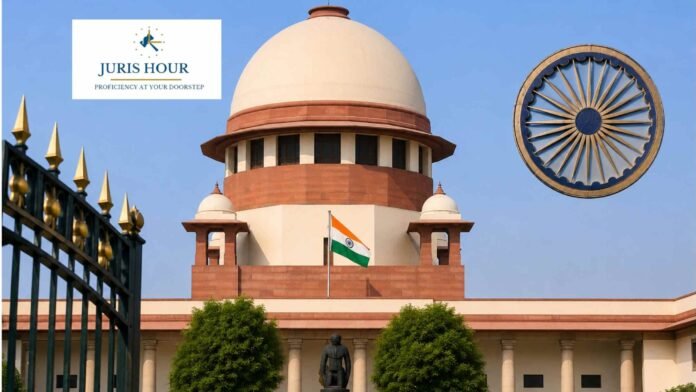
The Supreme Court on Tuesday heard a petition filed by self-styled social activist Baba Khatarnak (Badaravada Venugopal) questioning the absence of the Ashoka Emblem/Ashok Chakra on the Supreme Court building and seeking directions for its display in accordance with the statutory framework governing the use of the State Emblem.
During the hearing, the Bench headed by Chief Justice of India Surya Kant made pointed oral observations, indicating that the issue concerning the appearance of the Supreme Court building falls within the institution’s own administrative domain rather than judicial intervention.
Responding to the petitioner’s submissions, CJI Surya Kant remarked:
“Supreme Court ke gate pe kya lagana hai, hum dekh lenge. Aap duniya mein itni samasyaein hain, unka dhyan rakhiye.”
The remark came after the petitioner argued that the State Emblem of India (Regulation of Use) Rules, 2007 authorize the display of the National Emblem and questioned why the Supreme Court building does not display the Ashoka Emblem.
Addressing the Bench in person, the petitioner submitted:
“The State Emblem of India (Regulation of Use) Rules, 2007 authorise the display of the Ashoka Emblem. Why is the Ashoka Emblem not displayed on the Supreme Court building?”
The Chief Justice reiterated that the Court itself would decide matters concerning what is displayed on its premises, adding that the petitioner should instead devote attention to more pressing public issues.
Administrative Issue, Not a Matter for Judicial Directions
The proceedings reflect the Supreme Court’s consistent approach that questions relating to the design, insignia or display of symbols on the Court’s own premises are primarily matters of administrative decision-making by the institution, rather than issues warranting judicial adjudication. Similar pleas seeking installation of the National Emblem on the Supreme Court building have previously been treated as matters to be considered administratively instead of through writ directions.
The petitioner relied upon the State Emblem of India (Regulation of Use) Rules, 2007, contending that statutory provisions permit display of the National Emblem and that the Supreme Court building ought to reflect the same.
However, the Bench was not inclined to entertain the issue as one requiring judicial orders and made it clear through its oral observations that the Court would itself decide what should be displayed at its entrance.
The Focus
The Supreme Court already has its own official insignia, incorporating the Ashoka Chakra, the Lion Capital of Ashoka, and the Sanskrit motto “Yato Dharmastato Jayaḥ” (Where there is Dharma, there is Victory). The petition nevertheless sought a different form of display of the National Emblem on the Court’s building itself.
The hearing concluded with the Bench emphasizing institutional autonomy over matters concerning the Court’s own premises, while advising the petitioner to focus on broader public concerns rather than symbolic issues relating to the Supreme Court building.
Read More: Odisha Govt’s Plea Against Release of Animated Film ‘Mahaprabhu Jagannath’ in Supreme Court

