
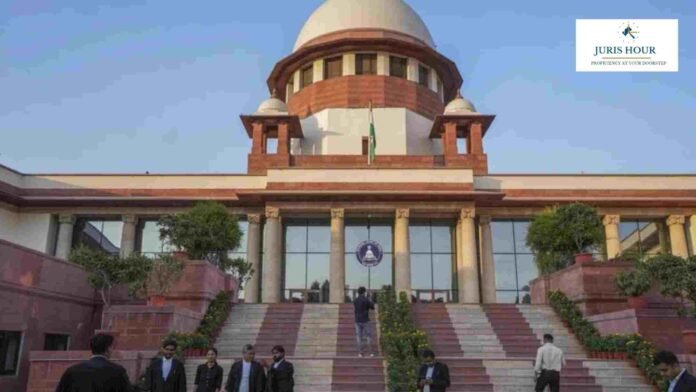
The Supreme Court has held that a 99-year registered document executed in favour of Vivekananda Kendra constituted a valid lease and could not be unilaterally cancelled by the lessor.
The Bench of Justices Pankaj Mithal and S.V.N. Bhatti has set aside the judgment of the Orissa High Court and restored the concurrent findings of the Trial Court and First Appellate Court.
The dispute pertained to land situated at Mouza Baripada Town, Ward No. 4 (Golapbag), under Baripada Town Police Station, recorded in the name of Anima Bose. On March 23, 1998, Anima Bose executed a registered 99-year document described as a lease deed in favour of Vivekananda Kendra for an annual rent of Rs. 1,000. The property was to be used for establishing a Kendra centre and carrying out its spiritual and service activities.
In December 2003, Anima Bose executed a unilateral deed cancelling the registered lease and subsequently issued a notice asking the Kendra to vacate the premises. The Kendra disputed the cancellation and asserted its leasehold rights. In May 2005, the Kendra claimed it was forcibly dispossessed. Thereafter, in January 2006, the property was sold through a power of attorney holder to Pradeep Kumar Agarwalla and another purchaser.
Vivekananda Kendra instituted a civil suit seeking declaration of its leasehold rights, invalidation of the cancellation deed and sale deed, recovery of possession, and injunction.
The Trial Court decreed the suit in favour of the Kendra, holding that the unilateral cancellation of a registered lease was illegal. The lease deed did not contain any clause permitting such cancellation. The purchasers were bound by the doctrine of lis pendens, having purchased the property during the pendency of the dispute. The suit was within limitation and maintainable.
The First Appellate Court affirmed these findings.
However, in the second appeal, the Orissa High Court framed a substantial question of law on whether the document in question created a leasehold right. The High Court concluded that the document was in substance a licence and not a lease, and therefore upheld the validity of the sale in favour of the purchasers.
The central issue before the Supreme Court was whether the 1998 document constituted a lease or merely a licence.
The Court relied upon the landmark decision in Associated Hotels of India Ltd. v. R.N. Kapoor (AIR 1959 SC 1262), which laid down that the real test to distinguish a lease from a licence is the intention of the parties, to be gathered from the substance of the document rather than its nomenclature.
It also referred to Mrs. M.N. Clubwala v. Fida Hussain Saheb and Annaya Kocha Shetty (Dead) Through LRs v. Laxmi Narayan Satose, reiterating that documents must be interpreted according to their plain and ordinary meaning, and purposive interpretation should be resorted to only when ambiguity exists.
Upon examining the clauses of the document, the Court noted that the document expressly used the term “demise.” It granted the property for 99 years. It fixed annual rent. It permitted the lessee to make alterations and constructions. It contemplated succession and assignment.
These features, the Court held, clearly established the creation of a leasehold interest.
The Supreme Court emphasized that there is no provision under the Registration Act, 1908 permitting unilateral cancellation of a registered lease deed in the absence of contractual authority. It also observed that none of the conditions under Section 111 of the Transfer of Property Act, 1882 for determination of a lease had been satisfied.
The Court rejected the High Court’s reliance on subsequent conduct and the fact that the lessor continued occupying part of the building, clarifying that exclusive possession must be examined in relation to the demised portion.
It held that once a valid lease was created, unilateral cancellation amounted to unlawful interference with the lessee’s possessory rights.
The Court observed that Defendant Nos. 3 and 4 were purchasers from the original owner and could only enjoy such rights as were legally available to the lessor. Since the lease subsisted, their rights remained subject to the leasehold interest of Vivekananda Kendra.
Setting aside the High Court’s judgment, the Supreme Court restored the decrees of the Trial Court and First Appellate Court. The Civil Appeal was allowed, with no order as to costs.
Case Details
Case Title: THE GENERAL SECRETARY, VIVEKANANDA KENDRA Versus PRADEEP KUMAR AGARWALLA AND OTHERS
Citation: JURISHOUR-147-SC-2026
Case No.: SPECIAL LEAVE PETITION (CIVIL) NO. 9558 OF 2023
Date: 26/02/2026

