
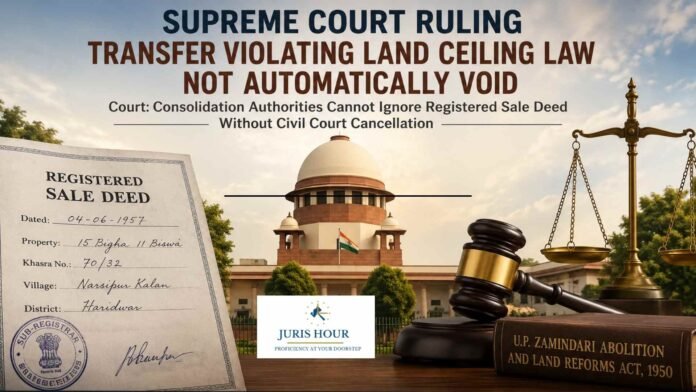
The Supreme Court has held that a transfer allegedly made in violation of Section 154 of the Uttar Pradesh Zamindari Abolition and Land Reforms Act, 1950, was not automatically void under the legal regime prevailing at the time of execution of the sale deed.
The bench of Justice Prashant Kumar Mishra ruled that consolidation authorities could not disregard a registered sale deed merely on the ground that it was allegedly voidable, unless it had first been cancelled by a competent civil court.
BUY NOW: Supreme Court Judgements E-Compilation – May 2026
The case arose from a dispute concerning agricultural land measuring approximately 15 bighas situated in Haridwar district. The appellants claimed title on the basis of a registered sale deed executed on June 4, 1957. According to the appellants, possession had been transferred pursuant to the sale and they had remained in possession ever since.
Decades later, in 1983, the appellants sought mutation of the land in their favour. Mutation was granted by the Naib Tehsildar in 1984. During subsequent consolidation proceedings initiated in the village, the appellants filed objections seeking recording of their names as tenure holders. Although they initially succeeded before the Consolidation Officer, the matter was reopened and ultimately decided against them.
The consolidation authorities, appellate authority, revisional authority, and eventually the High Court all concluded that the appellants had failed to prove execution of the sale deed and that the transaction violated Section 154 of the U.P. Zamindari Abolition and Land Reforms Act, rendering it void.
A central question before the Court was whether a transfer made in violation of Section 154 automatically became void.
The Court observed that the legal position prevailing at the time of the 1957 transaction was materially different from the present statutory framework. While Section 154 imposed restrictions on transfers beyond the prescribed ceiling limits, the consequence of a breach was governed by Section 163, which merely made the transferee liable to ejectment at the instance of the Gaon Sabha. The provision did not declare such transfers void ab initio.
The Bench relied upon the Supreme Court’s earlier decision in Kripashanker v. Director of Consolidation, which held that transfers violating Section 154 were not void but only voidable at the instance of the Gaon Sabha and only to the extent of the excess land transferred.
Accordingly, the Court held that the High Court and consolidation authorities erred in treating the 1957 sale deed as void.
The respondents argued that amendments introduced in 1981 and 1982, which expanded Sections 166 and 167 of the Act and declared transfers made in contravention of the Act void, should apply.
Rejecting this argument, the Supreme Court held that the amendments introduced substantive changes in legal consequences and could not be retrospectively applied to transactions that had taken place decades earlier. The Court noted that prior to the amendments, transfers violating Section 154 merely exposed the transferee to ejectment proceedings and did not automatically result in vesting of land in the State.
The Bench emphasized that the amending legislation neither expressly nor by necessary implication disclosed an intention to operate retrospectively. Applying the amended provisions to earlier transactions would disturb accrued rights and create inconsistencies within the statutory framework.
Consequently, the Court held that the 1957 sale deed could not be retrospectively declared void nor could the land be treated as vested in the State under the later amendments.
The Court also addressed an important jurisdictional issue concerning the powers of consolidation authorities.
Referring to earlier decisions including Gorakh Nath Dube v. Hari Narain Singh, Ningawwa v. Byrappa Shiddappa Hireknrabar, and Khursheed v. Shaqoor, the Court reiterated the distinction between void and voidable documents. It held that while consolidation authorities may disregard documents that are inherently void, they cannot ignore or invalidate a document that is merely voidable unless it has first been set aside by a competent civil court.
The Bench observed that a voidable transaction continues to remain legally effective until it is cancelled through appropriate legal proceedings. Therefore, the registered sale deed in the present case could not have been brushed aside merely because questions were raised regarding its validity.
The Supreme Court further stressed that registered documents enjoy a strong presumption of genuineness and due execution. The Court observed that registration is not a mere procedural formality but a solemn act carrying substantial evidentiary value.
The Bench noted that the authorities had placed undue reliance on alleged discrepancies concerning an attesting witness while overlooking the legal presumption attached to a registered sale deed that had existed for several decades. The Court observed that the burden of rebutting the presumption of validity lies heavily on the party challenging the document.
Membership Required to Access Case Details & Order Copy
To view the complete Case Details and Download Order Copy, you must have an active membership. Please subscribe to continue.

