
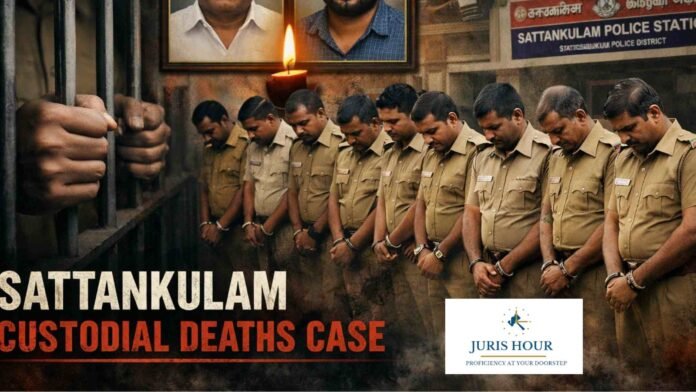
In a landmark judgment that underscores accountability in cases of custodial violence, a trial court in Madurai on April 6, 2026, sentenced nine police personnel to death for their role in the brutal custodial torture and killing of a trader and his son in 2020. The case, widely known as the Sattankulam custodial deaths, had sparked nationwide outrage and intensified debates over police excesses in India.
Table of Contents
Background of the Case
The incident dates back to June 2020, during the nationwide COVID-19 lockdown. P. Jayaraj (58) and his son J. Benicks (31), who ran a mobile phone shop in Thoothukudi district, were detained by police from the Sattankulam Police Station. They were allegedly picked up for keeping their shop open beyond permitted hours.
However, investigations later revealed that the allegations of lockdown violations were unfounded. What followed was a series of events that shocked the conscience of the nation.
Brutal Custodial Torture
According to findings presented in court, both father and son were subjected to prolonged and severe torture throughout the night while in police custody. The court observed that the violence began after a confrontation between Jayaraj and the police, and escalated when Benicks intervened to defend his father.
The judge described the acts as deliberate and vindictive, noting that the victims were unarmed, had no prior criminal record, and posed no threat. The torture inflicted was deemed not only excessive but carried out with the knowledge that it could result in death.
Court’s Observations
Presiding over the case, First Additional District and Sessions Judge G. Muthukumaran held all nine accused policemen guilty of murder, criminal conspiracy, and other offences under the Indian Penal Code.
In strong remarks, the court stated that law enforcement officers, entrusted with safeguarding citizens, had instead abused their authority. The judge emphasized that “where there is power, there must be responsibility,” and termed the incident as a grave violation of human rights.
He further remarked that the case might have been suppressed if not for the intervention of the Madras High Court, particularly its Madurai Bench, which had taken suo motu cognisance and closely monitored the investigation.
Calling custodial deaths a “social evil,” the court stressed the need for stringent punishment to act as a deterrent against future incidents.
Death Sentence and Penalty
The court awarded the death penalty to nine policemen, including inspectors, sub-inspectors, head constables, and constables who were directly involved in the crime. It ruled that life imprisonment would be insufficient given the brutality and nature of the offence.
Additionally, the court imposed a cumulative fine exceeding ₹1 crore on the convicts.
One of the accused, a special sub-inspector, had died during the trial after contracting COVID-19.
Findings of the Investigation
The probe, conducted by the Central Bureau of Investigation, uncovered a premeditated conspiracy among the police personnel. Jayaraj was initially detained from his shop on June 19, 2020, and taken to the police station.
When Benicks arrived to inquire about his father’s arrest and objected to the alleged assault, he too was detained. Both were then wrongfully confined and brutally assaulted with the intent of “teaching them a lesson.”
The investigation revealed disturbing attempts to cover up the crime. The victims were reportedly forced to clean their own bloodstains, and later, a sanitation worker was made to remove remaining evidence. Authorities also filed fabricated cases against the two men to justify their detention.
Wider Impact and Public Reaction
The Sattankulam case had drawn widespread condemnation from civil society, political leaders, and human rights organizations. It became a symbol of systemic issues within law enforcement and highlighted the urgent need for police reforms.
During the trial, references were also made to similar incidents, including the killing of George Floyd in the United States, underscoring the global concern surrounding custodial violence.
Government Stand
Both the Tamil Nadu government and the Centre supported stringent action in the case. The prosecution sought maximum punishment, asserting that custodial deaths are unacceptable in a democratic society governed by the rule of law.
Read More: Cloud Tools by Function for a CA Firm – 2026

