
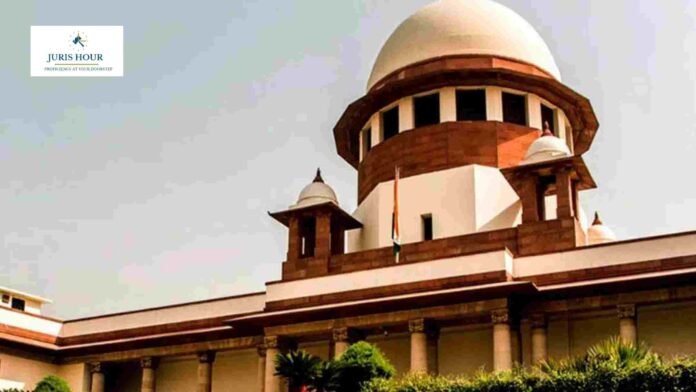
In a ruling on eligibility criteria for Higher Secondary School Teachers (HSSTs), the Supreme Court of India has held that the State Eligibility Test (SET) qualification must be in the concerned subject of appointment. Dismissing the appeals filed by Zubair P., the Court upheld the judgment of the Kerala High Court and ruled that possession of SET in an unrelated subject does not satisfy statutory requirements under the Kerala Education Rules.
The Bench of Justices K.V. Viswanathan and Vipul M. Pancholi clarified the interpretation of Rule 6(2)(24)(iii) of Chapter XXXII of the Kerala Education Rules (KER), which governs appointments to the cadre of Higher Secondary School Teachers.
The appellant, Zubair P., had entered service as an Upper Primary School Teacher in 2002 and was later promoted as High School Teacher in 2004. On July 15, 2021, he was appointed as HSST (Economics). He possessed B.A. and M.A. in Economics, B.Ed. in Social Sciences and SET qualification in Malayalam.
However, a competing candidate (Respondent No. 4), who also held B.A. and M.A. in Economics and B.Ed. in Social Sciences, had cleared the SET in Economics.
The respondent challenged Zubair’s appointment on the ground that he did not possess SET in Economics and also lacked the minimum ten years of approved High School teaching service required for exemption from SET under Rule 10(4) of Chapter XXXII KER.
The State authorities rejected approval of Zubair’s appointment in June 2022. His writ petition was dismissed by a Single Judge, and the decision was later affirmed by a Division Bench of the Kerala High Court. Aggrieved, he approached the Supreme Court.
The central question before the Court was whether Rule 6(2)(24)(iii) of Chapter XXXII KER requires that the SET qualification must be in the concerned subject of appointment, even though the Rule does not explicitly use the words “in the concerned subject” in relation to SET.
The appellant argued that since Rule 6 explicitly requires the Master’s degree and B.Ed. to be “in the concerned subject” but does not repeat that phrase for SET, the omission was deliberate. Therefore, SET in any subject should suffice.
Rejecting this argument, the Supreme Court adopted a purposive and contextual interpretation of the Rule. The Bench relied on the principles laid down in Reserve Bank of India v. Peerless General Finance and Investment Co. Ltd., which emphasise that statutes must be interpreted in light of their object and scheme rather than in isolation.
The Court noted that the SET examination is conducted subject-wise. Paper II of the SET is based on the candidate’s postgraduate specialisation. The objective of SET is to ensure academic competence at the Higher Secondary level.
Therefore, permitting a candidate who cleared SET in Malayalam to teach Economics would defeat the very purpose of the eligibility test.
The Court observed that a textual omission cannot be read in isolation when the scheme and object of the Rule clearly indicate subject-specific eligibility.
The Court also referred to a Government Letter dated January 18, 2021, clarifying that SET must be passed in the respective subject for HSST appointments. While the appellant contended that executive instructions cannot override statutory rules, the Court held that the clarification was consistent with the statutory framework and did not contradict it.
The appellant further argued that he was entitled to exemption from SET under Rule 10(4), which grants relaxation to teachers with ten years of approved High School service.
However, the Court found that he had completed only 9 years, 10 months, and 14 days of eligible service after excluding periods of deputation and leave. Since he fell short of the mandatory ten-year requirement, he could not claim exemption.
The appellant relied on the Full Bench decision in Manager, MPVHS School v. Girija (2003), but the Supreme Court agreed with the High Court’s view that the ruling dealt with High School Assistants under Chapter XXXI of KER and concerned B.Ed. qualifications, not SET requirements for Higher Secondary Teachers under Chapter XXXII.
Thus, the precedent was held to be inapplicable.
The Supreme Court concluded that SET qualification must correspond to the subject of appointment. Possession of SET in an unrelated subject does not meet statutory eligibility. The competing candidate, who held SET in Economics, satisfied all required qualifications. The High Court committed no error in directing consideration of her appointment.
Accordingly, both civil appeals were dismissed.
The Court clarified that no recovery of excess salary paid to the appellant pursuant to his appointment shall be made.
Case Details
Case Title: Zubair. P Versus State Of Kerala & Ors.
Case No.: Special Leave Petition (C) No. 17785 of 2024
Date: 13/02/2026
Read More: Master Plan Can’t Be Altered by Post-Facto Approval: Supreme Court

