
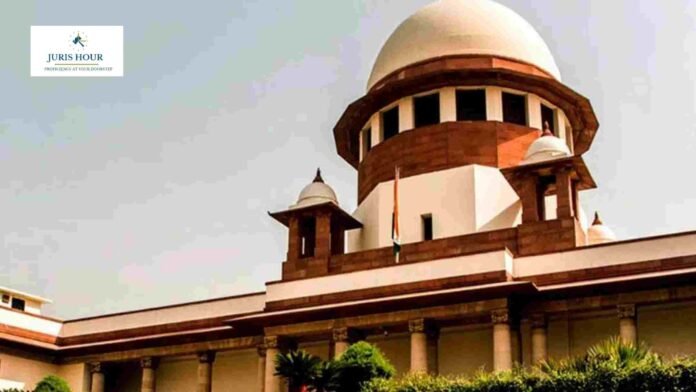
The Supreme Court has held that blacklisting of contractors cannot be imposed mechanically without a clear and specific show-cause notice.
While upholding the termination of a contract due to proven negligence, the bench of Justice Pamidighantam Sri Narasimha and Justice Alok Aradhe set aside the blacklisting order citing violation of principles of natural justice.
The bench has drawn a crucial distinction between termination of contract and blacklisting, emphasizing that the two actions operate in different legal spheres and require independent justification.
The dispute arose from a government contract awarded to the appellant for construction of an Elevated Service Reservoir (ESR) under a rural water supply scheme in Jharkhand. During construction, the top dome of the reservoir collapsed on June 1, 2024.
Following the incident, the State authorities issued a show-cause notice alleging poor construction quality and negligence. Multiple expert inquiries—including inputs from premier institutions like IITs—concluded that the collapse resulted from substandard work and deviation from approved design specifications.
Based on these findings, the Department passed an order on August 23, 2024, terminating the contract and blacklisting the contractor for five years. The decision was upheld by the High Court, prompting the contractor to approach the Supreme Court.
The Court upheld the termination of the contract, observing that there was “unimpeachable material” establishing negligence on the part of the contractor. It noted that the contractor had been given sufficient opportunity to present its case during departmental and judicial proceedings.
However, the Court found serious legal flaws in the blacklisting decision.
A central issue before the Court was whether blacklisting could automatically follow termination. Rejecting this approach, the Court held that termination deals with existing contractual obligations. Blacklisting affects future business prospects and carries severe civil consequences.
The Court clarified that blacklisting is not a “natural or logical consequence” of termination and must be independently justified.
The Court found that the show-cause notice issued to the contractor did not clearly indicate that blacklisting was being contemplated. It merely sought an explanation for the incident without specifying the proposed penalty of debarment.
The Court ruled that a valid show-cause notice must explicitly state the intention to blacklist. The contractor must be given a meaningful opportunity to respond to that specific proposal. Orders cannot go beyond the scope of the notice issued.
The absence of a clear notice proposing blacklisting rendered the action arbitrary and legally unsustainable.
The Court cautioned authorities against conflating these two processes, stressing that stricter standards of fairness apply in blacklisting cases due to their long-term impact.
The Court declined to remand the matter for fresh proceedings, noting that considerable time had already elapsed since the original order.
Instead, it directed that the blacklisting shall cease to operate with immediate effect, effectively granting relief to the contractor without prolonging litigation.
Case Details
Case Title: M/S A.K.G. Construction And Developers Pvt. Ltd. Versus State Of Jharkhand & Ors.
Citation: JURISHOUR-579-HC-2026(Ker)
Case No.: SLP (C) NO. 23858 OF 2025
Date: SLP (C) NO. 22669 OF 2025

