
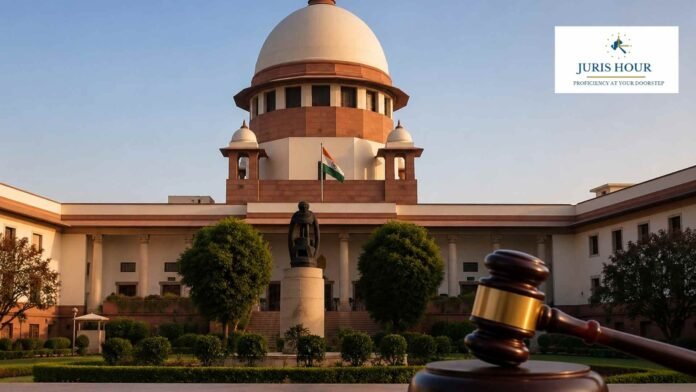
The Supreme Court has ruled that an increase in mining royalty introduced through a statutory amendment cannot be avoided merely because the underlying auction contract was concluded before the amendment came into force.
The bench of Justice Sanjay Karol and Justice N. Kotiswar Singh has observed that the respondent had the option of lifting the entire quantity before the enhanced royalty came into force but chose to remove the mineral later. Since dispatch occurred after the amendment, the higher royalty rate became applicable.
The dispute arose from the Supreme Court-supervised e-auction mechanism established during the Bellary mining scandal litigation. Pursuant to orders passed by the Supreme Court in 2011, a Monitoring Committee was constituted to oversee the sale of already extracted iron ore stockpiles through e-auctions. The successful bidders were required to pay the sale consideration along with royalty, taxes, and other statutory levies.
The respondent company had successfully bid for iron ore in June 2014 and paid the entire auction value, including royalty calculated at 10%, which was the prevailing rate at the time. The acceptance letter issued by the Monitoring Committee expressly mentioned royalty at 10% and required payment of the entire amount before delivery of the mineral.
However, on September 1, 2014, the Central Government amended the Second Schedule to the Mines and Minerals (Development and Regulation) Act, 1957 (MMDR Act), increasing the royalty rate on iron ore from 10% to 15%. Although the respondent had already completed payment under the auction contract, a substantial quantity of the iron ore was lifted and transported after the revised royalty rates came into effect.
Subsequently, the Accountant General raised objections regarding a deficiency in royalty collection. Acting on those objections, the authorities deducted the differential 5% royalty amount from the purchaser’s security deposit. The company challenged the deduction, arguing that its liability had crystallized when the auction was concluded and payment was made. The Karnataka High Court accepted this argument and held that imposing a higher royalty after acceptance of the bid would be unjust.
Before the Supreme Court, the State argued that royalty is a statutory levy governed by Section 9 of the MMDR Act and cannot be overridden by contractual arrangements. According to the State, royalty becomes payable at the rate prevailing when minerals are removed from the leased area, irrespective of when the contract was entered into.
The Court examined Section 9 of the MMDR Act and noted that royalty is payable on minerals removed or consumed from a leased area at the rate specified in the Second Schedule “for the time being.” It further observed that the Central Government possesses statutory authority to revise royalty rates through notification.
Relying heavily on the nine-judge Constitution Bench decision in Mineral Area Development Authority v. SAIL, the Supreme Court reiterated that royalty is fundamentally linked to the removal or dispatch of minerals. The Bench emphasized that royalty represents consideration for the privilege of extracting and removing minerals and is ordinarily determined with reference to the quantity dispatched.
The Court rejected the contention that the royalty rate stood frozen at the time of auction. It held that a contractual clause providing for payment towards future variations in royalty could not restrict the operation of a subsequent statutory amendment. Where a statutory change increases the royalty rate, contractual terms must yield to legislative mandate.
The Court therefore concluded that the authorities were justified in deducting the differential royalty amount from the security deposit.
Allowing the appeal, the Supreme Court quashed the Karnataka High Court judgment and upheld the State’s action in recovering the additional royalty. The ruling reinforces the principle that statutory levies such as mining royalty are governed by the law prevailing at the time of mineral dispatch and cannot be frozen by contractual arrangements entered into earlier.
Case Details
Case Title: The Director Of Mines And Geology Versus M/S BMM Ispat Ltd & Anr.
Citation: JURISHOUR-1545-SC-2026
Case No.: Special Leave Petition (Civil) No.16259 of 2019
Date: 04/06/2026

