
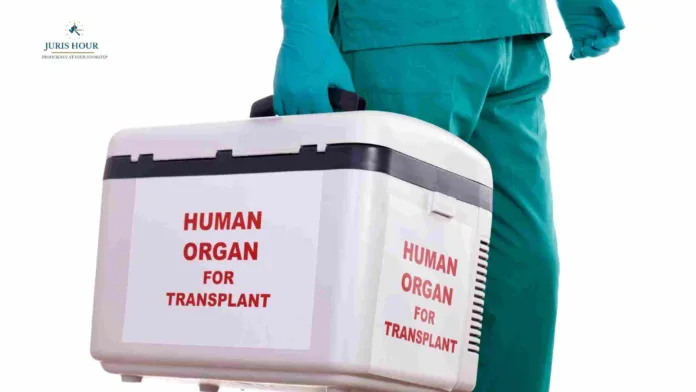
HomeOther LawsSupreme Court Hears Plea Challenging Illegal Organ Transplant Practices

Supreme Court Hears Plea Challenging Illegal Organ Transplant Practices

Published on

🚀 Stay Connected With JurisHour

WhatsApp X Telegram

The Supreme Court of India today heard a critical plea raising questions about the legality and ethical concerns surrounding organ transplant procedures, particularly focusing on the controversial concept of “brain death.” The matter has triggered intense debate over medical definitions, legal standards, and constitutional supremacy.

During the hearing, Justice Surya Kant expressed his difficulty in comprehending the intricate medical arguments presented. “This is primarily a medical issue. How do we decide it?” he remarked, underlining the challenge faced by the judiciary in addressing highly technical medical concepts.

Dr. S. Ganpathy, appearing as an expert witness, passionately argued that the case involved much more than routine medical ethics. He referred to a recent address by the Chief Justice of India (CJI) at the Bar Association in Amravati, where the CJI asserted that it is not Parliament but the Constitution that remains supreme in India, and therefore, the judiciary must intervene when constitutional values are at stake.

Dr. Ganpathy elaborated, “This is a matter concerning brain death, and the term itself is a misnomer. It was coined to enable the harvesting of organs from individuals who may not actually be dead, thereby bypassing stringent safeguards meant to protect life.”

Highlighting deep concerns over potential misuse of medical definitions to facilitate illegal organ transplants, Dr. Ganpathy urged the Court to scrutinize the standard medical protocols and the legal framework governing organ transplantation in India.

Justice Kant responded with candor, “It is impossible for me to grasp this medical language,” emphasizing the need for clearer medical-legal guidelines and definitions before the judiciary can proceed to pass judgments in such complex matters.

Read More: Attempt to Introduce Fresh Adjudication in Old Excise Prosecution Without Fresh Sanction Quashed: Madras High Court

Mariya Paliwala
Mariya Paliwalahttps://www.jurishour.in/
Mariya is the Senior Editor at Juris Hour. She has 7+ years of experience on covering tax litigation stories from the Supreme Court, High Courts and various tribunals including CESTAT, ITAT, NCLAT, NCLT, etc. Mariya graduated from MLSU Law College, Udaipur (Raj.) with B.A.LL.B. and also holds an LL.M. She started her career as a freelance tax reporter in the leading online legal news companies.

Latest articles

Gujarat High Court upholds Constitutional Validity Of Section 16(2)(c) of CGST Act

The Gujarat High Court has upheld the constitutional validity of section 16(2)(c) of the...

Govt Notifies FEMA (Non-Debt Instruments) Amendment Rules, 2026

The Central Government has notified the Foreign Exchange Management (Non-debt Instruments) (Amendment) Rules, 2026,...

CENVAT Credit Allowed on Outward Freight Prior to 01.04.2008: Madras High Court

The Madras High Court has upheld the eligibility of CENVAT credit on outward transportation...

Excise Duty Refund Dispute: Madras High Court Upholds Burden of Proof on TVS Motor to Establish Non-Passing of Duty Incidence

The Madras High Court has dismissed appeals filed by TVS Motor Company Limited, holding...

More like this

Gujarat High Court upholds Constitutional Validity Of Section 16(2)(c) of CGST Act

The Gujarat High Court has upheld the constitutional validity of section 16(2)(c) of the...

Govt Notifies FEMA (Non-Debt Instruments) Amendment Rules, 2026

The Central Government has notified the Foreign Exchange Management (Non-debt Instruments) (Amendment) Rules, 2026,...

CENVAT Credit Allowed on Outward Freight Prior to 01.04.2008: Madras High Court

The Madras High Court has upheld the eligibility of CENVAT credit on outward transportation...