
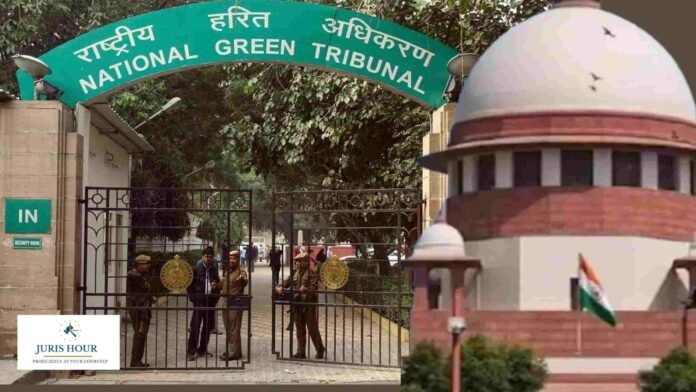
The Supreme Court has upheld the powers of the National Green Tribunal (NGT) to impose environmental compensation based on the scale and cost of real estate projects, even in the absence of a legislatively prescribed formula.
The bench of Justice Dipankar Datta dismissed both appeals, affirming the NGT’s orders directing Rhythm County to pay ₹5 crore and Key Stone Properties to pay ₹4.47 crore as environmental compensation to the Maharashtra Pollution Control Board (MPCB).
The two Pune-based real estate developers—M/s Rhythm County and M/s Key Stone Properties—challenging hefty compensation orders passed by the NGT for violations of environmental norms.
The appeals arose from separate orders passed by the NGT’s Western Zone Bench, Pune, in 2022. In the lead case, the NGT found that Rhythm County had undertaken residential and commercial construction at Autade Handewadi, Pune, without obtaining mandatory statutory consents under the Air and Water Acts and had continued construction even after a stop-work notice was issued.
Holding that the violations were serious, the NGT enhanced the environmental compensation from about ₹2.39 crore (as assessed by a Joint Committee) to ₹5 crore, considering the project’s overall cost of approximately ₹335 crore.
In the connected matter, Key Stone Properties was found to have carried out construction over several years without requisite consents and even handed over possession to occupants without a valid Consent to Operate. Although the project later obtained post-facto environmental clearance under a one-time regularisation window and furnished a bank guarantee for remediation and community augmentation, the NGT imposed additional compensation of ₹4.47 crore for distinct violations.
Both developers argued that the NGT had exceeded its jurisdiction by imposing compensation without a clear statutory framework or formula. They contended that reliance on project cost or turnover as a yardstick for environmental compensation was arbitrary and unsupported by law. The appellants also criticised the NGT for allegedly relying mechanically on reports of Joint Committees and on guidelines issued by the Central Pollution Control Board (CPCB), which they claimed were meant primarily for industrial units and not real estate projects.
Key Stone Properties further relied on earlier Supreme Court judgments to argue that environmental compensation requires a finding of actual environmental damage and cannot be imposed merely for procedural violations.
Rejecting these submissions, the Supreme Court held that the NGT Act, 2010 confers wide remedial powers on the Tribunal. Referring to Sections 15 and 20 of the Act, the Court emphasised that the NGT is mandated to apply the principles of sustainable development, precaution, and “polluter pays” while granting relief.
The Bench clarified that the absence of a rigid statutory formula does not denude the NGT of its authority to quantify environmental compensation. On the contrary, the law intentionally grants flexibility to the Tribunal to mould relief in a manner proportionate to the nature, scale, and impact of environmental violations.
The Court relied heavily on its earlier ruling in Goel Ganga Developers India Pvt. Ltd. v. Union of India, where compensation up to 5% of project cost was recognised as a general benchmark in cases of serious environmental violations. Applying that principle, the Court noted that the ₹5 crore compensation imposed on Rhythm County amounted to barely 1.49% of the project cost and could not be termed excessive or disproportionate.
The Court categorically held that project cost or turnover can be relevant factors for determining environmental compensation, provided there is a rational nexus with the scale of operations and environmental impact. It observed that larger projects typically exert greater stress on natural resources and the environment, and linking compensation to economic magnitude serves both deterrent and restorative purposes.
At the same time, the Bench clarified that such metrics cannot be applied mechanically and must be supported by reasoned findings, distinguishing the present cases from earlier judgments where compensation was struck down for being arbitrary or conjectural.
On the criticism relating to CPCB guidelines, the Court observed that these guidelines are indicative and facilitative, not mandatory or exhaustive. While primarily designed for industrial pollution cases, they do not fetter the NGT’s discretion in other categories of environmental violations.
The Court also rejected the argument that the NGT had abdicated its adjudicatory role by relying on Joint Committee reports. It held that expert committees assist in fact-finding and technical assessment, but the final determination in both cases reflected independent application of mind by the NGT.
Case Details
Case Title: M/S. Rhythm County Versus Satish Sanjay Hegde & Ors.
Case No.: CIVIL APPEAL No. 7187 OF 2022
Date: 30/01/2026
Read More: ICEGATE to Suspend Bills of Entry Filing on February 1 Due to Union Budget System Updates

