
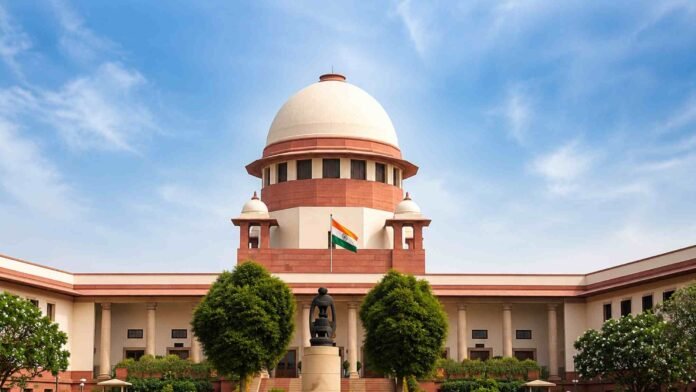
The Supreme Court has held that minor inconsistencies in records cannot be treated as fatal to a motor accident compensation claim and reiterated that proceedings under the Motor Vehicles Act are welfare-oriented and must be decided on the basis of “preponderance of probabilities” rather than the criminal standard of proof beyond reasonable doubt.
The bench of Justice Vikram Nath and Justice Sandeep Mehta set aside concurrent findings of the Motor Accident Claims Tribunal (MACT) and the Calcutta High Court and awarded compensation of ₹14.9 lakh to the family of a claimant who had suffered 100% permanent disability in a road accident.
The dispute arose from an accident that occurred on May 21, 2004. Raj Kumar Das claimed that after getting down from a rickshaw near Mondalpara Bus Stop and while paying the fare, he was struck by a lorry, resulting in severe injuries and eventual traumatic paraplegia causing permanent disability. He subsequently filed a compensation claim under Section 163A of the Motor Vehicles Act seeking ₹3.5 lakh.
The MACT had dismissed the claim in 2007 on the ground that Das failed to prove that his injuries were caused by the alleged accident. The Calcutta High Court later affirmed that decision in 2022, observing that the records contained glaring discrepancies and that the occurrence of the accident itself had not been sufficiently established.
However, the Supreme Court found serious flaws in this reasoning. It noted that motor accident compensation proceedings are summary in nature and are intended to provide expeditious justice to victims. The Court emphasised that in a claim under Section 163A, negligence itself need not be established and it is enough if the injuries are reasonably connected to the vehicle involved in the accident.
The Court observed that the issue was not whether every aspect of the accident had been proved with precision, but whether the available material reasonably established that the injuries arose from the accident in question.
One of the primary grounds relied upon by the Tribunal and High Court was an MRI report mentioning “fall from lorry.” The Supreme Court rejected the conclusion drawn from this entry. It observed that medical history recorded in emergency situations is generally based on information provided by attendants and is intended primarily to facilitate diagnosis rather than reconstruct the precise mechanics of an accident. The Court held that such isolated entries could not outweigh the FIR, chargesheet and claimant’s own consistent testimony.
The Court also addressed the delay in lodging the FIR, another factor that had weighed heavily with the lower courts. It observed that in cases involving serious injuries, obtaining medical treatment naturally takes precedence over legal formalities. Since the claimant had remained under continuous treatment and hospitalisation for several months, delay in approaching the police could not automatically create suspicion regarding the accident.
Similarly, the Court found that a discrepancy regarding the registration number of the vehicle could not be treated as decisive. While the claimant had once referred to the vehicle as WB-41-2999 during oral testimony, the FIR, chargesheet and claim petition consistently mentioned vehicle number WB-41-3999. The Court held that a single error in recollection by a severely injured person could not override consistent documentary evidence.
The Court further rejected the view that non-examination of independent witnesses weakened the claim. It held that where the injured person’s testimony remains consistent and withstands cross-examination, absence of additional witnesses cannot by itself justify rejection of the claim.
In a significant observation, the Court cautioned against adopting a hyper-technical approach in motor accident cases and stated that procedural requirements cannot be applied so mechanically that trivial errors become insurmountable obstacles to justice.
The Court observed: “Victims of accidents are seldom in a position to procure precise documents or give a coherent narration of the events that led to the accident while they are undergoing treatment. The absence of perfect proof cannot be a ground to deny compensation under a welfare statute.”
Since the accident had occurred over two decades ago and all necessary material regarding age, income and disability was available on record, the Court declined to remand the matter. Instead, invoking its powers under Article 142 of the Constitution, it decided to determine compensation itself using principles applicable to Section 166 claims, while clarifying that this approach was adopted only because of the peculiar facts of the case and should not be treated as a precedent.
The Court noted that the claimant was a 37-year-old brick-field labourer and sole earning member of his family who suffered complete loss of earning capacity due to 100% permanent disability.
The compensation was calculated at ₹14.9 lakh under various heads, including loss of earning capacity, mental agony, pain and suffering, attendant charges and medical expenses.
The Supreme Court directed the insurer to deposit the amount along with interest at 6% from the date of filing of the claim petition within three months before the MACT for release to the claimant’s legal representatives.
Case Details
Case Title: Raj Kumar Das (D) Thr. Lrs. Versus National Insurance Co. Ltd.
Citation: JURISHOUR-1390-SC-2026
Case No.: SLP (C) NO. 3585 OF 2023
Date: 25/05/2026

