
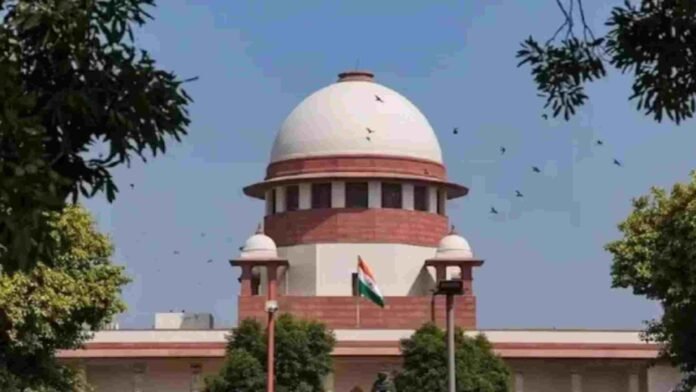
The Supreme Court has restored a Rs. 27.06 crore liquidated damages award in favour of NTPC Vidyut Vyapar Nigam Limited (NVVNL) against Saisudhir Energy Ltd (SEL), setting aside the Delhi High Court Division Bench’s reduction of damages to Rs. 20.70 crore.
The dispute arose from a Power Purchase Agreement (PPA) dated 24 January 2012, executed under the Jawaharlal Nehru National Solar Mission (JNNSM), a flagship Government of India initiative aimed at scaling up grid-connected solar power. NVVNL, designated as the nodal agency, entered into the PPA with Saisudhir Energy Ltd for commissioning and supply of 20 MW solar power at a fixed tariff for 25 years.
Under the agreement, the scheduled commissioning date was 26 February 2013. However, Saisudhir failed to meet the deadline, commissioning 10 MW with a delay of two months and the remaining 10 MW after a delay of nearly five months.
Clause 4.6 of the PPA stipulated a graded regime of liquidated damages for delay in commissioning, including encashment of performance bank guarantees and damages of ₹1,00,000 per MW per day for delays exceeding three months. NVVNL invoked these provisions, asserting entitlement to liquidated damages for the admitted delay.
A three-member arbitral tribunal delivered a split award in 2015. While the majority limited damages to ₹1.2 crore, the minority upheld NVVNL’s claim for full liquidated damages as a genuine pre-estimate of loss.
Subsequently, both parties approached the Delhi High Court under Section 34 of the Arbitration Act. The Single Judge modified the award, holding that although NVVNL had not demonstrated specific monetary loss, the delay was undisputed. Relying on Section 74 of the Indian Contract Act, 1872, the court awarded 50% of the contractual damages, amounting to ₹27.06 crore.
On appeal, the Division Bench under Section 37 further reduced the compensation to ₹20.70 crore, recalculating damages based on the duration of delay.
Allowing NVVNL’s appeal, the Supreme Court held that the Division Bench had exceeded its limited appellate jurisdiction under Section 37 by reworking the quantum of damages. The Court restored the Single Judge’s award of ₹27.06 crore, while dismissing Saisudhir’s appeal.
The Bench, comprising Justices P.S. Narasimha and Atul S. Chandurkar, made several critical observations:
- Limited Scope of Section 37: Once the Section 34 court had exercised discretion reasonably and within contractual limits, the appellate court could not substitute its own assessment merely because another view was possible
SAISUDHIR ENERGY LTD.
. - Public Interest in Renewable Energy Projects: The Court rejected Saisudhir’s argument that the PPA was a purely commercial contract. It held that solar power generation under JNNSM served a broader public and environmental purpose, justifying application of principles governing public utility projects.
- Proof of Actual Loss Not Mandatory: Relying on Construction and Design Services v. DDA, the Court reiterated that in public utility projects, delay itself constitutes loss, and strict proof of actual damage is not a prerequisite under Section 74 of the Contract Act.
- Validity of Liquidated Damages Clause: Having contractually agreed to Clause 4.6, Saisudhir could not later challenge NVVNL’s entitlement by arguing absence of direct financial investment or demonstrable loss.
The judgment also relied on the Constitution Bench ruling in Gayatri Balasamy v. ISG Novasoft Technologies Ltd., clarifying that while courts have limited powers to modify arbitral awards, such powers do not extend to fresh merits-based recalculations, particularly at the appellate stage.
The Supreme Court set aside the Delhi High Court Division Bench judgment dated 18 January 2018 and restored the Single Judge’s order awarding Rs. 27.06 crore as reasonable compensation. NVVNL’s appeal was allowed, while Saisudhir Energy’s appeal was dismissed. The parties were directed to bear their own costs.
Case Details
Case Title: M/S Saisudhir Energy Ltd. Versus M/S NTPC Vidyut Vyapar Nigam Ltd.
Case No.: CIVIL APPEAL NOS.12892-12893 OF 2024
Date: 30/01/2026

