
HomeOther LawsItaly Proposes Nationwide Ban on Burqa and Niqab: Meloni Govt Targets “Islamic...

Italy Proposes Nationwide Ban on Burqa and Niqab: Meloni Govt Targets “Islamic and Cultural Separatism”

Published on

🚀 Stay Connected With JurisHour

WhatsApp X Telegram

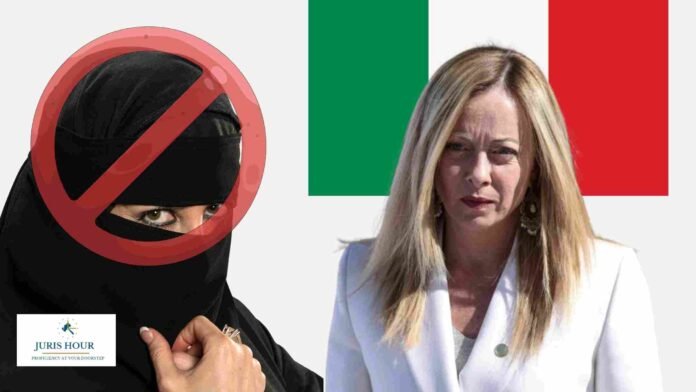
In a move stirring intense debate across Europe, Prime Minister Giorgia Meloni’s government has introduced a draft law proposing a nationwide ban on the wearing of burqa and niqab in public spaces across Italy.

The proposed legislation, which the government says is aimed at countering “Islamic and cultural separatism,” would prohibit face coverings that conceal identity in public areas — including streets, offices, schools, hospitals, and public transport.

Under the bill, violators could face hefty fines ranging from €300 to €3,000, depending on the severity and frequency of the offense.

In addition to the ban, the draft law introduces strict transparency norms for mosque funding and places restrictions on foreign donations to religious organizations — measures the government argues are necessary to prevent foreign influence and promote national integration.

“This law is about security, transparency, and cultural cohesion. Italy must remain a nation united by shared values, not divided by separatist ideologies,” Meloni said during a press briefing in Rome.

Critics, however, have denounced the proposal as discriminatory and unconstitutional, accusing the government of targeting Muslim communities under the guise of national security. Civil rights groups and opposition parties have warned that such a move could deepen social polarization and infringe upon religious freedom guaranteed under the Italian Constitution.

The bill will now be debated in Parliament, where it is expected to face both support from right-wing allies and opposition from centrist and left-wing parties.

If enacted, Italy would join countries like France, Denmark, Austria, and the Netherlands, which have already implemented similar bans on full-face Islamic veils in public spaces.

The Meloni government’s push reflects a growing European trend of legislating around identity, migration, and religious expression — issues that continue to shape the continent’s political discourse.

Read More: Cash Transactions Beyond Rs. 20K Can Trigger Penalty — Income Tax Dept. Warns Strict Action

Mariya Paliwala
Mariya Paliwalahttps://www.jurishour.in/
Mariya is the Senior Editor at Juris Hour. She has 7+ years of experience on covering tax litigation stories from the Supreme Court, High Courts and various tribunals including CESTAT, ITAT, NCLAT, NCLT, etc. Mariya graduated from MLSU Law College, Udaipur (Raj.) with B.A.LL.B. and also holds an LL.M. She started her career as a freelance tax reporter in the leading online legal news companies.

Latest articles

Unauthenticated Foreign Customs Documents Can’t Establish Pakistani Origin of Imported Dry Dates: CESTAT

The Chandigarh Bench of the Customs, Excise and Service Tax Appellate Tribunal (CESTAT) has...

Wrong Service Classification Alone Can’t Justify Extended Limitation Without Proof of Tax Evasion: Rajasthan High Court

The Rajasthan High Court has held that mere classification of services under an incorrect...

No Right To Representation Against Anti-Dumping Findings: Delhi High Court

The Delhi High Court has held that constitutional courts cannot routinely direct authorities to...

Coal Purchasers Can’t Be Saddled with Clean Energy Cess or Penalty Without Proof of Knowledge: Gauhati High Court

The Gauhati High Court has held that purchasers of coal cannot be made liable...

More like this

Unauthenticated Foreign Customs Documents Can’t Establish Pakistani Origin of Imported Dry Dates: CESTAT

The Chandigarh Bench of the Customs, Excise and Service Tax Appellate Tribunal (CESTAT) has...

Wrong Service Classification Alone Can’t Justify Extended Limitation Without Proof of Tax Evasion: Rajasthan High Court

The Rajasthan High Court has held that mere classification of services under an incorrect...

No Right To Representation Against Anti-Dumping Findings: Delhi High Court

The Delhi High Court has held that constitutional courts cannot routinely direct authorities to...