
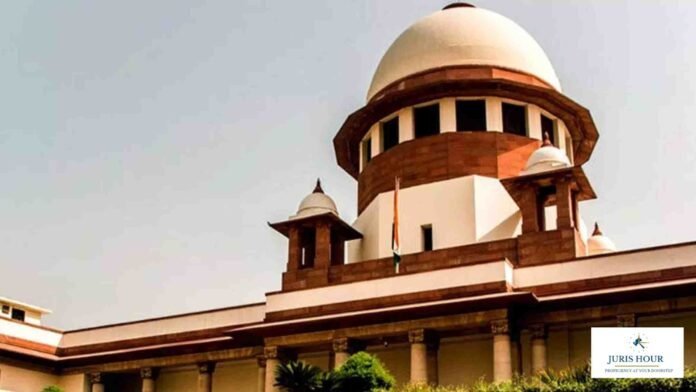
The Supreme Court has dismissed the appeal filed by Babu Singh, holding that pattas granted on land classified as public utility land are void ab initio and cannot confer any legal rights.
The bench of Justice Prashant Kumar Mishra and Justice N.V. Anjaria has observed that Public utility land cannot be converted into cultivable land by subordinate revenue authorities. The power to alter the category of such land lies exclusively with the State Government, and not with officers like the Sub-Divisional Officer. Paragraph Ka-155-Ka of the Land Records Manual only permits changes in revenue entries relating to tenure holders, and does not authorize reclassification of land itself.
The case revolved around land originally recorded as Category-6 land, which includes barren or uncultivable land, water bodies, roads, and other non-agricultural uses under the U.P. Land Records Manual.
In 1992, based on reports from revenue authorities, the Sub-Divisional Officer (SDO) approved a change in the land’s classification from Category-6 to Category-5 (cultivable land). This reclassification led to the grant of pattas (leases) in favour of the appellant and others, with their names duly recorded in revenue records.
Subsequently, during consolidation proceedings, the appellant was allotted chaks and claimed continuous possession since the grant of pattas.
Years later, during consolidation operations, authorities found that the land was actually public utility land (khalihan and pasture land) falling within the ambit of Section 132 of the U.P. Zamindari Abolition and Land Reforms Act, 1950, which prohibits conferment of bhumidhari rights on such land.
Acting on this, the Consolidation Officer ordered deletion of the appellant’s name from revenue records. The High Court upheld this decision, declaring that the pattas were illegal and incapable of conferring any rights.
The core issue before the Supreme Court was whether the Sub-Divisional Officer had the jurisdiction to change the classification of land from Category-6 to Category-5 and thereby validate the pattas granted.
The Court emphasized that allowing such reclassification would defeat the statutory prohibition under Section 132 and enable indirect circumvention of the law.
The bench ruled that since the reclassification itself was without jurisdiction, the pattas granted on its basis were void ab initio and conferred no rights on the appellant.
Even assuming the pattas were valid, the Court noted that at best they could be treated as Asami pattas, which are temporary and valid only for five years, and would have expired long ago.
The appellant argued that earlier proceedings rejecting cancellation of pattas barred fresh action under the principle of res judicata.
Rejecting this contention, the Court clarified that earlier proceedings were dismissed without adjudicating the legality of the pattas on merits, and therefore res judicata did not apply.
Reinforcing earlier precedents such as Hinch Lal Tiwari v. Kamala Devi and Jagpal Singh v. State of Punjab, the Court reiterated that community and public utility lands must be preserved and cannot be diverted for private use through administrative actions.
Finding no infirmity in the High Court’s decision, the Supreme Court dismissed the appeal, holding it devoid of merit, and upheld the correction of revenue records.
Case Details
Case Title: Babu Singh Versus Consolidation Officer And Others
Citation: JURISHOUR-934-SC-2026
Case No.: Civil Appeal No. 4633 Of 2026
Date: April 21, 2026

