
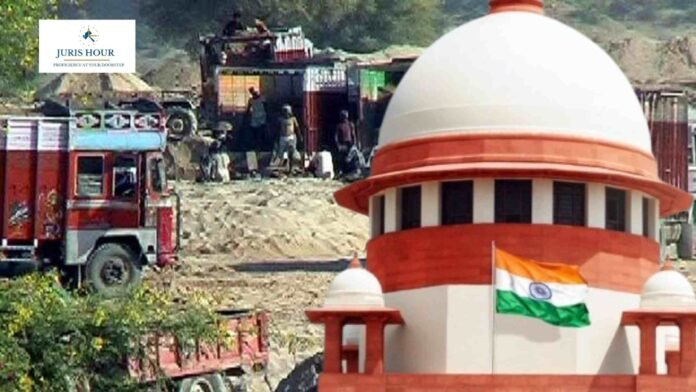
The Supreme Court of India has taken serious note of rampant illegal sand mining in the National Chambal Gharial Sanctuary, observing that the situation reflects a “systemic and institutional failure” of State authorities and poses a grave threat to endangered wildlife, ecological balance, and public safety.
The bench of Justice Vikram Nath and Justice Sandeep Mehta underscored that illegal sand mining has far-reaching consequences, including riverbed degradation, groundwater depletion, increased flood risks, and destruction of aquatic biodiversity. It reiterated that environmental protection is an integral part of the right to life under Article 21 of the Constitution.
The matter arose from a suo motu writ petition initiated by the Court following alarming reports of large-scale illegal mining activities within the protected sanctuary area. The Court emphasized that such activities not only violate environmental laws but also severely damage fragile river ecosystems and habitats of critically endangered species like the gharial.
Murders of Forest Officials Highlight Lawlessness
The Court was particularly disturbed by recent violent incidents linked to illegal mining operations. It noted that a forest guard in Morena, Madhya Pradesh, was brutally killed after being run over by a tractor transporting illegally mined sand. A similar incident in Dholpur, Rajasthan, earlier this year resulted in the death of another forest guard.
These incidents, according to the Court, demonstrate the “brazen and organized” nature of illegal mining syndicates and the direct threat posed to enforcement personnel. The Court observed that such repeated attacks indicate a breakdown of law enforcement and administrative control in the affected regions.
Buy Now: E-Compilation of Supreme Court Judgements – March 2026
Threat to Public Infrastructure
Apart from ecological damage, the Court flagged serious risks to public infrastructure. Illegal mining near an inter-State bridge on National Highway-44 has reportedly created deep cavities around its pillars, raising concerns about its structural integrity. The Court warned that continued excavation could lead to catastrophic consequences, endangering thousands of daily commuters.
Court Slams State Inaction and Possible Connivance
In strong observations, the Court stated that authorities appear to have “abdicated their constitutional responsibilities” and that the circumstances may even suggest “tacit connivance” in allowing illegal mining to continue unchecked.
The Court rejected the States’ plea of inadequate resources, noting that lack of equipment or preparedness cannot justify failure to act against organized illegal activities that result in environmental destruction and loss of human life.
Key Directions Issued by the Supreme Court
Invoking its powers under Article 142 of the Constitution, the Court issued a series of stringent interim directions to curb illegal mining:
- Installation of high-resolution CCTV cameras along mining routes and vulnerable river stretches
- Real-time monitoring under direct supervision of district police and forest अधिकारियों
- Mandatory GPS tracking of vehicles and machinery involved in mining activities (pilot in Morena and Dholpur)
- Immediate seizure of vehicles involved in illegal mining and prosecution of offenders
- Assessment and recovery of environmental compensation based on the “polluter pays” principle
- Formation of joint police-forest patrol teams equipped with modern gear and protection
- Development of a uniform inter-State Standard Operating Procedure (SOP) for enforcement
- Establishment of dedicated control rooms for centralized monitoring
The Court further warned that any negligence or non-compliance by officials would attract personal accountability, including contempt proceedings.
Highlighting the gravity of the situation, the Court cautioned that if immediate and effective steps are not taken, it may consider drastic measures such as a complete ban on sand mining in the affected States, deployment of paramilitary forces, and imposition of heavy penalties on State Governments.
The matter is now scheduled for further hearing on May 11, 2026, where the States of Madhya Pradesh, Rajasthan, and Uttar Pradesh are expected to submit detailed compliance reports and action plans.
Case Details
Case Title: In Re: Illegal Sand Mining In The National Chambal Sanctuary And Threat To Endangered Aquatic Wildlife.
Citation: JURISHOUR-839-SC-2026
Case No.: Suo Moto Writ Petition (Civil) No. 2 Of 2026
Date: 17/04/2026

