
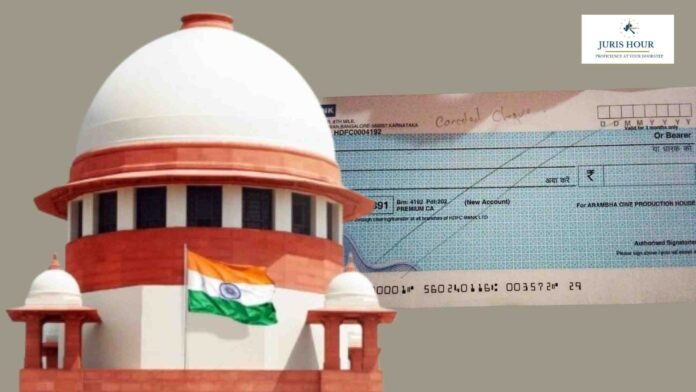
The Supreme Court has held that complaints under Section 138 of the Negotiable Instruments Act cannot be dismissed at the pre-trial stage merely on the ground that the cheque was not issued for a legally enforceable debt.
The bench of Justice J.K. Maheshwari and Justice Atul S. Chandurkar has restored a criminal complaint filed by Renuka against a respondent accused in a Rs. 50 crore cheque bounce case.
The case arose from a complex matrimonial and financial dispute involving alleged fraudulent transfer of shares by the appellant’s husband. As part of an amicable settlement, the husband had agreed to transfer certain properties and pay ₹50 crore to the appellant. A third party—acting as a mediator and guarantor—issued a cheque of ₹50 crore in favour of the appellant to secure the payment.
However, when the cheque was presented, it was dishonoured with the remark “payment stopped by drawer.” Following statutory notice and non-payment, the appellant initiated proceedings under Section 138 of the Negotiable Instruments Act.
The trial court had initially issued process against the accused. However, the Sessions Court set aside this order, holding that there was no legally enforceable debt at the time of issuance of the cheque. This view was upheld by the Bombay High Court, leading to the present appeal before the Supreme Court.
A bench held that both the Sessions Court and the High Court erred in prematurely evaluating the existence of a legally enforceable debt.
The Court emphasized that at the stage of issuing process under Section 138, the Magistrate is only required to verify whether the basic ingredients of the offence are satisfied—namely issuance of cheque, presentation and dishonour, issuance of statutory notice, and failure to pay within the prescribed period
Once these elements are established, the statutory presumption under Section 139 of the Negotiable Instruments Act comes into play, which assumes that the cheque was issued towards discharge of a legally enforceable debt.
The Court clarified that this presumption is rebuttable—but only during trial through evidence. It cannot be negated at the threshold stage based on preliminary objections.
Rejecting the reasoning of the Sessions Court, the Supreme Court observed that dismissing the complaint at a pre-trial stage without allowing evidence effectively nullifies the statutory presumption and defeats the purpose of the law.
The bench further noted that disputed questions—such as whether the cheque was issued for a contingent liability or as part of an incomplete agreement—must be adjudicated during trial.
The Supreme Court set aside the orders of both the Sessions Court and the High Court. It restored the complaint for adjudication on merits before the trial court.
The Court clarified that its observations are limited to the issue of maintainability and should not influence the final outcome of the trial.
Case Details
Case Title: Renuka Versus The State Of Maharashtra
Citation: JURISHOUR-649-SC-2026
Case No.: SLP (CRL.) NO.7829 OF 2023
Date: 07/04/2026
Read More: Primacy Of Merit In Appointments Under Unreserved Category: Supreme Court

