
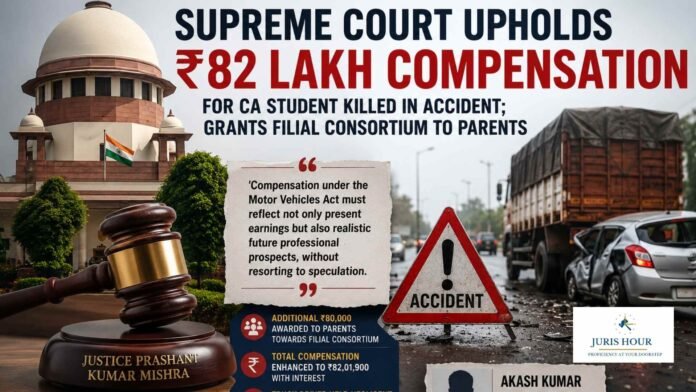
The Supreme Court has upheld a compensation award exceeding ₹82 lakh to the parents of a Chartered Accountancy (CA) Final student who lost his life in a road accident in Delhi. The Court reaffirmed that compensation under the Motor Vehicles Act must reflect not only the deceased’s present earnings but also realistic future professional prospects, while cautioning against speculative assumptions.
The bench Justice Prashant Kumar Mishra and Justice N.V. Anjaria dismissed the appeal filed by the Insurance Company challenging the compensation and negligence findings, while partly allowing the claimants’ appeal by granting an additional ₹80,000 towards filial consortium.
The case arose from a fatal road accident that occurred in the early hours of June 11, 2013, near Andrews Ganj Bus Stop on Delhi’s BRT Corridor.
Akash Kumar, a 20-year-old CA Final student undergoing articleship with a reputed accounting firm, was travelling in a Wagon-R car driven by his roommate. The vehicle collided with a truck parked on the road. Akash sustained fatal injuries and died, while the driver suffered injuries.
According to the claimants, the truck had been left stationary in the middle of the road without parking lights, reflectors, indicators, or any warning signs. An FIR was subsequently registered, and the truck driver was charge-sheeted for offences under the Indian Penal Code.
The Motor Accident Claims Tribunal (MACT), after examining evidence including eyewitness testimony and site photographs, concluded that the truck driver had negligently left the vehicle on the road without adequate warning measures.
The Tribunal rejected the insurer’s contention that the Wagon-R driver was responsible for the accident or had contributed to the occurrence through negligent driving.
Significantly, neither the truck driver nor the owner entered the witness box to support their defence that the truck had suffered a puncture and had been parked safely on the side of the road.
The Delhi High Court subsequently affirmed these findings.
Before the Supreme Court, the insurer argued that since the Wagon-R had struck the truck from behind, the accident should be treated as a case of contributory negligence.
The Court declined to accept this argument.
It observed that a stationary vehicle occupying a roadway during the night without any warning indicators posed a serious hazard to road users. The Bench noted that the testimony of the injured eyewitness remained unshaken and that there was no evidence from the truck driver or owner to establish their version of events.
The Court emphasized that merely because a vehicle collides from behind does not automatically establish negligence on the part of the following vehicle. Each case must be assessed in light of its surrounding circumstances.
One of the central issues before the Court concerned the assessment of compensation.
At the time of his death, Akash Kumar was pursuing CA Final and receiving an articleship stipend ranging between approximately ₹3,500 and ₹14,400 per month. The claimants argued that he also earned money through private tuition and had strong prospects of becoming a successful Chartered Accountant.
The Tribunal had considered evidence from the Joint Director of the Institute of Chartered Accountants, who testified regarding salary prospects available to newly qualified CAs. Taking into account the deceased’s educational trajectory and professional advancement, the Tribunal assessed his monthly income at ₹55,500 rather than restricting the calculation to his actual stipend.
Based on this assessment, future prospects, deductions, and multiplier calculations, compensation of ₹81.21 lakh was awarded.
The Supreme Court observed that the Tribunal had already adopted a forward-looking approach by considering the deceased’s future professional prospects while determining his income.
The Court acknowledged that adding a further 50% towards future prospects could technically result in some overlap in the calculation methodology. However, it declined to reduce the compensation.
The Bench stressed that compensation under the Motor Vehicles Act cannot be evaluated solely through rigid mathematical formulas and must account for the human element involved in the loss of a young life.
The Court noted that the deceased stood on the threshold of a promising professional career and that nearly a decade had elapsed since the accident. Interfering with the compensation at this stage would not advance the cause of substantive justice.
While refusing to reduce the compensation, the Court also rejected the parents’ plea for substantial enhancement.
The Bench held that there was no concrete evidence to establish the alleged tuition income or guarantee that the deceased would certainly qualify as a Chartered Accountant and achieve higher earnings.
The Court warned that compensation cannot be based on assumptions of assured professional success or comparisons with highly successful professionals.
According to the judgment, the Tribunal had already adopted an exceptionally liberal and beneficial approach while evaluating the deceased’s future earning capacity. Any further enhancement on that basis would enter the realm of speculation rather than compensation.
The Supreme Court, however, found merit in one aspect of the claimants’ appeal.
The Tribunal and the High Court had not awarded any compensation under the conventional head of consortium.
Relying on the principles laid down in National Insurance Co. Ltd. v. Pranay Sethi and Magma General Insurance Co. Ltd. v. Nanu Ram, the Court held that parents of an unmarried deceased child are entitled to compensation for “filial consortium.”
Accordingly, the Court awarded ₹40,000 each to the deceased’s parents, resulting in an additional ₹80,000 being added to the compensation amount.
With the addition of filial consortium, the total compensation payable to the claimants was enhanced from ₹81,21,900 to ₹82,01,900, together with interest as directed by the Tribunal. The insurer has been directed to deposit the enhanced amount within four weeks.
Membership Required to Access Case Details & Order Copy
To view the complete Case Details and Download Order Copy, you must have an active membership. Please subscribe to continue.

