
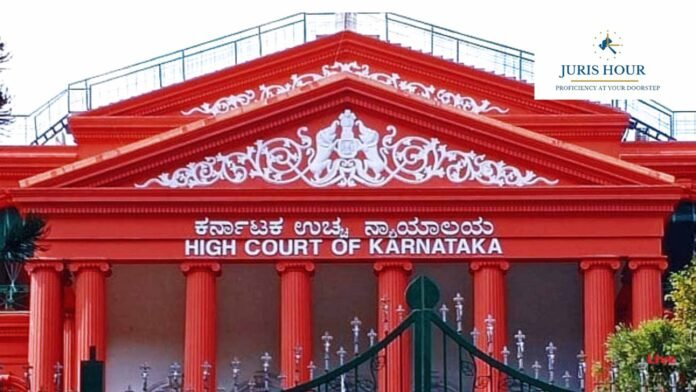
The Karnataka High Court has held that the statutory first charge created in favour of the Telangana Commercial Tax Department (CTD) for recovery of tax arrears takes precedence over the priority rights claimed by a secured creditor under the SARFAESI Act, delivering an important ruling on the conflict between government tax dues and secured debt recovery.
The bench of Justice Anant Ramanath Hegde has observed that Section 26E of the SARFAESI Act grants priority in payment to secured creditors but does not itself create a statutory first charge over property. In contrast, the Andhra Pradesh sales tax laws expressly create a statutory first charge in favour of the State for unpaid taxes.
BPL Engineering had mortgaged approximately 42.99 acres of land in favour of an IDBI Bank-led consortium in 1997 and 1998 to secure loans. After the company defaulted, the account was classified as a Non-Performing Asset (NPA) in 2001. The debt was later assigned to the Stressed Assets Stabilisation Fund (SASF), which initiated recovery proceedings under the SARFAESI Act.
Buy Now: Supreme court Judgements E-Compilation – JUNE 2026
Meanwhile, the Commercial Tax Department issued attachment orders in 2007 and 2011 for recovery of substantial tax arrears. The department claimed outstanding dues under the Andhra Pradesh General Sales Tax Act, Central Sales Tax Act, and Andhra Pradesh Value Added Tax Act. Tax arrears eventually exceeded ₹72 crore.
In 2012, the Karnataka High Court ordered the winding up of BPL Engineering. Subsequently, SASF assigned its recovery rights to Omkara Assets Reconstruction in August 2024. Omkara was later permitted by the High Court to sell the secured property outside liquidation proceedings. However, the continued existence of CTD attachment orders allegedly prevented successful auction attempts.
The applicant sought recall of the 2007 and 2011 attachment notices issued by the Commercial Tax Department, arguing that as a secured creditor it enjoyed priority under Section 26E of the SARFAESI Act.
The Commercial Tax Department, on the other hand, filed applications seeking recall of the order allowing Omkara to sell the property outside liquidation proceedings. Permission to sell the property itself for recovery of tax arrears based on the statutory first charge available under state taxation laws.
Omkara contended that Section 26E of the SARFAESI Act grants secured creditors priority over all other debts, including government dues, once the security interest is registered with the Central Registry of Securitisation Asset Reconstruction and Security Interest of India (CERSAI). It argued that the provision should apply to pending disputes and that its rights as assignee of the original secured creditor should prevail over the CTD’s claims.
The company also emphasized that the mortgages were created in 1997 and 1998, long before the tax department issued attachment orders in 2007 and 2011. Therefore, it claimed a superior right over the property.
The Commercial Tax Department argued that the tax laws created a statutory first charge over the property of the dealer for unpaid taxes. According to the department, the tax liability arose as early as 1995 and 1996, even before the mortgages were created in favour of the lending banks. It contended that Section 26E merely provides payment priority and does not extinguish a statutory first charge created under state legislation.
The High Court extensively examined recent Supreme Court rulings, particularly Jalgaon District Central Co-operative Bank Ltd. v. State of Maharashtra and Punjab and Sind Bank v. State of Punjab. The Court observed that a distinction exists between a “statutory first charge” and a mere “priority of payment.”
Relying on Supreme Court precedent, the Court held that where a valid statutory first charge exists independently of a non-obstante clause, such charge prevails over the payment priority granted under Section 26E of the SARFAESI Act.
The Court concluded that section 26E of the SARFAESI Act does not override a statutory first charge created under state tax laws. The statutory first charge available to the Commercial Tax Department prevails over the secured creditor’s claim. The Supreme Court has already clarified that Section 26E operates prospectively. Registration of security interest with CERSAI in 2021 does not defeat tax claims that had already crystallized under the applicable tax statutes.
The Court further observed that even if arguments regarding retroactive application of Section 26E were accepted, they would not assist Omkara because the State’s statutory charge had already come into existence long before the security interest was registered with CERSAI.
Membership Required to Access Case Details & Order Copy
To view the complete Case Details and Download Order Copy, you must have an active membership. Please subscribe to continue.
Read More: ICAI Dismisses Social Media Claims of Student and Examination Data Breach, Calls Them “False”

