
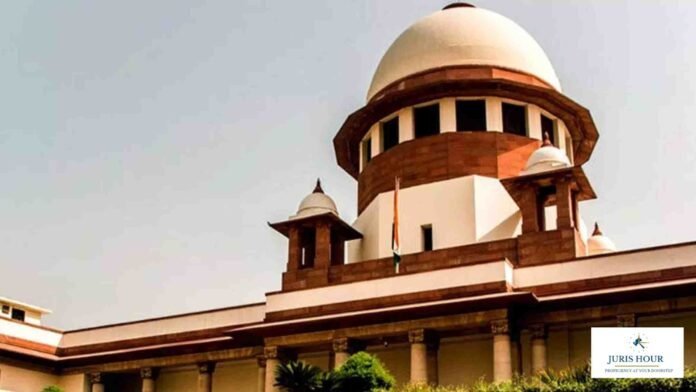
The Supreme Court has held that the clever drafting under Order VII Rule 11 CPC can’t bypass Benami Law bar in property suits.
The bench of Justice J.B. Pardiwala and Justice R. Mahadevan has delivered a significant judgment on the scope of rejection of plaints under Order VII Rule 11 of the Code of Civil Procedure and the applicability of the Prohibition of Benami Property Transactions Act, 1988, while deciding the case of Manjula and Others v. D.A. Srinivas.
The bench extensively examined whether a civil suit claiming ownership through a Will could be rejected at the threshold on the ground that it was allegedly founded upon a benami transaction.
The dispute arose from a civil appeal challenging a Karnataka High Court judgment which had restored a suit that was earlier rejected by the trial court under Order VII Rule 11(a) and (d) CPC. The trial court had concluded that the plaint disclosed no cause of action and that the suit was barred by Sections 4 and 6 of the Benami Act. However, the High Court reversed that order and restored the suit for adjudication on merits.
According to the facts recorded by the Supreme Court, the respondent-plaintiff had filed a suit claiming ownership over certain properties on the basis of a Will dated 20 April 2018 allegedly executed by late K. Raghunath. The plaintiff sought declaration of ownership, rectification of alleged errors in the Will schedule, and consequential injunction reliefs. The defendants, who were the wife and children of the deceased, contended that the properties were self-acquired assets of late Raghunath and that he had earlier executed a registered Will in favour of his wife in 2016.
The defendants further alleged that the plaintiff’s own pleadings disclosed a benami arrangement because the plaintiff claimed that he had financed the purchase of the properties while the assets were purchased in the name of late Raghunath due to statutory restrictions under the Karnataka Land Reforms Act. They argued that the plaintiff was effectively seeking enforcement of a benami transaction disguised as a testamentary claim through a Will.
During the proceedings, the appellants also pointed out that criminal proceedings relating to the alleged murder of K. Raghunath and allegations concerning fabrication of the disputed Will were pending against the plaintiff. It was alleged that the plaintiff had manipulated mutation entries and sold portions of the properties while criminal investigations were ongoing.
The Supreme Court undertook an elaborate examination of the legal principles governing rejection of plaints under Order VII Rule 11 CPC. The Court reiterated that a plaint can be rejected if it fails to disclose a cause of action or if the suit appears from the statements in the plaint to be barred by law. The Court emphasized that courts must undertake a “meaningful and substantive reading” of the plaint rather than a superficial or formal examination.
Relying on earlier precedents including T. Arivandandam v. T.V. Satyapal, the Court observed that clever drafting creating an illusion of a cause of action cannot be permitted to bypass statutory bars. It held that courts are duty-bound to reject vexatious or legally barred litigation at the threshold itself.
The Court also clarified that while deciding an application under Order VII Rule 11 CPC, the court is entitled to examine not only the plaint averments but also the documents annexed to the plaint. The judgment stressed that if the pleadings and accompanying documents, read holistically, demonstrate that the suit is barred by law, the plaint must be rejected.
Importantly, the Supreme Court observed that trial courts cannot mechanically admit plaints and issue summons without independently scrutinising whether the suit discloses a real cause of action. The Court held that trial courts have an affirmative duty to reject frivolous suits, suits barred by law, or suits where clever drafting is used to conceal legal infirmities.
The judgment further explained that suppression of material facts creating an illusory cause of action may itself justify rejection of the plaint. The Court noted that suppression of material facts amounts to fraud upon the court and litigants approaching courts must disclose all relevant facts candidly.
The Supreme Court also dealt extensively with the Benami Act, fiduciary relationship exceptions, and the effect of the Benami Transactions (Prohibition) Amendment Act, 2016. The appellants argued that the employer-employee relationship pleaded in the case could not be treated as a fiduciary relationship so as to invoke the statutory exception under Section 2(9)(A)(ii) of the amended Benami Act. The respondent, on the other hand, argued that the transaction was protected by the fiduciary exception and that the suit was based on testamentary succession through a Will rather than enforcement of a benami transaction.
The Court extensively analysed the interplay between Order VII Rule 11 CPC, statutory bars under the Benami Act, fiduciary exceptions, and testamentary claims. The judgment also discusses the prospective or retrospective operation of the 2016 Benami Amendment Act and the meaning of “fiduciary capacity” under the amended law.
Case Details
Case Title: Manjula And Others Versus D.A. Srinivas
Citation: JURISHOUR-1180-SC-2026
Case No.: Civil Appeal No. 7370 Of 2026
Date: 08/05/2026

