
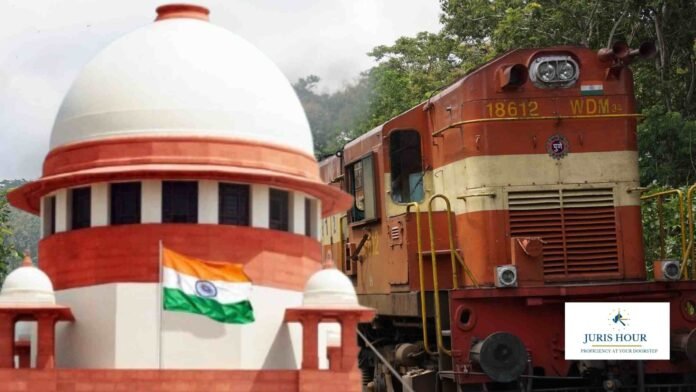
The Supreme Court has held that the Indian Railways cannot be treated as a deemed distribution licensee under the Electricity Act, 2003 merely because it is an entity of the Central Government.
The bench of Justice Dipankar Datta and Justice Satish Chandra Sharma ruled that Railways, while operating its own electricity infrastructure for traction and operational purposes, does not undertake “distribution” or “supply” of electricity to consumers within the meaning of the Electricity Act and is therefore liable to pay Cross-Subsidy Surcharge (CSS) and Additional Surcharge for availing open access power.
The judgment was delivered by the Supreme Court in a batch of appeals filed by the Indian Railways challenging the common judgment dated 12 February 2024 passed by the Appellate Tribunal for Electricity (APTEL). The dispute arose from orders passed by various State Electricity Regulatory Commissions and the Central Electricity Regulatory Commission (CERC) regarding the legal status of Railways under the Electricity Act.
The principal controversy before the Court was whether Indian Railways qualifies as a deemed distribution licensee under the third proviso to Section 14 of the Electricity Act and whether it is exempt from payment of Cross-Subsidy Surcharge while procuring electricity through open access.
The litigation originated after Indian Railways sought connectivity for procurement of 100 MW power through inter-State open access for traction substations. Maharashtra State Electricity Transmission Co. Ltd. refused connectivity and asked Railways to obtain an order regarding its status as a deemed distribution licensee. Railways thereafter approached CERC claiming that it was a deemed distribution licensee by virtue of Section 14 of the Electricity Act and also relied upon Section 11 of the Railways Act, 1989.
Railways argued that Section 11 of the Railways Act empowers it to erect and operate electric traction equipment, power supply systems and distribution installations and therefore it possesses statutory authority to distribute electricity for railway operations. It further contended that being a department of the Central Government, it falls within the definition of “Appropriate Government” under Section 2(5) of the Electricity Act and consequently enjoys the status of a deemed distribution licensee.
CERC had earlier accepted the stand of Railways and held that Railways was entitled to open access as a deemed distribution licensee. However, APTEL reversed that position and held that Railways merely consumes electricity for its own operations and does not supply electricity to consumers.
Upholding the APTEL ruling, the Supreme Court held that a distribution licensee under the Electricity Act must satisfy two essential conditions — it must operate and maintain a distribution system and it must supply electricity to consumers within its area of supply. The Court observed that Railways only uses electricity internally for traction, signalling, locomotives and railway facilities and does not supply electricity to consumers as contemplated under the statutory framework.
The Court categorically held that the “distribution installation” referred to in Section 11 of the Railways Act cannot be equated with a “distribution system” under the Electricity Act. According to the Court, a distribution system under the Electricity Act necessarily culminates at the installation of a consumer and involves supply of electricity to consumers. Railways’ internal network, which only conveys electricity for self-consumption, does not satisfy this requirement.
Rejecting Railways’ reliance on the non-obstante clause under Section 11 of the Railways Act, the Court held that there is no irreconcilable conflict between the Railways Act and the Electricity Act. The Court observed that Section 11 does not exempt Railways from complying with the licensing framework under the Electricity Act.
The Supreme Court further noted that Railways itself had admitted that it does not seek to supply electricity to third parties or engage in the business of distributing electricity beyond railway operations. This, according to the Court, demonstrated that Railways was only attempting to claim the status of a deemed distribution licensee to avoid payment of Cross-Subsidy Surcharge and Additional Surcharge.
On the issue of “Appropriate Government”, the Court held that Indian Railways does function under the control of the Central Government and falls within the ambit of “Appropriate Government” under Section 2(5)(a) of the Electricity Act. However, the Court clarified that such status alone does not automatically confer the benefit of being treated as a deemed distribution licensee.
The Court also distinguished Railways from entities like Military Engineering Services (MES), which are recognised deemed distribution licensees because they actually supply electricity to consumers within defined areas such as cantonments. Railways, on the other hand, only maintains a closed internal network for operational use.
While analysing the concept of Cross-Subsidy Surcharge, the Supreme Court emphasised that the surcharge is intended to compensate distribution licensees when high-value consumers opt for open access power procurement. The Court observed that such charges are essential to maintain financial viability of distribution companies and support subsidised electricity supply to weaker consumer categories.
The Court relied upon its earlier decision in Sesa Sterlite Ltd. v. Orissa Electricity Regulatory Commission and reiterated that even if an entity is treated as a distribution licensee or transmission licensee, it may still be liable to pay Cross-Subsidy Surcharge if the electricity procured through open access is meant for self-consumption.
The Supreme Court upheld the APTEL judgment and ruled against the claim of Indian Railways for exemption from Cross-Subsidy Surcharge and Additional Surcharge under the Electricity Act.
Case Details
Case Title: Indian Railways Versus West Bengal State Electricity Distribution Company Limited & Ors.
Citation: JURISHOUR-1179-SC-2026
Case No.: Civil Appeal No. 4652 Of 2024
Date: 08/05/2026

