
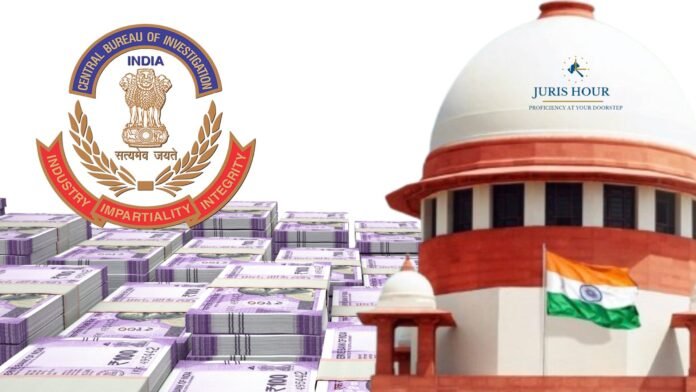
The Supreme Court has quashed criminal proceedings initiated by the Central Bureau of Investigation (CBI) against a borrower after the loan account had already been settled through a compromise approved by the Debts Recovery Tribunal (DRT).
The bench of Justice B.V. Nagarathna and Justice Ujjal Bhuyan has observed that allowing such prosecution to continue after a judicially endorsed settlement would amount to an abuse of the legal process and could adversely affect the sanctity of commercial settlements.
The case arose from credit facilities availed by M/s Mohan Traders from UCO Bank between 2006 and 2009. The bank initially sanctioned cash credit and letter of credit facilities which were subsequently enhanced over time against various mortgaged properties offered as security. Following the death of the original proprietor managing the business, the firm allegedly faced severe financial difficulties, resulting in irregular repayments and eventual classification of the loan account as a Non-Performing Asset (NPA).
Consequently, UCO Bank initiated proceedings under the SARFAESI Act and also filed recovery proceedings before the DRT at Jabalpur. During the pendency of those proceedings, the parties negotiated a One-Time Settlement (OTS). The bank agreed to settle outstanding dues of approximately ₹6.49 crore for a compromise amount of ₹4.25 crore. The settlement proposal was approved by the bank’s competent authority and subsequently placed before the DRT through a joint application filed by both sides.
The DRT recorded the compromise, and after the borrower deposited the entire settlement amount, UCO Bank issued a “No Dues Certificate” on 30 September 2015. Thereafter, the DRT dismissed the bank’s recovery application as withdrawn, recording that the compromise amount had been fully paid and the loan account stood settled.
Despite the settlement and closure of recovery proceedings, UCO Bank lodged a complaint with the CBI in February 2018, more than two years after the compromise had been fully implemented.
The bank alleged that the borrower had fraudulently enhanced credit facilities by submitting forged audit reports and had substituted valuable mortgaged properties with an encroached property, causing substantial financial loss to the bank. Based on the complaint, the CBI registered an FIR under Sections 420 and 471 of the Indian Penal Code relating to cheating and use of forged documents.
Following investigation, the CBI filed a chargesheet against the borrower. Interestingly, although allegations were initially raised against certain bank officials, the investigating agency ultimately did not charge any bank employee and dropped Prevention of Corruption Act allegations, concluding that no proactive role of bank officials in sanctioning or enhancing the credit facilities was established.
The trial court framed charges against the borrower under Sections 420 and 471 IPC, and the Chhattisgarh High Court refused to quash the proceedings. This led to the appeal before the Supreme Court.
The Supreme Court framed the central issue as whether a criminal prosecution under Sections 420 and 471 IPC could continue after settlement of the loan account through an approved compromise that had received the imprimatur of the DRT.
The Court extensively examined earlier precedents including Nikhil Merchant v. CBI, Gian Singh v. State of Punjab, Narinder Singh v. State of Punjab, Parbatbhai Aahir v. State of Gujarat, and K. Bharthi Devi v. State of Telangana. These decisions recognize that criminal proceedings involving disputes with overwhelmingly civil or commercial characteristics may be quashed when parties have reached a full settlement and continuation of prosecution would serve no useful purpose.
The Bench observed that the present dispute arose from banking and commercial transactions and predominantly possessed a civil character. It noted that the settlement had not merely been a private arrangement but had been formally approved by the bank’s highest competent authority and recorded by the DRT in judicial proceedings.
A major factor influencing the Court was the conduct of the bank itself.
The judgment records that the bank had claimed to suspect fraud as early as 2013. However, despite such alleged suspicion, it chose to negotiate and approve the compromise settlement in 2015, accepted the settlement amount, issued a No Dues Certificate, and sought withdrawal of its recovery proceedings before the DRT. Only after obtaining the benefit of the settlement did the bank initiate criminal proceedings through the CBI.
The Court found this conduct inconsistent and lacking in good faith. It noted that the compromise proposal itself contained a specific certification by the bank that there were no documentation lapses or irregularities affecting the security and legal remedies available to the bank. The settlement proposal also certified compliance with RBI compromise guidelines.
According to the Court, after making such representations and obtaining a judicial endorsement of the compromise, it was not proper for the bank to belatedly launch criminal proceedings alleging fraud and forgery.
The Supreme Court concluded that continuation of the criminal prosecution would be oppressive and would amount to abuse of the process of the court. The Bench observed that after a full and final settlement, the possibility of securing a conviction had become “remote and bleak.” Continuing the prosecution would therefore result in grave prejudice and injustice to the borrower.
Importantly, the Court highlighted the broader economic consequences of permitting such prosecutions after settlements. It warned that if banks are allowed to pursue criminal proceedings after accepting and implementing compromise settlements, borrowers and commercial entities may become reluctant to resolve disputes through negotiated settlements. Such uncertainty could undermine confidence in banking settlements and adversely affect the larger commercial ecosystem.
The Court observed that maintaining the sanctity of settlements, particularly those incorporated into judicial proceedings before forums like the DRT, is essential for encouraging resolution of commercial disputes and supporting economic activity.
Allowing the appeal, the Supreme Court set aside the Chhattisgarh High Court’s order dated 5 July 2024. The Court also quashed the CBI chargesheet dated 27 November 2018 and the trial court’s order framing charges under Sections 420 and 471 IPC.
Case Details
Case Title: Vijay Kumar Kela & Anr. Versus CBI
Citation: JURISHOUR-1469-SC-2026
Case No.: SLP (CRIMINAL) NO. 18035 OF 2024
Date: 29/05/2026

