
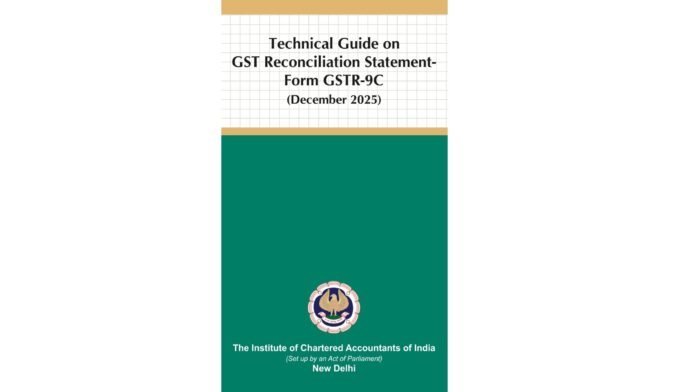
In a move with far-reaching implications for high-turnover businesses, multi-state entities, and tax professionals, the Institute of Chartered Accountants of India (ICAI) has issued a fully revised Technical Guide on GST Reconciliation Statement (Form GSTR-9C). The publication reflects structural changes introduced under India’s GST 2.0 architecture and tightens compliance for entities exceeding ₹5-crore aggregate turnover.
President CA. Charanjot Singh Nanda emphasized that the revised guide aims not merely to educate taxpayers but to shape a more transparent compliance ecosystem backed by technology-based checks.
Key Regulatory Shifts Introduced
1. Transition From Chartered Audit to Self-Certification
GST Audit requirement eliminated from 01.08.2021; self-certified GSTR-9C continues for FY 2020-21 onwards. ICAI notes the shift places greater accuracy burden on taxpayers, eliminating external auditor safety nets. Errors now directly attract scrutiny via data trails, analytics flags, and portal-linked tax intelligence.
2. Aggregate Turnover Clarification: No GSTIN-wise Escape Routes
Threshold of ₹5 crore is PAN-based, not state-wise. Even if one State shows minimal sales, all GSTINs must file GSTR-9C once PAN turnover crosses the limit. Taxpayers often miscompute by excluding exempt supplies; the guide unequivocally confirms interest, exempt goods, and nil-rated supplies count towards turnover.
3. Tougher Stance on Non-Filers
Non-filing is not merely delay, but a breach triggering best-judgment assessment under Section 62.
Guide distinguishes:
- Non-filers: Registered, but fail to file returns → liable for GSTR-9C.
- Unregistered liable persons: Must pay tax, but exempt from GSTR-9C.
ICAI warns that persistent non-filing will now activate special audit and departmental scrutiny.
4. Multi-Locational Entities Face Enhanced Disclosure
Every GSTIN qualifies as a distinct person, mandating separate reconciliation, valuation, ITC allocation trails and inter-unit supply reporting. Transfer pricing, HR cost allocation, central IT cost, and cross-utilised service reporting are now explicit audit flags.
High-risk red zones identified:
| Risk Area | Compliance Trigger |
| Centralised IT / HR cost billed nowhere | Mandatory valuation under Rule 28 |
| Service cross-charge without invoice | Treated as supply under Schedule I |
| HO salary cost excluded in valuation | Allowed only where ITC is fully available |
5. Gaps in ERP & GST Data Integrity Officially Recognised
The guide acknowledges repeated mismatches due to internal architecture failures — a rare institutional admission.
Examples flagged include:
- ERP character limits preventing GSTR-2A vs 3B alignment
- HO-based input invoices claimed in wrong State
- Invisible cross-utilisation of services when multiple GSTIN trial balances are not segregated
TECHNICAL GUIDE
This signals coming enforcement: systemic accounting behaviour will now be treated at par with tax non-compliance.
6. New Late Fee Interpretation: GSTR-9 & 9C Treated as One Composite Filing
- Late fee not leviable separately; counted until both 9 and 9C are furnished.
TECHNICAL GUIDE - Table 17 newly inserted to capture late fee payment disclosures.
This correction ends ambiguity exploited for staggered filings to avoid fee multiplication.
7. Expanded Definitions: Unbilled Revenue, Inter-Branch Supply, Zero-Value Internally Generated Services
- Unbilled revenue recognition aligned with IND-AS 115 to plug timing arbitrage.
TECHNICAL GUIDE - HR/IT services routed from HO → other States = “supply,” even when not invoiced.
- However, value deemed NIL if full ITC available at recipient — a nuanced compliance relaxation.
TECHNICAL GUIDE
Professional Community Impact
The GST & Indirect Taxes Committee under CA Rajendra Kumar P and CA Umesh Sharma notes that compliance models must now include:
- continuous reconciliation
- inter-unit stock & service trails
- valuation logic documentation
- ISD vs cross-charge method justification files
- live audit documentation for data-based enforcement
ICAI signalled that reconciliation is now as much a data process audit as a tax reporting one.
Conclusion
The revised guide positions GSTR-9C not as a year-end statement but as a surveillance-grade audit matrix that integrates accounting policy, valuation methodology, ERP integrity and State-wise tax trails.
With GST 2.0 pushing automation over manual scrutiny, compliance will now hinge on system architecture discipline rather than post-tax advisory repair.

