
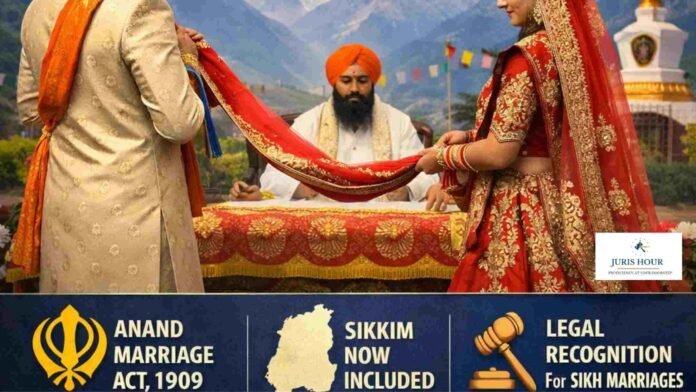
The Ministry of Home Affairs has formally extended the Anand Marriage Act, 1909 to the State of Sikkim, enabling statutory recognition of Anand Karaj marriages performed according to Sikh religious rites within the State.
The notification has been issued in exercise of powers conferred upon the President under Article 371F(n) of the Constitution of India, which allows for special legislative adaptations for the State of Sikkim. President Droupadi Murmu signed the notification on January 31, 2026, extending the applicability of the 1909 Act with specific modifications tailored to the State’s legal and administrative framework
According to the notification, any reference in the Anand Marriage Act to a law not in force or to an authority not in existence in Sikkim shall be construed as a reference to the corresponding law or functionary operating within the State. In situations where ambiguity arises regarding the equivalent authority, the Central Government will have the final authority to determine the appropriate corresponding functionary, and such determination will be binding.
This adaptation ensures smooth administrative implementation of the Act in Sikkim without requiring immediate structural changes to existing governance mechanisms.
Commencement to Be Notified Separately
While the Act has been extended to Sikkim, the notification clarifies that the actual commencement date of the Act in the State will be notified separately by the Central Government through a subsequent Gazette notification. The Centre may also appoint different commencement dates for different provisions of the Act or for different areas within Sikkim, allowing phased implementation if required.
What is the Anand Marriage Act, 1909?
The Anand Marriage Act, 1909 is a central legislation enacted during the British era to provide legal recognition to marriages solemnised according to Sikh religious rites, known as the Anand Karaj ceremony. Prior to the enactment of this law, Sikh marriages were often registered under general civil or Hindu marriage laws, which did not fully reflect Sikh religious customs.
The Act was introduced following sustained demands from the Sikh community to secure independent statutory recognition for their distinct form of marriage, performed in the presence of the Guru Granth Sahib and solemnised through the recitation of the four Laavaan.
Under the Anand Marriage Act, a marriage is considered valid if it is solemnised according to Sikh religious ceremonies, irrespective of whether the parties are registered under any other personal law. The Act originally consisted of limited provisions and primarily served the purpose of validating the religious ceremony itself rather than laying down a comprehensive matrimonial code.
Key aspects include:
- Legal recognition of marriages performed through Anand Karaj
- Applicability exclusively to Sikhs
- Validation of marriage based on religious rites rather than civil formalities
Registration and Legal Evolution
While the original 1909 Act did not mandate compulsory registration, subsequent legal developments and State-level amendments have strengthened its implementation. In several States, rules have been framed allowing for registration of Anand marriages, enabling couples to obtain official marriage certificates without registering under the Hindu Marriage Act or Special Marriage Act.
In 2012, Parliament amended the Act to facilitate the registration of Anand marriages, reinforcing the legal identity of Sikh marriages across India. This amendment addressed long-standing concerns that Sikh couples were being compelled to register marriages under laws not reflective of their religious identity.
Legal Significance Today
The Anand Marriage Act holds substantial importance in matters relating to:
- Proof of marriage
- Succession and inheritance
- Immigration and visa documentation
- Matrimonial disputes and family law proceedings
By extending the Act to Sikkim, the Central Government has ensured that Sikh couples in the State can now rely on a faith-specific legal framework for marriage recognition, aligning Sikkim’s personal law landscape with national standards.
Read More: Child’s Welfare Can’ Be Decided by Ignoring Broken Promises and Court Orders: Supreme Court

