
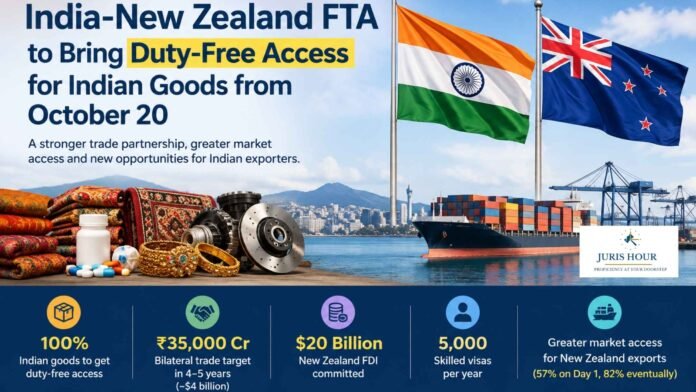
The India-New Zealand Free Trade Agreement (FTA) is set to come into force on October 20, opening the New Zealand market to duty-free exports covering 100 per cent of Indian goods. The agreement is expected to provide a significant boost to Indian exporters across labour-intensive and manufacturing sectors.
Under the pact, Indian products including textiles, carpets, chemicals, gems and jewellery, pharmaceuticals, automobiles, auto components and machinery will receive duty-free access to the New Zealand market. The removal of tariffs is expected to improve the competitiveness of Indian exporters, particularly for products that previously faced duties of up to 10 per cent.
Bilateral Trade Targeted to Double
Union Commerce Minister Piyush Goyal said the agreement has the potential to help double bilateral trade in goods and services to around ₹35,000 crore, or approximately $4 billion, over the next four to five years.
The government expects the agreement to create greater opportunities for Indian businesses by reducing tariff barriers and expanding access to New Zealand consumers. The pact is also being viewed as an avenue for deeper economic engagement between the two countries.
New Zealand has also committed to $20 billion in foreign direct investment in India under the agreement. According to Goyal, the investment commitment could provide Indian manufacturing industries with additional capital and technology while encouraging New Zealand companies to establish or expand their presence in India.
New Zealand to Eliminate Tariffs on Major Imports from India
The agreement provides for substantial tariff liberalisation by New Zealand. On the first day of implementation, 57 per cent of New Zealand’s exports to India will become completely tariff-free, covering products such as sheep meat, wool, wood products and coal.
The proportion of New Zealand exports receiving tariff-free access is eventually expected to rise to 82 per cent. Overall, up to 95 per cent of New Zealand exports to India, including products such as apples, kiwis, wool and sheep meat, will receive greater market access under the agreement.
India Retains Protection for Sensitive Agricultural Sectors
While India has provided extensive market access for New Zealand goods, the FTA retains protection for several sensitive domestic sectors.
In particular, dairy products have been kept outside India’s market-access concessions. India has also maintained reservations covering a number of agricultural commodities, including onions, chickpeas, peas, maize, almonds, artificial honey and sugar.
The safeguards are intended to preserve protection for sectors identified as sensitive during the trade negotiations.
Services Sector Gets Access to 118 Sectors
The agreement extends beyond merchandise trade and provides expanded opportunities for India’s services industry.
According to the government statement cited in the report, Indian service providers will gain access to around 118 sectors in New Zealand, including information technology, professional services, construction, tourism and audio-visual services.
The pact also contains provisions relating to the movement of skilled professionals and workers. It provides for 5,000 skilled-worker visas and 1,000 working-holiday visas every year.
Indian students are also set to benefit from post-study work rights of up to four years, potentially creating additional mobility opportunities for those pursuing education and subsequent employment in New Zealand.
FTA Comes Amid Global Trade Uncertainty
The agreement assumes significance against the backdrop of heightened geopolitical uncertainty and changing global tariff policies. The pact was signed on April 27 and is now moving towards implementation.
The agreement is expected to help India diversify its trade partnerships and expand market access for domestic exporters, particularly in the wider Indo-Pacific region.
The report notes that the agreement comes at a time when businesses are dealing with greater uncertainty in international trade, making diversification of export destinations increasingly important for Indian industry.
Engineering Exports Expected to Receive Fresh Impetus
The engineering sector is among those expected to benefit from the expanded market access.
Pankaj Chadha, Chairman of EEPC India, said the implementation of the agreement could enable India to target a doubling of engineering exports to New Zealand over the next five years, reaching approximately $280–300 million.
The Federation of Indian Export Organisations also viewed the agreement as providing fresh momentum to Indian exports by widening market access and supporting greater strategic diversification across the Indo-Pacific market.
Key Features of India-New Zealand FTA
| Area | Key Provision |
| Implementation | October 20 |
| Indian goods | 100% of Indian goods to receive duty-free access to New Zealand |
| Bilateral trade target | ₹35,000 crore (about $4 billion) in 4–5 years |
| New Zealand FDI commitment | $20 billion |
| New Zealand exports tariff-free on Day 1 | 57% |
| New Zealand exports eventually tariff-free | 82% |
| New Zealand exports receiving greater market access | Up to 95% |
| Indian services access | Around 118 sectors |
| Skilled-worker visas | 5,000 annually |
| Working-holiday visas | 1,000 annually |
| Post-study work rights | Up to four years |
| Sensitive Indian sectors protected | Dairy and specified agricultural commodities |
The India-New Zealand FTA therefore establishes a broader framework for merchandise trade, services, investment and professional mobility. With implementation scheduled for October 20, Indian exporters across manufacturing, engineering, textiles, pharmaceuticals and other sectors are set to gain expanded access to the New Zealand market, while India has retained safeguards for several sensitive domestic sectors.
Read More: GSTN Introduces emSigner Version 3.3 for New DSC Tokens Issued From September 21

