
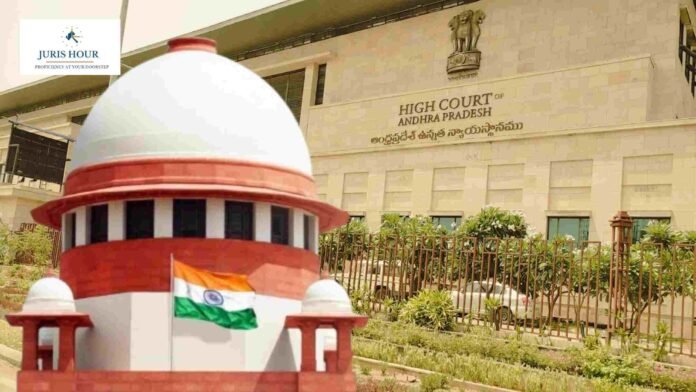
The Supreme Court has dismissed the Special Leave Petition (SLP) filed by the Andhra Pradesh government against a High Court judgment that held the State liable to compensate a bullion trader after seized silver was stolen from police custody. The apex court declined to interfere with the High Court’s findings, thereby allowing the ruling directing payment of compensation or return of silver to attain finality.
A Bench of Justices Pamidighantam Sri Narasimha and Alok Aradhe, while hearing the SLP filed by the State of Andhra Pradesh and others, observed that it was “not inclined to interfere with the impugned judgment and order passed by the High Court” and accordingly dismissed the petition along with connected interlocutory applications.
The case arose from a writ petition filed by a Salem-based bullion trader, engaged in the business of gold and silver bullion and registered under the CGST and SGST Acts, 2017 in Tamil Nadu. On 27 January 2021, a consignment of 105 kilograms of pure silver lumps was being transported from Hyderabad to Salem when it was intercepted and seized by police officials at Kurnool. Along with the silver, cash amounting to ₹2.05 lakh was also seized.
Subsequently, the silver and cash were subjected to confiscation proceedings under the GST law. The authorities offered the trader an option to redeem the goods on payment of fine in lieu of confiscation, calculated at a rate of ₹66,667 per kilogram of silver. Owing to the non-constitution of the GST Appellate Tribunal, the trader’s appellate remedies became ineffective. Consequently, in March 2023, the trader paid a total sum of ₹39.20 lakh towards tax, penalty and fine.
Following this payment, the GST authorities issued a release order directing the return of the entire seized silver and cash.
When the trader approached the police authorities for release of the goods, he was informed that the seized silver and cash had been stolen from the police station itself. The theft, it later emerged, was committed by police personnel.
Although certain quantities of silver and cash were subsequently recovered from the accused officers and produced before the jurisdictional Judicial Magistrate, only 81.567 kilograms of silver and ₹10 lakh in cash were ultimately returned to the trader.
The trader alleged a substantial shortfall in the quantity of silver returned. He further claimed that a significant portion of the silver that was handed back was impure, containing only around 60 per cent silver content.
After issuing repeated legal notices seeking compensation for the loss and receiving no response from the authorities, the trader approached the Andhra Pradesh High Court under Article 226 of the Constitution.
The principal question before the High Court was whether the State could avoid liability for the loss of seized goods by invoking the doctrine of sovereign immunity, or whether such loss—caused by negligence and criminal acts of State officials—would attract public law compensation under the doctrine of constitutional tort.
The State relied on the landmark judgment in Kasturi Lal v. State of Uttar Pradesh, which had recognized immunity for certain acts performed in the exercise of sovereign functions.
A Division Bench of Justices R. Raghunandan Rao and T.C.D. Sekhar rejected the State’s defence and held that sovereign immunity cannot be used as a shield when State negligence results in deprivation of constitutional rights.
The Court relied on a consistent line of Supreme Court precedents, including N. Nagendra Rao v. State of A.P., Nilabati Behera v. State of Odisha, and the Constitution Bench judgment in Kaushal Kishor v. State of Uttar Pradesh, to reiterate that the State can be held liable in public law for damages arising from violation of fundamental rights.
The Bench held that loss of property due to negligence of State authorities can amount to a constitutional tort, as it directly impacts the fundamental right to carry on trade and business under Article 19(1)(g) of the Constitution.
The Court observed that the theft of seized silver from within a police station demonstrated a “sheer failure of the State machinery” to safeguard property entrusted to it under law.
While the High Court declined to conclusively rule on the allegation regarding impurity of the silver returned, citing lack of sufficient material, it accepted the existence of a quantitative shortfall.
It held that the trader was entitled to 23.44 kilograms of pure silver, being the difference between the quantity seized and the quantity actually returned.
The Court directed the current market value of silver shall be taken for valuing the shortfall quantity. The excess cash of ₹7.95 lakh (₹10 lakh returned against ₹2.05 lakh seized) shall be adjusted against the value of silver payable. The remaining balance shall be paid either in the form of pure silver or cash equivalent. If the silver or payment is not made within three weeks, valuation shall be based on the market price prevailing on the date of actual return or payment.
Supreme Court’s Endorsement
With the Supreme Court dismissing the State’s SLP, the Andhra Pradesh High Court’s ruling has now attained finality.
Case Details
Case Title: THE STATE OF ANDHRA PRADESH & ORS. Versus M/S G.R.M. JEWELLERS & ANR
Case No.: Special Leave to Appeal (C) No(s). 4047/2026
Date: 10-02-2026
Read More: Raghav Chadha Pushes for Blockchain-Based Land Records

