
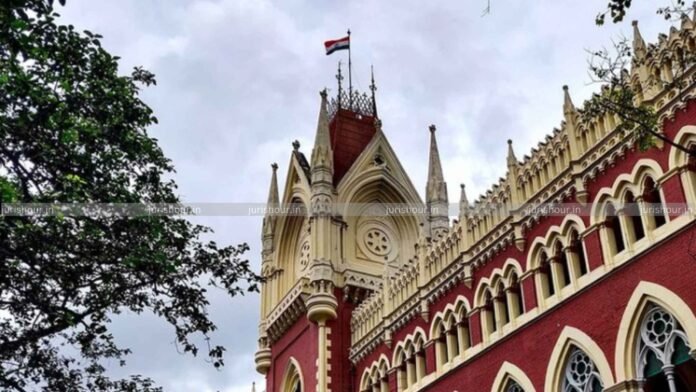
The Calcutta High Court has upheld an order directing the Central Goods and Services Tax authorities to pay compensatory interest at 9% per annum on a service tax refund of approximately Rs. 2.20 crore, holding that the interest must be calculated from three months after the original refund applications were filed in 2012.
The Division Bench of Justice Rajarshi Bharadwaj and Justice Uday Kumar dismissed the appeal filed by the Commissioner of CGST and Central Excise, Kolkata South Commissionerate and observed that an appeal under Section 35G of the Central Excise Act, 1944, was not maintainable against a procedural direction issued by the Customs, Excise and Service Tax Appellate Tribunal under Rule 41 of the CESTAT (Procedure) Rules, 1982.
Electrosteel Castings entered into an agreement on October 3, 2006, to undertake a drinking water supply and distribution project for the Kerala Water Authority. The work included the construction and maintenance of water supply and wastewater schemes.
Read More: Service Tax E-Magazine – August 2026
The company initially treated the activities as taxable under the category of “commercial or industrial construction service” and paid service tax during the relevant period.
However, on October 31, 2011, Tokyo Engineering Consultants Limited informed the company that the activity of laying water pipelines for the project did not fall within the taxable construction service category.
Electrosteel consequently filed two refund applications under Section 11B of the Central Excise Act. The first application, seeking Rs. 15.23 lakh, was filed on January 5, 2012. The second application, for approximately Rs. 2.05 crore, was filed on March 20, 2012.
The second claim was returned by the department on March 26, 2012, on the ground that it was barred by limitation. The first refund application was rejected on October 18, 2012, following the issuance of a show-cause notice.
The Commissioner (Appeals) subsequently rejected the company’s appeals on December 30, 2013.
Electrosteel challenged the rejection orders before CESTAT. By an order dated August 9, 2024, the Tribunal set aside the departmental orders and directed the authorities to sanction the refunds within one month.
The Revenue challenged the Tribunal’s decision before the Calcutta High Court. Those appeals were dismissed on January 3, 2025.
Meanwhile, Electrosteel submitted a request on September 12, 2024, seeking implementation of the Tribunal’s refund order. The department issued a deficiency memorandum on October 7, 2024, following which the company furnished additional documents on October 24, 2024.
On January 6, 2025, the Assistant Commissioner sanctioned the principal refund. However, no interest was granted for the delay in making the refund.
Electrosteel filed an appeal before the Commissioner (Appeals) against the denial of interest. It also moved a miscellaneous application before CESTAT under Rule 41, seeking directions for payment of interest.
On July 4, 2025, CESTAT directed the refund-sanctioning authority to pay interest at 9% per annum. The Tribunal ordered that the interest be calculated from three months after the original refund applications were filed in January and March 2012.
The company subsequently withdrew the protective appeal pending before the Commissioner (Appeals).
The Revenue argued before the High Court that CESTAT had no jurisdiction to award interest through a miscellaneous application filed under Rule 41.
According to the department, the Assistant Commissioner’s order sanctioning the refund without interest was independently appealable under Section 85 of the Finance Act, 1994. The assessee could not bypass that statutory appellate remedy and directly approach the Tribunal through a miscellaneous application.
The department further argued that CESTAT had not awarded interest in its original order dated August 9, 2024. Therefore, the Tribunal had become functus officio and could not subsequently modify its final order by granting substantive relief in the form of interest.
It was also contended that the refund was sanctioned within three months of October 24, 2024, when Electrosteel submitted the documents sought under the deficiency memorandum. On that basis, the department claimed that no interest was payable under Section 11BB.
The Revenue alternatively submitted that even if interest was payable, it could only be granted at the notified statutory rate of 6%, and not at 9% as directed by the Tribunal.
The High Court rejected the Revenue’s objections and held that its appeal was ex facie non-maintainable.
The Court explained that an appeal under Section 35G is maintainable only against an order passed “in appeal” by CESTAT under Section 35C, arising from an appeal instituted under Section 35B.
An order issued under Rule 41, on the other hand, is a procedural or implementation direction intended to give effect to an earlier final order, prevent abuse of the Tribunal’s process or secure the ends of justice.
Relying on the decisions in Commissioner of Customs, Bangalore v. Toyota Kirloskar Auto Parts Pvt. Ltd. and Commissioner of Customs (Import), Mumbai v. Pride Foramer, the Court held that directions issued under Rule 41 are not orders passed “in appeal”. Such directions, therefore, cannot be challenged before the High Court under Section 35G.
The Tribunal had merely exercised its inherent authority to ensure effective implementation of its earlier refund order, the High Court observed.
Examining the matter on merits, the High Court noted that Electrosteel had executed a turnkey drinking water supply and distribution project for the Kerala Water Authority, a statutory government body under the Public Health Engineering Department.
Referring to the decision in Nagarjuna Construction Co. Ltd. v. CCE, Hyderabad, the Court observed that laying pipelines for potable water supply projects undertaken for state agencies does not amount to taxable commercial or industrial construction service.
The project was a public welfare initiative and did not attract service tax. Consequently, the amount deposited by Electrosteel was paid under a mistake of law.
The Court held that an amount collected without the authority of law cannot acquire the character of a tax or duty in view of Article 265 of the Constitution. Refunds of amounts deposited under a mistake of law would, therefore, not be restricted by the ordinary procedural and limitation conditions governing statutory tax refunds.
Interest Runs from Original 2012 Applications
The High Court rejected the department’s argument that the interest period should be calculated from October 24, 2024, when the additional documents were submitted.
Relying on the Supreme Court’s decision in Ranbaxy Laboratories Ltd. v. Union of India, the Court held that the liability to pay interest under Section 11BB arises automatically after the expiry of three months from the date on which the original refund application is received.
The date of an appellate order subsequently recognising the refund entitlement does not postpone the commencement of interest.
In the present case, the original refund applications were filed on January 5, 2012, and March 20, 2012. The company’s communication dated September 12, 2024, was merely a representation seeking implementation of the Tribunal’s order and could not be treated as a fresh refund application.
The Court noted that the department’s own refund-sanctioning order referred to the original applications filed in 2012. Therefore, the three-month interest-free period had expired in 2012 itself.
Membership Required to Access Case Details & Order Copy
To view the complete Case Details and Download Order Copy, you must have an active membership. Please subscribe to continue.
Read More: 57th GST Council Meeting Full Details From Timings To Official Meeting Date

