
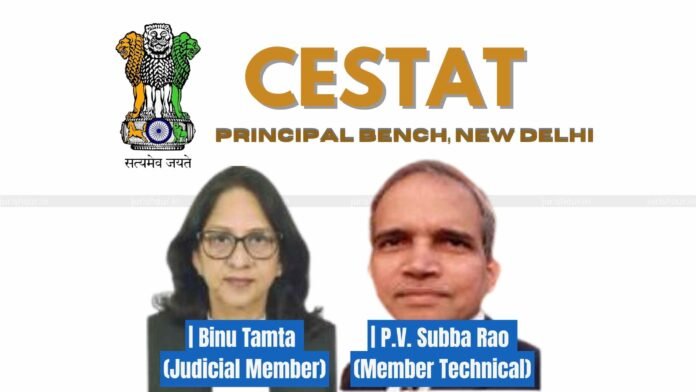
The Customs, Excise and Service Tax Appellate Tribunal (CESTAT), New Delhi, has held that CENVAT credit cannot be denied merely because the assessee availed the credit on the basis of running account bills instead of conventional invoices, so long as the documents substantially satisfy the requirements prescribed under Rule 9 of the CENVAT Credit Rules, 2004 read with Rule 4A of the Service Tax Rules, 1994.
Setting aside the orders passed by the lower authorities, the bench of Binu Tamta (Judicial Member) and P. V. Subba Rao (Technical Member) ruled that hyper-technical objections regarding the nomenclature or form of documents cannot defeat a substantive claim for credit when the receipt of taxable services and payment of service tax are undisputed.
The dispute arose after the Service Tax Department conducted an audit of the assessee, which was engaged in providing and receiving various taxable services, including construction services, transport of goods by road, renting of immovable property, construction of residential complexes, and legal consultancy services.
Buy Now: Customs Duty Judgements E-Compilation – June 2026
During the audit, the Department alleged that the Housing Board had wrongly availed CENVAT credit without possessing the prescribed documents under Rule 9(1) of the CENVAT Credit Rules, 2004.
Two show cause notices dated July 18, 2019 and August 4, 2019 were issued covering the periods from October 1, 2013 to March 31, 2014 and April 1, 2014 to June 30, 2017. The Department sought recovery of CENVAT credit amounting to ₹55.57 lakh and ₹55.93 lakh respectively, along with interest and penalties.
According to the department, the appellant had availed credit on the basis of running account bills prepared during execution of works, which allegedly did not qualify as valid documents for availing credit under the statutory provisions. The adjudicating authority confirmed the demands, and the Commissioner (Appeals) upheld the order, prompting the Housing Board to approach the Tribunal.
The appellant contended that the Department had proceeded on an incorrect factual assumption that the running account bills were prepared by its engineers. It argued that the bills were actually prepared by the contractors and merely verified by the Housing Board’s designated officials with reference to measurement books.
It further submitted that the relevant contractor bills contained all particulars required under Rule 4A of the Service Tax Rules and Rule 9 of the CENVAT Credit Rules. The appellant also emphasized that wherever it was liable to discharge service tax under the reverse charge mechanism, it had duly paid the tax and availed credit only after such payment. Therefore, the denial of the entire credit merely because of the description or format of the documents was legally unsustainable.
The department argued that Rule 9 of the CENVAT Credit Rules specifically enumerates the documents on the strength of which credit can be taken.
According to the Department, the running account bills and measurement books relied upon by the appellant were not among the prescribed documents and also failed to contain the mandatory particulars required under Rule 4A of the Service Tax Rules. Consequently, the Department maintained that the appellant was not entitled to claim CENVAT credit on the basis of such records.
The Bench examined Rule 4A of the Service Tax Rules and Rule 9 of the CENVAT Credit Rules in detail.
The Tribunal observed that the statutory requirement is essentially to establish the identity of the service provider and recipient, the description and value of the taxable service, and the amount of service tax paid. The emphasis under Rule 9(2) is on the availability of substantial particulars rather than on the nomenclature or form of the document itself.
Relying upon its earlier decision in Resident Engineer, Rajasthan Housing Board v. Commissioner of Central GST Commissionerate-Udaipur, the Tribunal reiterated that running account bills read together with payment orders can be treated on par with invoices where they contain the essential statutory particulars. It further noted that the CENVAT Credit Scheme was introduced to eliminate the cascading effect of taxes and should not be frustrated by hyper-technical objections when there is no dispute regarding receipt of input services or payment of service tax.
The Tribunal also referred to earlier precedents recognizing CENVAT credit on documents such as cash memos and debit note-cum-bills, observing that the law provides flexibility regarding the nomenclature of documents used in commercial practice. It emphasized that business records maintained in the ordinary course are acceptable, provided they establish the relevant statutory particulars necessary for availing credit.
Applying these principles, the Tribunal found that the Housing Board had received construction-related input services and had either paid service tax to the service providers or discharged its liability under the reverse charge mechanism wherever applicable. The service tax payment challans constituted valid documents for availing credit under reverse charge, and the credit had been duly reflected in the books of account and ST-3 returns.
The Bench concluded that the documents relied upon by the appellant satisfied the requirements of Rule 4A of the Service Tax Rules read with Rule 9 of the CENVAT Credit Rules. Accordingly, the denial of CENVAT credit solely on the ground that the documents were running account bills was unsustainable. Since the appeals succeeded on merits, the Tribunal found it unnecessary to examine the issues relating to the extended period of limitation and penalties.
The CESTAT set aside the impugned orders passed by the Commissioner (Appeals) and allowed both appeals, holding that the appellant was entitled to the disputed CENVAT credit.
Membership Required to Access Case Details & Order Copy
To view the complete Case Details and Download Order Copy, you must have an active membership. Please subscribe to continue.

