
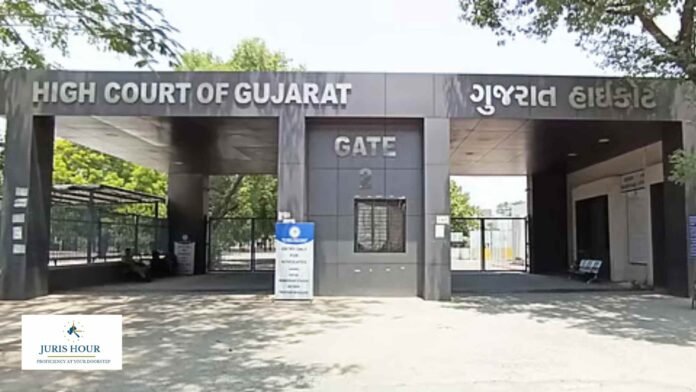
The Gujarat High Court has upheld the validity of Rule 12(4) of the Health Security Se National Security Cess Rules, 2026, ruling that manufacturers installing additional packing machines during a month are liable to pay cess based on the maximum number of machines installed on any day during that month.
The bench ofJustice A.S. Supehia and Justice Vaibhavi D. Nanavati rejected a constitutional challenge mounted by a pan masala manufacturer, holding that the impugned rule neither exceeds the parent statute nor violates Articles 14 and 19(1)(g) of the Constitution.
The petition was filed by manufacturers of pan masala (without tobacco), challenging Rule 12(4) of the Health Security Se National Security Cess Rules, 2026. The petitioners contended that the rule was inconsistent with Sections 4, 5 and 35, read with Schedule II of the Health Security Se National Security Cess Act, 2025, and sought the quashing of an order dated April 22, 2026, rejecting their claim for abatement of cess.
Buy Now: Service Tax Judgement E-Compilation : June 2026
The dispute arose after the petitioners installed three additional Form Fill and Seal (FFS) packing machines between March 18 and March 20, 2026. Although the machines became fully operational only on March 20, 2026, the department computed cess for the entire month of March by applying Rule 12(4), which requires calculation based on the highest number of machines installed on any day during the month.
The petitioners had deposited ₹7.68 crore towards cess for the three new machines but argued that only ₹2.97 crore was payable on a proportionate basis for the period from March 20 to March 31. Accordingly, they sought abatement and refund of ₹4.70 crore, asserting that cess could not be levied for the period when the machines had not yet been installed.
The petitioners argued that the charging provision under Section 4 levies cess only on machines actually installed for manufacturing specified goods. Since the three machines did not exist in the factory before March 20, they contended that no cess could legally be imposed for the earlier part of the month.
They further submitted that Section 5, which prescribes the manner of computation of cess, is based on factors such as machine speed, production capacity and weight of goods packed, all of which necessarily presuppose the existence of an installed and operational machine. According to them, Rule 12(4) impermissibly extended the levy to machines that were not even installed, thereby creating a tax liability beyond the parent statute.
The petitioners also relied upon Section 5(7), which provides proportionate abatement where a machine remains inoperative for fifteen days or more. They argued that since the newly installed machines were admittedly non-operational until March 20, they were entitled to proportionate abatement for the first nineteen days of the month. Additionally, they contended that Rule 12(4) discriminated between newly registered manufacturers—who receive pro-rata treatment in the first month—and existing manufacturers installing new machines, thereby offending Article 14 of the Constitution.
The Union of India opposed the petition, maintaining that Rule 12(4) had been framed to give effect to the legislative scheme of taxing production capacity rather than merely counting machines.
The Revenue argued that the abatement provision under Section 5(7) and Rule 15 applies only where an already installed and operational machine subsequently becomes inoperative for at least fifteen continuous days. Since the petitioners’ machines were newly installed and immediately put into operation upon installation, they could not be treated as “inoperative” within the meaning of the statute.
The Bench undertook an extensive examination of the statutory framework governing the levy and computation of cess.
The Court observed that Sections 4 and 5 of the Cess Act, together with Schedule II and Rule 12, form an integrated statutory scheme. While the levy is imposed on installed machines, the computation of cess is fundamentally linked to production capacity, measured through the maximum rated speed of machines and the weight of goods packed.
According to the Bench, Rule 12(4) cannot be read in isolation. It merely prescribes the method for calculating monthly cess by treating the number of machines installed during the month as the maximum number installed on any day of that month. This computational mechanism, the Court held, is entirely consistent with the legislative design reflected in Section 5 and Schedule II.
Rejecting the petitioners’ principal contention, the Court held that Rule 12(4) does not impose a new tax liability but only lays down the methodology for computing monthly cess.
The Bench emphasized that cess is not determined solely by the date on which a machine is installed but by the overall production capacity represented by all operational machines during the month. Accepting the petitioners’ interpretation would allow machines installed towards the end of a month—and actually used for manufacturing—to escape the statutory computation altogether, defeating the scheme of the legislation.
The High Court also rejected the petitioners’ reliance on the abatement provision.
It held that the expression “inoperative” in Section 5(7) applies only to machines that become non-operational after installation and remain so for at least fifteen consecutive days. A machine that was not yet installed cannot, by legal fiction, be regarded as an “inoperative” machine for claiming abatement.
Since the petitioners themselves admitted that the three machines became fully operational immediately after installation on March 20, the statutory conditions for abatement were not satisfied.
Referring to the Supreme Court’s decision in State of Tamil Nadu v. P. Krishnamurthy on the principles governing judicial review of subordinate legislation, the High Court reiterated that delegated legislation enjoys a presumption of validity and can be struck down only on well-established grounds such as inconsistency with the parent statute, constitutional violation or manifest arbitrariness.
Applying those principles, the Bench found that Rule 12(4) neither exceeded the rule-making power nor conflicted with the Cess Act. It concluded that the petitioners had misconstrued the statutory framework and failed to establish any constitutional infirmity in the impugned provision.
The Gujarat High Court dismissed the writ petition, holding that Rule 12(4) of the Health Security Se National Security Cess Rules, 2026 is constitutionally valid and is not ultra vires Sections 4, 5 or 35 of the Cess Act, Schedule II, or Articles 14 and 19(1)(g) of the Constitution.
The Court also observed that, insofar as the challenge to the adjudication order dated April 22, 2026 was concerned, the petitioners had an effective statutory appellate remedy under Rule 29 of the Rules. Accordingly, the writ petition stood dismissed.
Membership Required to Access Case Details & Order Copy
To view the complete Case Details and Download Order Copy, you must have an active membership. Please subscribe to continue.

