
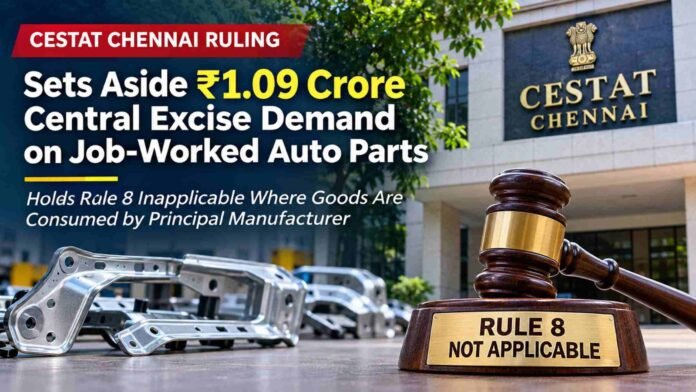
The Customs, Excise and Service Tax Appellate Tribunal (CESTAT), Chennai Bench has held that Rule 8 of the Central Excise Valuation Rules, 2000 cannot be invoked to value goods manufactured by a job worker using customer-supplied materials where the goods are consumed by the principal manufacturer and not by the job worker or on its behalf.
The Bench of Ajayan T.V. (Judicial Member) and Vasa Seshagiri Rao (Technical Member) has set aside Central Excise duty demands aggregating to ₹1,09,79,946 along with interest and penalties of ₹21,99,000, holding that the Department wrongly invoked Rule 8 of the Central Excise Valuation (Determination of Price of Excisable Goods) Rules, 2000 for valuing automobile parts manufactured on job-work basis.
Buy Now: Indirect Tax Judgments E-Compilation – October 2026
The bench observed that Rule 8 requires fulfilment of two conditions: the goods must not be sold by the assessee and must be used for consumption by the assessee or on its behalf in the manufacture of other articles. Since the automobile parts were consumed by the principal manufacturer in its own factory, the second condition was not satisfied.
The appellant was engaged in manufacturing motor vehicle parts falling under Heading 8708 of the First Schedule to the Central Excise Tariff Act, 1985, at its manufacturing facility in Irungattukottai, Sriperumbudur.
Apart from manufacturing its own goods, the appellant also manufactured certain automobile components using steel sheets, tools and dies supplied by Hyundai Motor India Ltd. (HMIL) on a stock-transfer basis.
The steel sheets were subjected to shearing and stamping processes, while additional materials such as rubber and plastic parts, nuts, springs and bushes were procured by the appellant and used in welding and assembly operations.
The finished components were subsequently cleared to HMIL, which used them in the manufacture of motor vehicles. The appellant discharged Central Excise duty on a value comprising the cost of materials, job charges and die amortisation charges.
Pursuant to an audit objection, the Department took the view that the clearances made to HMIL did not constitute sales since ownership of the goods continued to remain with HMIL.
Accordingly, the Department proposed that the assessable value should be determined under Section 4(1)(b) of the Central Excise Act, 1944, read with Rule 8 of the Central Excise Valuation Rules, 2000, by adopting 115% of the cost of production up to September 2003 and 110% thereafter.
Five show cause notices were issued covering the period from February 2003 to December 2006, raising an aggregate duty demand of ₹1,09,79,946.
The Department also proposed interest under Section 11AB of the Central Excise Act and penalties under Rule 25 of the Central Excise Rules, 2002.
The show cause notices, which had remained in the call book, were taken up for adjudication only in 2017.
The appellant contended that Rule 8 applies only where goods are not sold by the assessee but are consumed by the assessee itself or on its behalf in the manufacture of other articles.
In the present case, the automobile components were manufactured on job-work basis and subsequently consumed by HMIL in its own manufacturing operations. HMIL was neither a related person nor was it consuming the goods on behalf of the appellant.
The appellant also relied upon CBEC Circular No. 619/10/2002-CX dated February 19, 2002, and Circular No. 643/34/2002-CX dated July 1, 2002, to contend that goods manufactured on job-work basis were required to be valued under Rule 11 read with Rule 6 of the Valuation Rules.
It was further submitted that HMIL had already added a notional profit margin of 10% or 15% to the value of the steel sheets and coils supplied to the appellant and discharged duty on such enhanced value.
The appellant had also included its own manufacturing costs and profit in the assessable value. Therefore, adding another profit margin to the entire cost of production would result in an unjustified further loading.
It was additionally argued that Rule 10A, introduced with effect from April 1, 2007, could not be retrospectively applied to the disputed period ending December 2006.
The Tribunal examined Rule 8 of the Central Excise Valuation Rules, 2000, which provides for valuation at 110% of the cost of production where excisable goods are not sold by the assessee but are used for consumption by the assessee or on its behalf in the production or manufacture of other articles.
The Tribunal observed that the provision contains two distinct conditions: The goods must not be sold by the assessee. The goods must be consumed by the assessee or on its behalf in the manufacture of other articles.
While the first condition could be assumed to be satisfied in view of the Department’s contention regarding ownership, the second condition was clearly not fulfilled.
The Tribunal held that the goods were consumed by HMIL in its own factory for manufacturing motor vehicles. Consumption by HMIL for HMIL could not be treated as consumption by the appellant or on its behalf.
The Tribunal placed significant reliance on the Supreme Court’s decision in Commissioner of Central Excise, Pune v. Mahindra Ugine Steel Co. Ltd., 2015 (318) E.L.T. 592 (S.C.).
In that case, the Supreme Court had considered an identical issue involving motor vehicle parts manufactured on job-work basis using raw materials supplied by customers.
The Supreme Court held that Rule 8 would not apply where the goods manufactured by the job worker were supplied to the principal manufacturer for use in the manufacture of motor vehicles.
The Tribunal observed that the facts of the present case were indistinguishable from the aforesaid decision.
It further held that once Rule 8 was excluded, the residuary Rule 11 alone would apply.
It held that the adjudicating authority’s view that these Supreme Court decisions were confined to the erstwhile Valuation Rules, 1975, was contrary to the Board’s circular as well as the Supreme Court’s ruling in Mahindra Ugine Steel Co. Ltd.
The Tribunal also considered the Larger Bench decision in Eicher Motors Ltd. v. Commissioner of Central Excise, Indore, 2008 (228) E.L.T. 43 (Tri.-LB).
The Larger Bench had held that Rule 8 could not be applied at the stage when goods were cleared by a job worker to the principal manufacturer, since there was no further consumption by the job worker or on its behalf.
The Tribunal noted that the decision also clarified that where the principal manufacturer had already paid duty on inputs at a value determined under Rule 8, such enhanced value must be considered while determining the assessable value at the job worker’s end.
In the present case, HMIL had supplied steel sheets and coils after adding a notional profit margin of 10% or 15% and had discharged duty on the enhanced value.
The appellant had taken the enhanced value of those materials into account while computing its own cost of production.
The Tribunal therefore held that the Department’s demand for an additional profit margin on the entire cost of production was not sustainable.
The Tribunal rejected the Department’s reliance on Rule 10A of the Central Excise Valuation Rules.
It noted that Rule 10A was introduced through Notification No. 9/2007-Central Excise (N.T.) dated March 1, 2007, with effect from April 1, 2007.
Since the entire disputed period ended in December 2006, the provision could not be applied retrospectively to the clearances in question.
The Tribunal further observed that Rule 10A could not be used to read additional conditions into Rule 8.
The Tribunal made significant observations regarding the manner in which the demand had been confirmed by the lower authorities.
It noted that the adjudicating authority had a binding Board circular before it, which directly addressed the valuation of job-work goods, yet reached a conclusion contrary to the circular.
Further, Rule 10A, which came into effect in April 2007, had been invoked to support demands relating to the period from 2003 to 2006.
The Tribunal also observed that by February 2018, when the Commissioner (Appeals) passed the impugned order, the Supreme Court had already settled the issue in Mahindra Ugine Steel Co. Ltd.
The Tribunal remarked that sustaining a demand exceeding ₹1 crore in the face of the applicable Board circular and binding Supreme Court judgment fell short of the discipline expected of authorities discharging quasi-judicial functions.
The Tribunal held that interest under Section 11AB of the Central Excise Act was consequential to the duty demand and, therefore, could not survive once the underlying demand was set aside.
Similarly, the penalties imposed under Rule 25 of the Central Excise Rules, 2002, were also unsustainable as they were based on the alleged short payment of duty.
Membership Required to Access Case Details & Order Copy
To view the complete Case Details and Download Order Copy, you must have an active membership. Please subscribe to continue.
Read More: Govt. Invites Applications for 20 GSTAT Member Posts

