
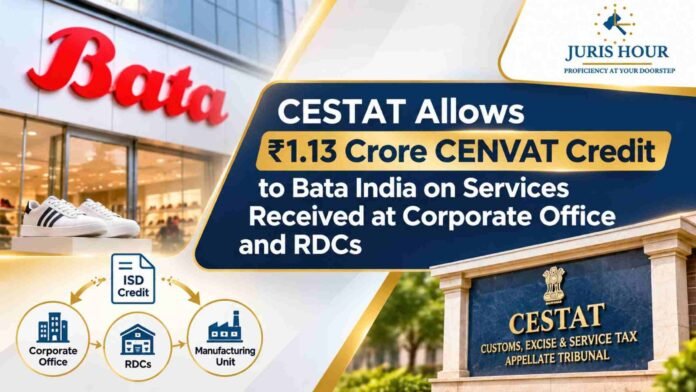
The Customs, Excise and Service Tax Appellate Tribunal (CESTAT), Chennai Bench, has set aside the denial of CENVAT credit amounting to ₹1,13,36,030 availed on input services distributed through Input Service Distributors (ISDs) to a manufacturing unit, holding that credit cannot be denied merely because the services were received at the corporate office and Regional Distribution Centres (RDCs), rather than at the factory.
The bench of Ajayan T.V. (Judicial Member) and Vasa Seshagiri Rao (Technical Member) observed that the issue had already attained finality between the parties in earlier proceedings and that the Revenue could not adopt a contrary position for an intervening period when the facts and applicable legal provisions remained unchanged.
Buy Now: Indirect Tax Judgments E-Compilation – October 2026
The dispute arose when the Department denied CENVAT credit of ₹1,13,36,030 availed by the footwear manufacturing unit at Hosur during September 2015 to April 2016.
The manufacturer received credit through challans issued by its registered Input Service Distributors, including its corporate office at Gurgaon and four Regional Distribution Centres situated at Faridabad, Kolkata, Thane and Bengaluru.
The disputed services included manpower supply, security, courier, telephone, transportation, rent, commission, convention, design, banking, technical consultancy, works contract, legal services, cleaning, web hosting, C&F agent services, business exhibitions, chartered accountancy, intellectual property services, maintenance and repair, advertising and management consultancy, among others.
The Department’s principal allegation was that these services were received at locations other than the manufacturing factory and, therefore, could not qualify as input services under Rule 2(l) of the CENVAT Credit Rules, 2004.
Accordingly, a Show Cause Notice dated October 6, 2016, proposed recovery of the credit under Rule 14 of the CENVAT Credit Rules, 2004, along with applicable interest and penalty.
The adjudicating authority confirmed the demand and imposed a penalty of ₹10 lakh. The Commissioner (Appeals) subsequently upheld the demand.
Before the Tribunal, the manufacturer pointed out that the Department had issued eleven earlier notices raising an identical allegation for the period April 2008 to August 2015.
Those proceedings had been decided by CESTAT through Final Order Nos. 41784-41792/2018 dated June 5, 2018, reported as Bata India Ltd. v. CCE & ST, Chennai III, 2018 (6) TMI 1414 – CESTAT Chennai.
In that decision, the Tribunal held that all disputed input services, except GTA services beyond the Regional Distribution Centres, were eligible for CENVAT credit, irrespective of whether they were received before or after April 1, 2011.
The Revenue did not challenge the decision.
Subsequently, the Madras High Court, in Bata India Ltd. v. Commissioner of Cus., C. Ex. & S.T., Chennai III, 2019 (24) G.S.T.L. 326 (Mad.), interfered only with the portion concerning GTA services and directed examination of the place of removal.
Following the remand, the Commissioner, through Order-in-Original No. 65/2022 CE dated November 30, 2022, examined the movement of goods from the RDCs to the manufacturer’s retail outlets.
It was found that the goods were transferred from the RDCs to the retail outlets on a stock-transfer basis and that ownership continued to remain with the manufacturer until the goods were sold at the retail outlets.
Consequently, the Commissioner held that the retail outlets constituted the place of removal and allowed CENVAT credit on transportation services from the RDCs to the retail outlets.
The Revenue did not challenge this order either.
The Tribunal observed that the Show Cause Notice in the present proceedings contained only one substantive allegation, namely, that the services were received at locations other than the manufacturing factory.
It did not allege that any particular service lacked a nexus with the manufacture of footwear, fell within the exclusion clauses of Rule 2(l), or had been incorrectly apportioned.
The Tribunal noted that the same locational objection had already been rejected in the earlier proceedings between the very same parties.
Relying upon the Supreme Court decisions in Bigen Industries Ltd. and Birla Corporation Ltd. v. Commissioner of Central Excise, 2005 (186) E.L.T. 266 (S.C.), the Tribunal reiterated that the Revenue cannot accept a decision in an assessee’s case and subsequently adopt a contrary position against the same assessee on identical facts.
The Tribunal observed that the doctrine rests on the principle that litigation must attain finality and that an assessee cannot be treated differently for different periods when the relevant facts and applicable legal provisions remain unchanged.
It further found that there was no material to suggest that the manufacturer’s business model, procurement of services or distribution of credit had changed during the disputed period.
Accordingly, the Tribunal held that the earlier decision squarely covered the present dispute.
The Tribunal also examined the Department’s objection concerning GTA services and the determination of the place of removal.
It noted that the Commissioner, in the subsequent adjudication dated November 30, 2022, had specifically recorded that goods were transferred from the RDCs to the manufacturer’s own retail outlets without any transfer of ownership.
The ultimate sale took place only at the retail outlets, which remained under the ownership of the manufacturer.
On this basis, the Commissioner had already recognised the retail outlets as the place of removal and allowed credit on transportation services from the RDCs to the retail outlets.
The Tribunal observed that the Revenue had not challenged this subsequent order.
It further referred to Rule 2(qa) of the CENVAT Credit Rules, which recognised a depot or other premises from where goods were sold after clearance as a place of removal.
Consequently, transportation from the factory to the RDCs was also required to receive the same treatment as transportation from the RDCs to the retail outlets.
Another important issue concerned the reliance placed by the Commissioner (Appeals) on the exclusion clauses under Rule 2(l) of the CENVAT Credit Rules.
The Tribunal found that the Show Cause Notice had not invoked clauses (A), (B), (BA) or (C) of Rule 2(l).
Further, the services to which the Commissioner (Appeals) applied these exclusion clauses, including construction, renting of motor vehicles, motor vehicle insurance and employee life and health insurance, did not even form part of the list of disputed services in the present Show Cause Notice.
The Tribunal observed that the authorities had apparently carried forward the list of services from earlier proceedings without verifying whether those services were involved in the present dispute.
Relying upon the Supreme Court decision in Commissioner of Customs, Mumbai v. Toyo Engineering India Ltd., 2006 (201) E.L.T. 513 (S.C.), the Tribunal reiterated that the Department cannot travel beyond the allegations contained in the Show Cause Notice.
It held that an adjudication based on allegations that were never raised in the notice cannot sustain the demand.
Accordingly, the exclusion clauses could not be invoked to deny the credit in the present proceedings.
Having held that the CENVAT credit was admissible, the Tribunal observed that the demand of interest under Rule 14 of the CENVAT Credit Rules read with Section 11AA of the Central Excise Act, 1944, and the penalty imposed under Rule 15(1) read with Section 11AC, were founded on the allegation that the credit had been wrongly availed.
Once the underlying demand failed, the consequential interest and penalty could not survive.
CESTAT Chennai set aside the Order-in-Appeal and granted consequential relief in accordance with law.
The Tribunal held that the denial of CENVAT credit solely on the ground that services were received at the corporate office and Regional Distribution Centres was unsustainable, particularly when the identical issue had already been decided in favour of the manufacturer and the Revenue had accepted those decisions.
Membership Required to Access Case Details & Order Copy
To view the complete Case Details and Download Order Copy, you must have an active membership. Please subscribe to continue.
Read More: Supply of Water to Industrial Units Is Sale of Goods, Not A Taxable Service: CESTAT

