
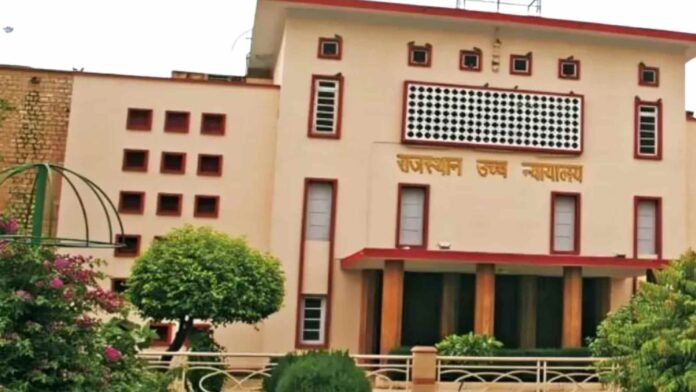
The Rajasthan High Court has held that a declaration filed under the Sabka Vishwas (Legacy Dispute Resolution) Scheme, 2019 (SVLDRS) cannot be rejected merely because it includes a redemption fine imposed in lieu of confiscation of goods.
The bench of Justice Arun Monga and Justice Maneesh Sharma ruled that redemption fine is not one of the disqualifying categories under Section 125 of the Finance (No. 2) Act, 2019, and therefore taxpayers cannot be declared ineligible on that basis alone.
The petitioner is a manufacturer engaged in producing TMT bars, steel pipes, tubular poles, precast concrete products, real estate construction materials and safety products. It was registered under the Central Excise Act, 1944.
Buy Now: Service Tax Judgement E-Compilation : June 2026
The dispute originated from an Order-in-Original, by which the excise authorities ordered confiscation of 291.218 MT of MS Ingots valued at ₹78.62 lakh. However, the company was permitted to redeem the confiscated goods upon payment of a redemption fine of ₹10 lakh, besides a penalty of ₹3 lakh.
The assessee’s appeal before the Commissioner (Appeals) was dismissed in February 2018, following which it approached the Customs, Excise and Service Tax Appellate Tribunal (CESTAT). While the appeal remained pending, the Central Government introduced the Sabka Vishwas (Legacy Dispute Resolution) Scheme, 2019, providing taxpayers an opportunity to settle pending disputes relating to Central Excise and Service Tax.
Accordingly, the petitioner filed a declaration under the Scheme. However, the Designated Committee rejected the declaration on November 12, 2019, recording that “RF not covered under the SVLDRS”, treating redemption fine as outside the scope of the Scheme.
The petitioner argued that the rejection was arbitrary and illegal because it was denied an opportunity of hearing before rejection. Section 125 of the Finance (No. 2) Act, 2019 does not exclude cases involving confiscation or redemption fine from the Scheme. The objective of SVLDRS was to provide a one-time amnesty and reduce legacy litigation. The Gujarat High Court had already decided an identical issue in Synpol Products Pvt. Ltd. v. Union of India, holding that declarations involving redemption fine are eligible under the Scheme.
The department defended the rejection, contending that the Designated Committee had acted strictly in accordance with the Scheme. A CBIC clarification dated December 20, 2019 stated that the expression “fine” under the Scheme referred to fines imposed under Section 9 of the Central Excise Act and not redemption fine under Section 34, thereby excluding redemption fine from the Scheme’s coverage.
The Court identified the core legal issue as whether the redemption fine imposed in lieu of confiscation of goods falls within the ambit of the Sabka Vishwas Scheme.
Examining Section 125 of the Finance (No. 2) Act, 2019, the Bench observed that the provision exhaustively lists categories of persons who are ineligible to make declarations under the Scheme. Importantly, cases involving confiscation of goods or redemption fine do not figure among those excluded categories. Therefore, the Court held that a taxpayer cannot be denied the Scheme merely because the dispute includes a redemption fine.
The Court further relied extensively on the Gujarat High Court’s decision in Synpol Products Pvt. Ltd., which had interpreted the Scheme in light of its legislative objective of reducing pending litigation. That judgment had concluded that redemption fine forms part of the amount recoverable under indirect tax laws and therefore falls within the Scheme.
The Rajasthan High Court noted that the Gujarat High Court had also rejected the CBIC’s interpretation contained in its communication dated December 20, 2019, observing that such an interpretation was inconsistent with the statutory provisions and the object of the Scheme.
An important aspect highlighted by the Rajasthan High Court was that the Revenue had challenged the Gujarat High Court’s judgment before the Supreme Court by filing a Special Leave Petition.
However, the Supreme Court dismissed the Special Leave Petition (Civil) No. 449 of 2021 on March 3, 2021, thereby leaving the Gujarat High Court’s interpretation undisturbed. The Rajasthan High Court considered this while agreeing with the reasoning adopted by the Gujarat High Court.
The Bench held that the redemption fine imposed in lieu of confiscation forms part of the recoverable amount under the indirect tax enactments and cannot be segregated from the duty demand for the purposes of the SVLDR Scheme.
It further ruled that the CBIC clarification seeking to exclude redemption fine from the Scheme was contrary to the provisions of the Finance (No. 2) Act, 2019 and therefore could not override the statutory framework.
Since redemption fine is not one of the disqualifications prescribed under Section 125, the petitioner could not have been declared ineligible merely because its declaration included redemption fine.
Allowing the writ petition, the Rajasthan High Court quashed the Designated Committee’s order dated November 12, 2019 rejecting the SVLDRS declaration.
The court directed the tax authorities to treat the petitioner’s Form SVLDR-1 as a valid and eligible declaration and ordered the department to examine the declaration on its merits and process it in accordance with the Sabka Vishwas (Legacy Dispute Resolution) Scheme, 2019 and the applicable Rules.
Membership Required to Access Case Details & Order Copy
To view the complete Case Details and Download Order Copy, you must have an active membership. Please subscribe to continue.
Read More: ITAT Can’t Quash Penalty Solely Because Assessment Was Earlier Quashed: Karnataka High Court

