
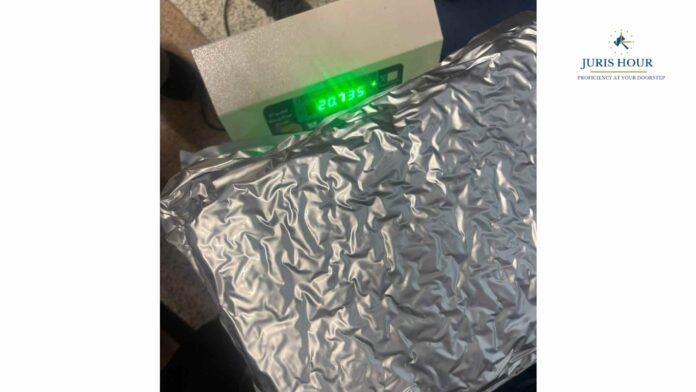
Customs officers at the Air Intelligence Unit (AIU), Indira Gandhi International (IGI) Airport, New Delhi, have seized 20.760 kilograms of Hydroponic Weed (suspected ganja/marijuana) from a passenger arriving from Bangkok, dealing another significant blow to attempts to smuggle narcotic substances into India through international air routes.
The seizure was made on 18 July 2026 during routine surveillance and passenger profiling by the AIU. It is learnt that the passenger had arrived at Delhi from Bangkok on Flight No. 6E 1064 and was intercepted after crossing the Customs Green Channel based on Advance Passenger Information System (APIS) profiling, which flagged the traveller for further scrutiny.
During the examination, Customs officers subjected the passenger’s baggage to X-ray screening, where suspicious images were detected. A detailed physical examination of the baggage subsequently led to the recovery of 20.760 kilograms (gross weight) of Hydroponic Weed, a high-potency form of cannabis commonly cultivated under controlled indoor conditions using hydroponic techniques.
Buy Now: Service Tax Judgement E-Compilation : June 2026
The recovered green-coloured substance, suspected to be ganja/marijuana, was concealed inside the passenger’s baggage using packaging and concealing materials designed to evade detection by enforcement authorities.
Following the recovery, Customs authorities registered a case under the Narcotic Drugs and Psychotropic Substances (NDPS) Act, 1985. The passenger has been arrested under Section 43(b) of the NDPS Act, while the suspected narcotic substance, along with the concealing and packaging materials, has been seized under Section 43(a) of the Act.
Hydroponic cannabis is considered significantly more potent than conventionally cultivated marijuana due to its higher concentration of psychoactive compounds. In recent years, enforcement agencies have witnessed an increasing trend of organised syndicates attempting to smuggle hydroponic weed into India through international airports, particularly from countries in Southeast Asia.
The seizure highlights the growing reliance of Customs authorities on data-driven passenger profiling, intelligence inputs, and advanced baggage screening systems to identify high-risk passengers without disrupting the movement of genuine travellers.
Customs officials have initiated further investigation to ascertain the source of the contraband, identify possible international trafficking networks, determine the intended recipients in India, and uncover whether the passenger was acting independently or as part of a larger organised smuggling syndicate.
The investigation is continuing.

