
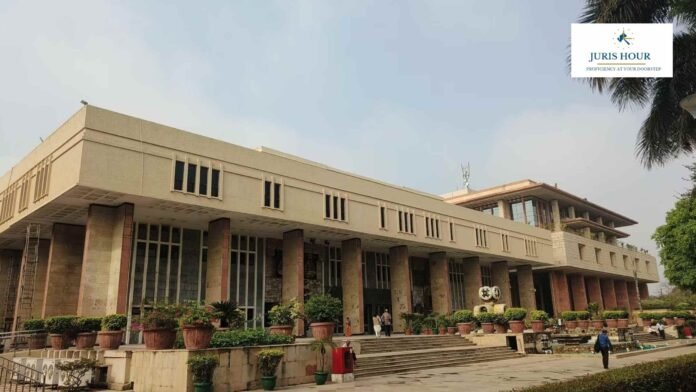
The Delhi High Court has dismissed a writ petition challenging a Customs revisional order on the ground that the petitioners were allegedly denied a personal hearing and held that the principles of natural justice were duly complied with because the petitioners had been granted four separate opportunities of hearing but failed to effectively avail themselves of those opportunities.
A Division Bench comprising Justice Anil Kshetrapal and Justice Shail Jain observed that adjournments had been granted to the petitioners “as a matter of indulgence rather than of right”. It further held that a clerical mistake concerning the time of hearing recorded in the revisional order could not be treated as a fundamental defect invalidating the proceedings.
The petitioners had approached the High Court seeking the quashing of an order dated March 28, 2025, passed by the Central Government under Section 129DD of the Customs Act, 1962.
Buy Now: Customs Duty E-Magazine – August 2026
The proceedings originated from the seizure of foreign currency from three of the petitioners at Indira Gandhi International Airport, New Delhi.
On October 5, 2016, officers of the Directorate of Revenue Intelligence’s Delhi Zonal Unit intercepted the three persons while they were travelling to Dubai. Although no incriminating material was initially found in their baggage, they allegedly disclosed before their personal search that foreign currency had been concealed in their turbans and rectums.
Approximately €390,000 was recovered during the search.
According to the Customs authorities, the subsequent investigation revealed that the currency had been supplied by the first petitioner, who had allegedly arranged the travel of the three carriers and promised them monetary consideration for transporting it to Dubai.
The three persons reportedly attributed the currency to the first petitioner in statements recorded under Section 108 of the Customs Act. The foreign currency was thereafter seized and disposed of by the authorities in accordance with the applicable procedure.
A show-cause notice dated April 3, 2017, was issued to the petitioners proposing the confiscation of the recovered currency and the initiation of penal action against them.
After considering their replies, the adjudicating authority passed an order-in-original dated July 31, 2018. It ordered the confiscation of the foreign currency as well as the material used for its concealment. A combined penalty of ₹54.56 lakh was also imposed upon the petitioners.
The petitioners subsequently approached the Delhi High Court in an earlier writ petition, alleging procedural irregularities in the show-cause notice proceedings and seeking a fresh adjudication with an effective opportunity of representation.
The High Court declined to interfere at that stage and directed them to pursue their remedies before the appellate authority, including their request for cross-examination.
The petitioners then filed appeals before the Commissioner (Appeals), but the appeals were rejected through a common order dated February 25, 2022. Four separate revision applications were subsequently instituted before the Central Government, primarily contending that the petitioners had not been permitted to cross-examine the witnesses.
The revision applications were rejected on March 28, 2025, resulting in the present writ petition.
Counsel for the petitioners submitted that hearings were initially fixed for September 27 and October 9, 2024, but adjournments had been requested for bona fide reasons duly communicated to the revisional authority.
Through a communication dated September 26, 2024, the petitioners sought the deferment of the hearing, preferably until after Diwali. A further adjournment was requested on October 7 on the ground that their counsel had met with an accident and suffered a head injury. Medical certificates were also submitted while seeking an additional month.
It was further argued that the revisional authority had been informed that the same counsel represented all four petitioners. Despite this, hearing notices allegedly continued to be sent to their former counsel, resulting in a communication gap.
The petitioners maintained that specific requests for a physical hearing during the post-lunch session were made on October 11 and December 5, 2024.
According to them, a virtual hearing was ultimately scheduled for 3:45 pm on December 6, 2024. Their counsel claimed to have joined the videoconference at the appointed time, but the Additional Secretary conducting the proceedings allegedly did not join.
On this basis, the petitioners argued that the revisional order was rendered invalid because they had been denied an essential component of natural justice.
The respondents opposed the petition and maintained that the prescribed procedure had been followed throughout the revision proceedings.
They informed the Court that opportunities for personal hearing had been provided on September 18, September 27, October 9 and December 6, 2024. No one appeared for the petitioners on the first three dates.
After considering the adjournment request dated October 7, a final opportunity was granted on December 6. Separate hearings were scheduled for the four petitioners, and they were informed on the morning of December 6 that the virtual hearings would take place between 3 pm and 3:45 pm.
The respondents asserted that the hearings were conducted as scheduled and that only the departmental representative appeared. Neither the petitioners nor their counsel attended, and the authority received no communication concerning an inability to join or any technical difficulty.
They acknowledged that the revisional order incorrectly referred to the hearing time as 11:30 am but described this as a bona fide clerical mistake. The personal-hearing sheet, according to the respondents, accurately recorded the proceedings conducted between 3 pm and 3:45 pm.
The Court was also informed that during the period of more than three months between the December 6 hearing and the March 28 revisional order, the petitioners did not submit any request for another hearing.
After examining the record, the High Court held that the petitioners’ allegation of denial of personal hearing did not withstand scrutiny.
The Bench noted that four separate opportunities had been provided between September and December 2024. None appeared for the petitioners on September 18, September 27 or October 9, even though their requests for adjournment had been accommodated.
The Court observed that when the final opportunity was fixed for December 6, the Central Government accommodated the petitioners’ changing preferences regarding the mode and timing of the hearing. Virtual hearings were ultimately scheduled between 3 pm and 3:45 pm, and an intimation was sent at 11:44 am that morning.
The petitioners’ assertion that their counsel joined the videoconference at 3:45 pm but the Additional Secretary failed to appear was found to be unsupported by evidence.
The personal-hearing sheet dated December 6 recorded that only the departmental representative had appeared. The petitioners had not placed any material on record to substantiate their version of events or contradict the official hearing record.
The High Court also took note of the petitioners’ conduct after the scheduled hearing. Between December 6, 2024, when the matter was reserved, and March 28, 2025, when the revisional order was pronounced, they did not seek another opportunity of hearing.
According to the Bench, this conduct demonstrated that the petitioners had not pursued their remedies with due diligence.
“Such silence is difficult to reconcile with the conduct of a party genuinely aggrieved by an alleged denial of hearing,” the Court observed.
The prolonged failure to seek another hearing also supported the respondents’ contention that the petitioners had no further submissions to make before the revisional authority.
The Bench rejected the attempt to rely on the incorrect reference to an 11:30 am hearing in the revisional order.
It held that this isolated error did not establish that no hearing had been conducted. The personal-hearing sheet prepared on the same date explained the discrepancy and correctly recorded the scheduled hearing.
The petitioners, therefore, could not elevate the clerical mistake into a “foundational infirmity” going to the root of the revisional order.
The Court concluded that repeated and adequate opportunities had been granted, but the petitioners failed to avail themselves of those opportunities through their own conduct. The revisional order had consequently been passed on the material available on record after compliance with procedural fairness.
Rejecting the plea that the order was a nullity for want of personal hearing, the High Court dismissed the writ petition as devoid of merit.
Membership Required to Access Case Details & Order Copy
To view the complete Case Details and Download Order Copy, you must have an active membership. Please subscribe to continue.
Read More: Consolidated GST SCN Covering Multiple FY Is Not Without Jurisdiction: Delhi High Court

