
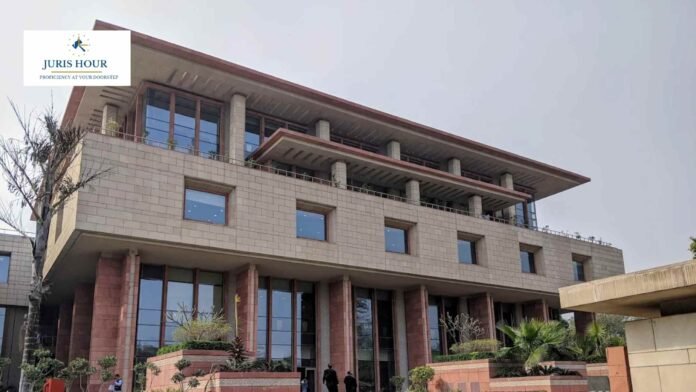
The Delhi High Court has held that the issuance of a consolidated show cause notice under Section 74 of the Central Goods and Services Tax Act, 2017, covering multiple financial years does not, by itself, amount to a patent lack of jurisdiction warranting interference under Article 226 of the Constitution.
The Bench of Justice Anil Kshetarpal and Justice Shail Jain dismissed a writ petition challenging GST proceedings involving audit objections, invocation of the extended proceedings under Section 74, and a consolidated notice covering the financial years 2017-18 to 2021-22.
BUY NOW: E-Magzine: Single SCN or Composite Assessment Order for Multiple Tax Periods
The Court held that disputes relating to the sufficiency of material supporting allegations of fraud or suppression, consideration of documents, eligibility for input tax credit, reverse-charge liability and computation of tax demand were matters that could appropriately be examined by the statutory appellate authority under Section 107 of the CGST Act.
The petitioner is a partnership firm engaged in the manufacture, export and distribution of flanged pipes and fittings in India and abroad.
On December 15, 2023, the GST authorities issued Form GST ADT-01 proposing an audit under Section 65 of the CGST Act for the period from July 2017 to March 2022. The firm subsequently furnished documents and information in response to the audit notice on several dates.
An audit memo dated February 1, 2024 raised discrepancies concerning the availment of input tax credit, payment of tax under the reverse charge mechanism and other transactions. The petitioner submitted a clarification along with supporting documents.
Another audit memo was issued on March 26, 2024, raising objections relating to ITC, RCM, dealings with certain suppliers, export transactions and other issues. The petitioner again submitted replies and supporting material.
On June 26, 2024, the authorities issued Form GST ADT-02 under Section 65(6), recording audit objections involving a tax liability of approximately Rs.78.53 lakh, excluding interest. The petitioner disputed the audit findings and alleged that its replies and supporting documents had not been properly considered.
The Department thereafter issued Form GST DRC-01A on July 8, 2024, intimating the proposed liability under Section 74(5). Despite the petitioner disputing the proposed demand and the invocation of Section 74, a show cause notice in Form GST DRC-01 was issued on July 26, 2024.
The notice proposed recovery of tax, interest and penalty on the allegation that the petitioner had suppressed material facts with the intention of evading tax.
The petitioner initially approached the Delhi High Court against the show cause notice. During the pendency of the writ petition, however, the adjudicating authority passed an order-in-original dated February 3, 2025, confirming the tax demand along with applicable interest and penalty.
The petitioner consequently extended its challenge to the adjudication order. It contended that the authority had failed to properly consider its detailed reply and the documents placed on record, including DRC-03 payment or reversal documents, reconciliations, invoices, bank statements and records relating to exports.
At the outset, the High Court noted that the adjudication order was appealable under Section 107 of the CGST Act. The appellate remedy constituted a complete, efficacious and comprehensive statutory mechanism for examining grievances arising from an adjudication order.
The Court observed that the appellate authority possesses wide powers to examine questions of fact and law, reassess the material on record, scrutinise the adjudicating authority’s findings and determine the legality and correctness of the order under challenge.
The High Court clarified that the existence of an alternative statutory remedy does not create an absolute bar against the exercise of writ jurisdiction. Relying on the Supreme Court’s decision in Assistant Commissioner of State Tax v. Commercial Steel Limited, the Bench noted that a writ petition may still be entertained in exceptional cases involving a breach of fundamental rights, violation of natural justice, excess of jurisdiction or challenge to the validity of a statute or delegated legislation.
However, the mere assertion of one of these grounds would not justify bypassing the statutory appellate mechanism. The High Court must independently determine whether the facts genuinely disclose an exceptional circumstance requiring the exercise of extraordinary jurisdiction.
The Bench therefore examined whether the petitioner’s objections revealed any patent jurisdictional defect or manifest violation of natural justice.
The petitioner argued that the show cause notice failed to disclose the essential ingredients required to invoke Section 74, namely fraud, wilful misstatement or suppression of facts with intent to evade tax.
According to the petitioner, the allegations merely arose from discrepancies noticed during the audit and were unsupported by material establishing fraud or intentional suppression.
The Court found that this objection had been specifically raised before the adjudicating authority. The adjudication order had noticed the submission and proceeded to consider whether Section 74 was applicable, including the allegation of suppression.
The petitioner had also been afforded an opportunity to file its defence and participate in the adjudication. Therefore, the dispute did not concern denial of a hearing but the sufficiency of the evidence and the correctness of the authority’s conclusion.
The Court said that deciding whether the Department’s material constituted sufficient evidence of fraud, wilful misstatement or suppression would require consideration of the show cause notice, the relied-upon material, the petitioner’s replies and the findings contained in the adjudication order.
Such questions, the Bench held, fell within the appellate jurisdiction under Section 107. Mere disagreement with the conclusion reached by the adjudicating authority could not be characterised as a patent lack of jurisdiction or violation of natural justice.
Another principal objection was that a single show cause notice could not cover the financial years 2017-18 to 2021-22 because separate limitation periods applied to each financial year.
The High Court rejected this argument as a jurisdictional challenge, relying on its earlier decision in Ambika Traders through Proprietor Gaurav Gupta v. Additional Commissioner, Adjudication, DGGSTI, CGST Delhi North.
In that decision, the Court had held that the statutory scheme did not prohibit the issuance of a consolidated show cause notice covering multiple financial years.
The Bench pointed out that Sections 73(3) and 74(3) use the expressions “for any period” and “for such periods,” while Sections 73(10) and 74(10) refer to a “financial year” for determining the limitation applicable to the passing of an adjudication order.
According to the Court, the fact that limitation is calculated with reference to individual financial years does not mandate the issuance of a separate show cause notice for every financial year.
The Court further noted that where fraudulent availment or utilisation of ITC is alleged, transactions extending across different financial years may need to be examined together to identify a purported pattern of fraud or suppression.
Consequently, a consolidated notice covering multiple financial years cannot be treated as inherently without jurisdiction. The Court, however, clarified that a claim that the demand for a particular financial year was barred by limitation constituted a separate issue that could be raised in the statutory appeal.
The petitioner also challenged the audit proceedings on the ground that its replies and documents had not been considered before Form GST ADT-02 was issued. It alleged that the audit report had already been approved before its final reply was furnished.
The Court held that determining these objections would require an examination of the audit record and the material considered by the Department.
It also noted that the petitioner had subsequently received an opportunity to defend itself during the adjudication proceedings. Whether its audit-stage replies were properly considered and whether any prejudice resulted were questions that could be raised before the appellate authority.
The Bench distinguished the Andhra Pradesh High Court’s decision in Vardhaman Gold v. State of Andhra Pradesh, where an audit report and consequential notice were set aside because the mandatory statutory period had not elapsed before the audit was finalised.
In the present case, the petitioner had subsequently been afforded a full opportunity to answer the show cause notice and participate in the adjudication. Its grievance concerned the manner in which its replies and material were considered, rather than the complete denial of an opportunity to meet the Department’s case.
The petitioner argued that the adjudication order had failed to properly consider DRC-03 forms, reconciliations, invoices, bank statements, export records and other supporting documents.
The Court observed that the order recorded the petitioner’s submissions and dealt with the objections raised during adjudication. Whether the authority correctly appreciated the documents or whether those documents justified a different conclusion concerned the merits of the case.
The Bench emphasised the distinction between a case in which a party is denied an opportunity of hearing and a case in which the party, despite having been heard, disputes the manner in which its defence or documents were considered.
The latter, the Court said, ordinarily constitutes a challenge to the merits of adjudication and must be pursued through the statutory appellate mechanism.
Since the petitioner participated in the proceedings, filed a detailed reply and submitted supporting documents, the Court found no patent denial of an opportunity to present its case.
The petitioner had also disputed the separate heads of demand. It claimed that certain amounts had already been paid or reversed through DRC-03, some ITC had not been availed or was otherwise admissible, the alleged RCM liability had been discharged, and the export transactions were supported by invoices, returns and proof of realisation.
The High Court held that these submissions challenged the factual findings and calculation of liability. Their determination would require an examination of returns, invoices, ledgers, DRC-03 forms, reconciliations, bank statements and other documents.
The same reasoning applied to disputes involving differences between GSTR-2A and GSTR-3B, blocked credit under Section 17(5), and compliance with Rule 96A of the CGST Rules. These issues did not present exceptional circumstances justifying interference under Article 226.
The High Court dismissed the writ petition and pending applications.
The Court nevertheless granted the petitioner liberty to file an appeal under Section 107 of the CGST Act.
It also clarified that if an appeal was filed, the petitioner could seek exclusion of the period during which the writ petition remained pending before the High Court. The appellate authority was directed to consider the issue of limitation, including any request to exclude the time spent pursuing the writ proceedings, independently and in accordance with law.
Membership Required to Access Case Details & Order Copy
To view the complete Case Details and Download Order Copy, you must have an active membership. Please subscribe to continue.
Read More: Procedural Error in Customs Broker Licence Inquiry Can Be Rectified Through Remand: Delhi High Court

