
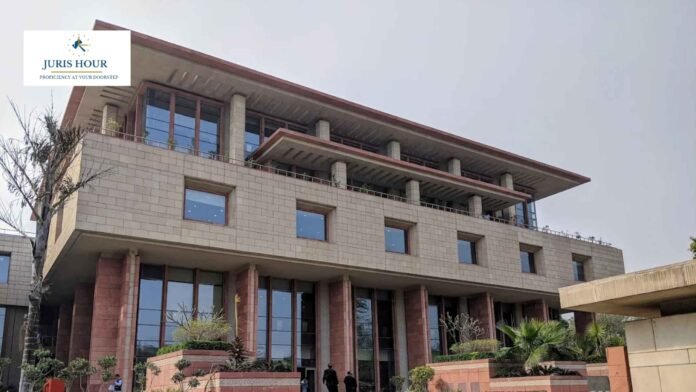
The Delhi High Court has denied regular bail to a man accused of involvement in the smuggling of 10.275 kg of ganja through Delhi’s IGI Airport.
Although no contraband was recovered from him, the bench of Justice Madhu Jain held that the absence of a personal recovery could not decide the bail application on its own. It considered his statement recorded under Section 108 of the Customs Act, forensic material from his phone, alleged communications and financial transactions, and the prosecution’s claim that he was part of a larger smuggling network.
Buy Now: E-Magazine: 1000+ Landmark GST Judgments (2017–2026)
The bench dismissed the bail application and stressed that its observations were limited to bail and did not decide whether the allegations against him were true.
The co-accused arrived at Terminal 3 of IGI Airport from Bangkok on January 1, 2026. Customs officers recovered 10.275 kg of ganja from his trolley bag. During the investigation, the co-accused allegedly named the petitioner.
Customs summoned the petitioner under Section 108 of the Customs Act on February 12, 2026 and recorded his statement that day. He was arrested on February 13 on allegations of trafficking and conspiracy. He later sought regular bail under Section 483 of the Bharatiya Nagarik Suraksha Sanhita, 2023.
The petitioner argued that officers had recovered nothing from his person, home or vehicle. His counsel submitted that Nitin’s disclosure had led to no recovery from him and could not, by itself, establish his involvement.
The defence also disputed the significance of call records and WhatsApp chats. It argued that the communications contained no specific reference to the recovered ganja. Relying on Toofan Singh v. State of Tamil Nadu and other decisions, counsel questioned the use of a co-accused’s statement recorded under Section 67 of the NDPS Act.
The petitioner further challenged the voluntariness and authenticity of his own Section 108 statement. His counsel pointed to the summons and statement being issued and recorded on the same day, questioned differences in signatures, and alleged that he had signed blank papers. The defence said these disputes should be resolved at trial. It also submitted that the investigation concerning the petitioner was complete, a supplementary complaint had been filed, and he had been in custody since February 13.
Customs argued that its case went beyond Nitin’s disclosure. It relied on petitioner’s Section 108 statement, forensic examination of his phone, call records, WhatsApp communications and examination of a DVR containing CCTV footage from near his residence.
According to the prosecution, the phone material showed communications among all the accused. Customs also alleged that Farhan had transferred money to the petitioner through a QR code. It described Farhan as the alleged leader of a wider network and said other persons allegedly linked to it had not joined the investigation despite summons. These remain prosecution allegations.
The High Court noted that the petitioner was stated to have said in response to a question under Section 108 that the 11 packets recovered from Nitin belonged to him. The statement also allegedly described a plan to bring the substance from Bangkok and deliver it to Farhan through the petitioner, with proposed payments of ₹15,000 to ₹20,000 to the petitioner and the co-accused.
The court did not make a final finding that the statement was voluntary or true. It said those questions, including its ultimate evidentiary value, belonged at trial. Referring to the Supreme Court’s treatment of voluntary Section 108 statements, however, the court held that it could not completely disregard the petitioner’s statement while deciding bail, particularly in light of the financial transactions indicated by the forensic material.
That distinction was central to the ruling. The court recognised the defence’s objection to reliance on a co-accused’s NDPS disclosure, but found that the prosecution had also placed the petitioner’s own disputed statement and electronic material before it. It therefore distinguished the decisions cited by the defence on the facts of this case.
The court said a bail hearing did not require a detailed trial of the evidence. At the same time, the lack of a recovery from the petitioner was not conclusive: his alleged role and the other material collected during investigation also had to be considered.
Taking together the Section 108 statement, phone forensics, alleged communications and financial transactions, and the allegation of a wider syndicate, the High Court held that the petitioner was not entitled to bail. It dismissed the application while expressly stating that its findings must not be treated as an opinion on the merits of the criminal case.
What Experts Say?
As per Srinivasan Gopal, Assistant Director(Retd) National Academy Of Customs Indirect Taxes And Narcotics Palasamudram, “Jurisdiction First, Admissibility Later: Why Section 108 Customs Cannot Enter an NDPS Prosecution. The prosecution against Abhay Kumar is under Sections 8, 20(b), 23 and 29 of the NDPS Act. There is no Customs Act offence charged. Section 108 of the Customs Act, by its own wording, applies only to “an inquiry which such officer is making under the Customs Act.” That textual limitation is decisive. If there is no Customs Act proceeding, then Section 108 has no jurisdictional foundation.The NDPS Act has its own provision, Section 67, for obtaining information and examining persons acquainted with the facts of the case. The Supreme Court in Tofan Singh drew a clear contrast between Section 67 NDPS and Section 108 Customs, noting the qualitative difference: Section 108 expressly concerns Customs inquiries, while Section 67 belongs to the NDPS statutory scheme. That contrast itself shows why importing Section 108 into NDPS prosecutions is impermissible. Even if a Customs offence is recorded alongside an NDPS offence, the officer must respect the Balbir Singh dictum. He can run two different proceedings: use Section 108 for the Customs case before the Chief Judicial Magistrate, and Section 67 for the NDPS case before the Special Court. Alternatively, following Balbir Singh, once narcotics are discovered the NDPS Act overtakes, and a single consolidated complaint under NDPS can be filed in the Sessions Court. In either approach, the statutes remain distinct, and their procedures cannot be transplanted across one another.The larger point is simple but fundamental: empowerment under multiple statutes does not confer a licence to import powers from one Act into another to overcome evidentiary deficiencies. The Supreme Court has already barred reliance on Section 67 NDPS confessions. To then rely on Section 108 Customs in an NDPS prosecution is a doctrinal bypass of that binding precedent. Fair, honest and just application of mind requires staying within the four corners of the charging statute. If the prosecution is under NDPS, NDPS procedures apply. Customs ends once narcotics are found. That is the clean doctrinal line.”
Membership Required to Access Case Details & Order Copy
To view the complete Case Details and Download Order Copy, you must have an active membership. Please subscribe to continue.
Read More: Can GST Appeal Can’t Be Dismissed Merely for Non-Appearance? Allahabad High Court

